

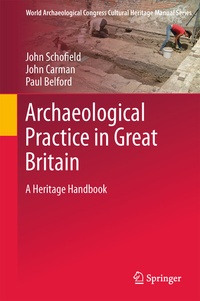
Archaeological Practice in Great Britain
Description

This manual provides a unique 'user guide' to practicing archaeology and working in the cultural heritage sector within the diverse settings of Great Britain, comprising of: England, Scotland, Wales, the Isle of Man and the Channel Islands.
As part of their training, archaeologists often seek work in parts of Britain, either for experience before travelling elsewhere, or directly as part of their career progression. While this does involve reading published material on excavation techniques, archaeological theory, and specific heritage management practices, or research using the Internet, the ideal preparation to working in Britain for the first time requires practitioners to know a little about a lot. Currently, there is no single resource which provides that primary resource for budding archaeologists.
Archaeological Practice in Great Britain will provide just such a resource: presented in an accessible style, with a comprehensive and up-to-date bibliography and lists of useful websites. Professionals with particular areas of expertise will contribute short sections on particular subjects, incorporated into the main text prepared by the authors. Throughout, the specific contexts and differences between the various component nations and regions of Great Britain will be made clear.
More details
Other editions
Additional editions
Persons
John Schofield has worked for English Heritage, initially as an Inspector with its Monuments Protection Programme, and more recently with the Characterisation Team. He is also Head of Military Programmes, and co-ordinates research into military and twentieth-century heritage. His most recent post is Director of Studies in Cultural Heritage Management, University of York.
John Carman gained his PhD in Archaeology from Cambridge University, having researched the role of law in archaeological heritage management. In 2005 he took up his present post as University Research Fellow and Senior Lecturer in Heritage Valuation in the Institute of Archaeology and Antiquity at the University of Birmingham. He has lectured and published widely in the field of archaeological heritage management.
Paul Belford has been a professional field archaeologist since the early 1990s, working on a wide range of projects throughout the UK and Europe. From 1995 he was based at the University of Sheffield, where he developed a research interest in historical and industrial archaeology. Since 2000 he has been the director of Ironbridge Archaeology, the contracting archaeology unit of the Ironbridge Gorge Museum.
Content
1. Introduction: to Great Britain.- 2. A history of archaeology in Britain.- 3. Britain's archaeological resource: a brief survey.- 4. Legal and administrative frameworks. 5. Acquiring Data: before fieldwork.- 6. Acquiring Data: during excavation and survey.- 7. Achieving Results: analysis, application, publication and dissemination.- 8. Opportunities, Funding, and Keeping Safe.- Appendix: Useful websites. - Bibliography.- Index.
