

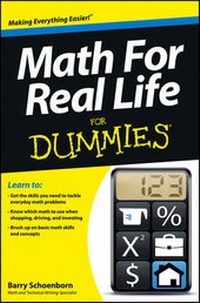
Math For Real Life For Dummies
Description

More details
Other editions
Additional editions
Person
Content
Introduction
Math is great. I've spent my life enjoying math and getting the benefits from it. But many people don't think math is so hot: They have fear and loathing.
The trouble is, a lot of what you learned in school probably was boring or painful, and most likely you forgot it right away. Or you may have deliberately not learned some types of math at all just to save yourself the trouble of forgetting them later. Why? Mainly because a lot of the math taught in schools wasn't math you could use. Well, that nonsense stops here, because this book is filled with math you can use. Here's just a brief sampling of the areas where you'll find real-life math to be useful:
At home, math comes in handy in the house, yard, workshop, and hobby room. It's also a big part of cooking in the kitchen, whether you're following a recipe or counting sticks of celery.
The grocery store and shopping center are the places where most people buy the most items with the most frequency. You can use math when you're shopping to make better choices and get better deals.
Real-life math helps with understanding food labels, losing weight, and exercising. You can get healthy by chance, but choice is better, and math helps you make choices.
On the job, you'll find that a brush-up on math skills is very handy, whether you're filling out a timesheet, managing time on a project, making change, or doing any other math-related tasks.
About This Book
Math for real life is math you need, because math for real life is math you use. And that's what I focus on in this book, which is different from other math books. Here's a quick rundown of the major differences:
This book is all about practical math. Although I cover math fundamentals (which are the building blocks of math for real life), I quickly move to problems you might deal with every day and the specific math skills you need to handle them. Other math books are often filled with abstractions.
The book doesn't include any high-level equations, because you don't need them to go shopping or to calculate your auto repair bill. Even the world of gambling operates on simple formulas.
It takes a comprehensive look at applying math in real-life areas. I include a little bit about a lot of subjects, and no subject goes any deeper than you need it to go. Many books are devoted to one subject (for example, algebra, geometry, trigonometry, or pre-calculus). Not this one - it's devoted to everything.
It's not dull (I hope), as other math books often are. Because it's a For Dummies book, you can be sure that it's easy to read and has touches of humor.
But wait! There's more! At the risk of sounding like a late-night infomercial, you'll find other unique features that I gar-on-tee you won't find in a more traditional math book:
You get terms, definitions, and word origins. The reason is that topics such as investments and insurance use so many odd words - and they need to be defined and explained.
You get special insights into our culture and the way we think. For example, a "sale" isn't always a sale, and "free" doesn't always mean free. Even so, we tend to buy. Math for real life shows you where the exaggerations are.
Conventions Used in This Book
This book is user-friendly: easy to hold in your hands, easy to read, and easy to understand. On top of that, it's easy to navigate, too, because the table of contents, the index, and the "In This Chapter" section at the beginning of each chapter help you find information you're looking for.
The book uses the following conventions:
Italic type highlights new terms. Once in a great while, you'll see italics used for emphasis.
Although English teachers would cringe at my breaking the rules, I usually write numbers as numerals, not words. For example, the text will say "if you drive 30 miles on 2 gallons of gas," not "if you drive thirty miles on two gallons of gas."
Variables in formulas appear as italics (for example, 3a + 4b = 10).
Web addresses are in monofont. They are usually very short and shouldn't break across two lines of text. But if they do, no extra characters indicate the break. Just type what you see into your browser.
What You're Not to Read
It would be great if you read all the words of this book in the order they appear, but life is short. You don't have to read chapters that don't interest you. This is a reference book, and it's designed to let you read only the parts you need. And if you get stuck, then you can go over to a chapter you skipped to get some help.
Here's a short list of "skippable" information. Information in these bits isn't essential to doing real-life math:
You don't have to read anything with a Technical Stuff icon next to it. That text gives you a little extra information about a technique, the origin of a principle, or maybe a formal definition.
Sidebars (that's what they're called in publishing) are blocks of text with a gray background. They are interesting (I think), but aren't critical to your understanding the main text.
Foolish Assumptions
The book makes some assumptions about you and what you're looking for in a math book:
You were exposed to math fundamentals in elementary school but may have forgotten a few of them. (Why not high school? Because in high school many people get bored, dazed, or frustrated with mathematics. So although you may have been in class, your mind was probably somewhere else.) Even if you missed some basic math concepts in school, don't fret: I review most of them in this book.
You're only interested in information that's relevant to you and are likely to skip concepts you're already comfortable with. That's okay. This is a reference book, not a novel.
You have access to a computer and the Internet. Although not essential, being able to access the Internet is very handy. You can use a search engine to find useful specialized calculators or to learn more about any topic in this book.
How This Book Is Organized
This book has four parts, each representing a particular math topic. The chapters in the parts focus on different aspects of that topic. Overall, the book moves from an early review of basics to chapters about math that comes up in everyday life to topics related to personal finance. Of course, you don't have to read the chapters in the order they appear. Following is an overview of the kind of information you can find in each part.
Part I: Boning Up on Math Basics
In this part, you get math basics, which amount mostly to counting and simple arithmetic. Chapters 1, 2, and 3 bring out broad concepts related to the arithmetic fundamentals. In Chapter 4, you work with simple and useful statistics. Chapter 5 is about mental math, a great shortcut when you don't have a calculator handy (which is most of the time).
Part II: Math for Everyday Activities
Part II shows you how to do the calculations that spring up regularly in real life. Want to seed your lawn or plant a flower bed? Math is involved. How about preparing a dinner for six from a recipe designed to feed four? You need math for that, too. Ever tried to decide whether the higher-priced but bigger box of cereal is a better deal than the lower-priced but smaller box? Again, math comes to the rescue. Shopping, cooking, driving around town, dining out, or trying to lose weight - math makes all these tasks easier.
Part III: Math to Manage Your Personal Finances
True, you may deal with personal finances daily, but they represent a sort of "special" kind of math. To handle these tasks well, you need to understand some general principles, a few specialized terms, and a few strategies. Fortunately, this part has you covered. Here you can get info to create a budget, better manage your bank account and check register, avoid credit card debt, invest more wisely, and more.
Part IV: The Part of Tens
What better way to end a book chock-full of easy-to-apply math formulas and principles than a couple of lists highlighting calculations you can do in your head and games you can play to build your math skills and sharpen your critical thinking? Consider this the icing-on-top-of-the-cake part.
Icons Used in This Book
In the margins of this book you'll see small drawings called icons. Each icon calls out a special kind of information.
A tip is a suggestion or a recommendation. It usually points out a quick and easy way to get things done or provides a handy piece of extra information.
A warning alerts you to conditions that, if you're not careful, could lead you to wrong answers, faulty conclusions, or otherwise mess up your day.
This icon appears beside information that's important enough to keep in mind, both for the task at hand and in general.
I use this icon to share esoteric...
