

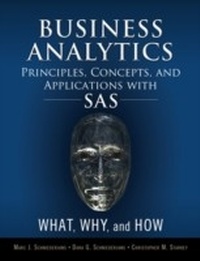
Business Analytics Principles, Concepts, and Applications with SAS
What, Why, and How
1st Edition
Published on 12. September 2014
352 pages
978-0-13-398957-1 (ISBN)
Description

Learn everything you need to know to start using business analytics and integrating it throughout your organization.
Business Analytics Principles, Concepts, and Applications with SAS brings together a complete, integrated package of knowledge for newcomers to the subject. The authors present an up-to-date view of what business analytics is, why it is so valuable, and most importantly, how it is used. They combine essential conceptual content with clear explanations of the tools, techniques, and methodologies actually used to implement modern business analytics initiatives.
They offer a proven step-wise approach to designing an analytics program, and successfully integrating it into your organization, so it effectively provides intelligence for competitive advantage in decision making.
Using step-by-step examples, the authors identify common challenges that can be addressed by business analytics, illustrate each type of analytics (descriptive, prescriptive, and predictive), and guide users in undertaking their own projects. Illustrating the real-world use of statistical, information systems, and management science methodologies, these examples help readers successfully apply the methods they are learning.
Unlike most competitive guides, this text demonstrates the use of SAS software, permitting instructors to spend less time teaching software and more time focusing on business analytics itself.
Business Analytics Principles, Concepts, and Applications with SAS will be a valuable resource for all beginning-to-intermediate level business analysts and business analytics managers; for MBA/Masters' degree students in the field; and for advanced undergraduates majoring in statistics, applied mathematics, or engineering/operations research.
Business Analytics Principles, Concepts, and Applications with SAS brings together a complete, integrated package of knowledge for newcomers to the subject. The authors present an up-to-date view of what business analytics is, why it is so valuable, and most importantly, how it is used. They combine essential conceptual content with clear explanations of the tools, techniques, and methodologies actually used to implement modern business analytics initiatives.
They offer a proven step-wise approach to designing an analytics program, and successfully integrating it into your organization, so it effectively provides intelligence for competitive advantage in decision making.
Using step-by-step examples, the authors identify common challenges that can be addressed by business analytics, illustrate each type of analytics (descriptive, prescriptive, and predictive), and guide users in undertaking their own projects. Illustrating the real-world use of statistical, information systems, and management science methodologies, these examples help readers successfully apply the methods they are learning.
Unlike most competitive guides, this text demonstrates the use of SAS software, permitting instructors to spend less time teaching software and more time focusing on business analytics itself.
Business Analytics Principles, Concepts, and Applications with SAS will be a valuable resource for all beginning-to-intermediate level business analysts and business analytics managers; for MBA/Masters' degree students in the field; and for advanced undergraduates majoring in statistics, applied mathematics, or engineering/operations research.
More details
Series
Language
English
Place of publication
NJ
United States
Publishing group
Pearson Education (US)
Target group
College/higher education
ISBN-13
978-0-13-398957-1 (9780133989571)
Copyright in bibliographic data and cover images is held by Nielsen Book Services Limited or by the publishers or by their respective licensors: all rights reserved.
Schweitzer Classification
Other editions
Additional editions
Marc J. Schniederjans | Dara G. Schniederjans | Christopher M. Starkey
Business Analytics Principles, Concepts, and Applications with SAS
What, Why, and How
Book
11/2014
Pearson FT Press
€119.45
Article exhausted; check different version
Persons
Marc J. Schniederjans is the C. Wheaton Battey Distinguished Professor of Business in the College of Business Administration at the University of Nebraska-Lincoln and has served on the faculty of three other universities. Professor Schniederjans is a Fellow of the Decision Sciences Institute (DSI) and in 2014-2015 will serve as DSI's president. His prior experience includes owning and operating his own truck leasing business. He is currently a member of the Institute of Supply Management (ISM), the Production and Operations Management Society (POMS), and Decision Sciences Institute (DSI). Professor Schniederjans has taught extensively in operations management and management science. He has won numerous teaching awards and is an honorary member of the Golden Key honor society and the Alpha Kappa Psi business honor society. He has published more than a hundred journal articles and has authored or coauthored twenty books in the field of management. The title of his most recent book is Reinventing the Supply Chain Life Cycle, and his research has encompassed a wide range of operations management and decision science topics. He has also presented more than one hundred research papers at academic meetings. Professor Schniederjans is serving on five journal editorial review boards, including Computers & Operations Research, International Journal of Information & Decision Sciences, International Journal of Information Systems in the Service Sector, Journal of Operations Management, and Production and Operations Management. He is also serving as an area editor for the journal Operations Management Research and as an associate editor for the International Journal of Strategic Decision Sciences and International Journal of the Society Systems Science and Management Review : An International Journal (Korea). In addition, Professor Schniederjans has served as a consultant and trainer to various business and government agencies.
Dara G. Schniederjans is an assistant professor of Supply Chain Management at the University of Rhode Island, College of Business Administration. She has published articles in journals such as Decision Support Systems, Journal of the Operational Research Society, and Business Process Management Journal. She has also coauthored two text books and coedited a readings book. She has contributed chapters to readings utilizing quantitative and statistical methods. Dara has served as a guest coeditor for a special issue on Business Ethics in Social Sciences in the International Journal of Society Systems Science. She has also served as a website coordinator for Decisions Sciences Institute. She currently teaches courses in Supplier Relationship Management and Operations Management.
Christopher M. Starkey is an economics student at the University of Connecticut-Storrs. He has presented papers at the Academy of Management and Production and Operations Management Society meetings. He currently teaches courses in Principles of Microeconomics and has taught Principles of Macroeconomics. His current research interests include macroeconomic and monetary policy, as well as other decision-making methodologies.
Dara G. Schniederjans is an assistant professor of Supply Chain Management at the University of Rhode Island, College of Business Administration. She has published articles in journals such as Decision Support Systems, Journal of the Operational Research Society, and Business Process Management Journal. She has also coauthored two text books and coedited a readings book. She has contributed chapters to readings utilizing quantitative and statistical methods. Dara has served as a guest coeditor for a special issue on Business Ethics in Social Sciences in the International Journal of Society Systems Science. She has also served as a website coordinator for Decisions Sciences Institute. She currently teaches courses in Supplier Relationship Management and Operations Management.
Christopher M. Starkey is an economics student at the University of Connecticut-Storrs. He has presented papers at the Academy of Management and Production and Operations Management Society meetings. He currently teaches courses in Principles of Microeconomics and has taught Principles of Macroeconomics. His current research interests include macroeconomic and monetary policy, as well as other decision-making methodologies.
Content
Preface xvi
PART I: What Is Business Analytics? 1
Chapter 1: What Is Business Analytics? 3
PART II: Why Is Business Analytics Important? 15
Chapter 2: Why Is Business Analytics Important? 17
Chapter 3: What Resource Considerations Are Important to Support Business Analytics? 29
PART III: How Can Business Analytics Be Applied? 43
Chapter 4: How Do We Align Resources to Support Business Analytics within an Organization? 45
Chapter 5: What Is Descriptive Analytics? 63
Chapter 6: What Is Predictive Analytics? 95
Chapter 7: What Is Prescriptive Analytics? 117
Chapter 8: A Final Business Analytics Case Problem 137
PART IV: Appendixes 161
Appendix A: Statistical Tools 163
Appendix B: Linear Programming 195
Appendix C: Duality and Sensitivity Analysis in Linear Programming 229
Appendix D: Integer Programming 249
Appendix E: Forecasting 257
Appendix F: Simulation 281
Appendix G: Decision Theory 289
Index 321
PART I: What Is Business Analytics? 1
Chapter 1: What Is Business Analytics? 3
PART II: Why Is Business Analytics Important? 15
Chapter 2: Why Is Business Analytics Important? 17
Chapter 3: What Resource Considerations Are Important to Support Business Analytics? 29
PART III: How Can Business Analytics Be Applied? 43
Chapter 4: How Do We Align Resources to Support Business Analytics within an Organization? 45
Chapter 5: What Is Descriptive Analytics? 63
Chapter 6: What Is Predictive Analytics? 95
Chapter 7: What Is Prescriptive Analytics? 117
Chapter 8: A Final Business Analytics Case Problem 137
PART IV: Appendixes 161
Appendix A: Statistical Tools 163
Appendix B: Linear Programming 195
Appendix C: Duality and Sensitivity Analysis in Linear Programming 229
Appendix D: Integer Programming 249
Appendix E: Forecasting 257
Appendix F: Simulation 281
Appendix G: Decision Theory 289
Index 321
