

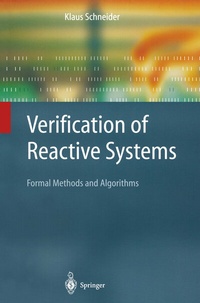
Verification of Reactive Systems
Description

This book is devoted to the foundation of the most popular formal methods for the specification and verification of reactive systems. In particular, the µ -calculus, omega -automata, and temporal logics are covered in full detail; their relationship and state-of-the-art verification procedures based on these formal approaches are presented. Furthermore, the advantages and disadvantages of the formalisms from particular points of view are analyzed. Most results are given with detailed proofs, so that the presentation is almost self-contained.
This book is targeted to advanced students, lecturers and researchers in the area of formal methods.
Reviews / Votes
From the reviews:
"The book starts with an introduction to formal methods in system design, talking about taxonomy and a classification of formal methods and systems. . Then the author introduces what he calls a unified specification language, which is propositional µ-calculus based on Kripke structure simulation, bisimulation and also quotient structures and products of Kripke structures. . it is a very helpful book that can be used both as a basis for a lecturer and as a handbook for learning about verification issues." (Manfred Broy, Mathematical Reviews, 2006 d)
"Verification of Reactive Systems deals very much with the fundamental theory of its subject matter, namely automata, temporal logic, and model checking. . is focused . systematic, and thorough. This makes it very suitable for a graduate course on selected topics on formal methods. It would also be highly useful as a general reference in logic and automata theory . . is a remarkable achievement, and fills, in book-form, a glaring gap in the literature. I heartily recommend it to every serious formal methods theoretician." (Joel Ouaknine, Software Testing, Verification and Reliability, Vol. 15 (3), 2005)
"This book is in the series on theoretical computer science. . The book classifies systems into transformational systems, interactive systems, and reactive systems. . can be kept as a reference for theories on verification of computing systems, especially finite state formalisms. The book is complete with respect to its concepts, and explanations. The research oriented readers can find the book useful . . For theory oriented readers, the flow of chapters is smooth. . On the whole, the book is well written . ." (Maulik A. Dave, SIGACT News, Vol. 37 (4), 2006)
More details
Other editions
Additional editions
Person
Klaus Schneider is working since 10 years on the specification and verification of reactive systems. Starting as a research assistant in 1992 at the university of Karlsruhe, he worked on the verification of hardware circuits with higher order logic theorem provers. After receiving his PhD in 1996, he focused his research topics on design, specification, and verification of reactive systems. His research group made a lot of important contributions to still active research areas. The book is based on his habilitation in 2001. Since 2002, the author is professor in computer science at the university of Kaiserslautern.
