

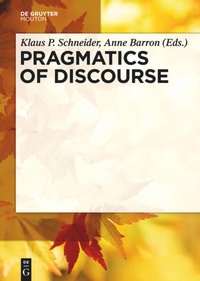
Pragmatics of Discourse
Description

Discourse is language as it occurs, in any form or context, beyond the speech act. It may be written or spoken, monological or dialogical, but there is always a communicative aim or purpose. The present volume provides systematic orientation in the vast field of studying discourse from a pragmatic perspective. It first gives an overview of a range of approaches developed for the analysis of discourse, including, among others, conversation analysis, systemic-functional analysis, genre analysis, critical discourse analysis, corpus-driven approaches and multimodal analysis. The focus is furthermore on functional units in discourse, such as discourse markers, moves, speech act sequences, discourse phases and silence. The final section of the volume examines discourse types and domains, providing a taxonomy of discourse types and focusing on a range of discourse domains, e.g. classroom discourse, medical discourse, legal discourse, electronic discourse.
Each article surveys the current state of the art of the respective topic area while also presenting new research findings.
More details
Other editions
Additional editions
Persons
Content
2 - Acknowledgements [Seite 9]
3 - Table of contents [Seite 11]
4 - 1. Discourse pragmatics: signposting a vast field [Seite 13]
5 - 2. Conceptualising discourse [Seite 47]
6 - Part I: Approaches to discourse [Seite 75]
6.1 - 3. The emergence of discourse analysis as a disciplinary field: philosophical, pedagogic and linguistic approaches [Seite 77]
6.2 - 4. Conversation analysis [Seite 109]
6.3 - 5. Systemic-functional approaches to discourse [Seite 137]
6.4 - 6. Genre analysis [Seite 177]
6.5 - 7. Critical discourse analysis [Seite 201]
6.6 - 8. Corpus linguistics and discourse analysis [Seite 227]
6.7 - 9. Multimodal pragmatics [Seite 251]
7 - Part II: Discourse structures [Seite 281]
7.1 - 10. Discourse Markers [Seite 283]
7.2 - 11. Stance [Seite 307]
7.3 - 12. Speech act sequences [Seite 335]
7.4 - 13. Phases in discourse [Seite 365]
7.5 - 14. Move structure [Seite 397]
7.6 - 15. Silence [Seite 419]
8 - Part III: Discourse types and domains [Seite 453]
8.1 - 16. Taxonomies of discourse types [Seite 455]
8.2 - 17. Classroom discourse [Seite 475]
8.3 - 18. Pragmatics and medical discourse [Seite 503]
8.4 - 19. Legal discourse: processes of making evidence in specialised legal corpora [Seite 537]
8.5 - 20. Electronic discourse [Seite 567]
8.6 - 21. Press releases [Seite 595]
9 - About the authors [Seite 613]
10 - Author index [Seite 620]
11 - Subject index [Seite 633]
