

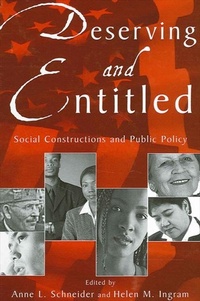
Deserving and Entitled
Description

Public policy in the United States is marked by a contradiction between the American ideal of equality and the reality of an underclass of marginalized and disadvantaged people who are widely viewed as undeserving and incapable. Deserving and Entitled provides a close inspection of many different policy arenas, showing how the use of power and the manipulation of images have made it appear both natural and appropriate that some target populations benefit from policy, while others do not. These social constructions of deservedness and entitlement, unless challenged, become amplified over time and institutionalized into permanent lines of social, economic, and political cleavage. The contributors here express concern that too often public policy sends messages harmful to democracy and contributes significantly to the pattern of uneven political participation in the United States.
Anne L. Schneider is Dean of the College of Public Programs at Arizona State University. Helen M. Ingram is Professor Emerita of Planning, Policy, and Design and Political Science at the University of California at Irvine, and Research Fellow, Southwest Center, at the University of Arizona. Schneider and Ingram have published many books, including coauthoring Policy Design for Democracy.
More details
Other editions
Additional editions
Persons
Anne L. Schneider is Dean of the College of Public Programs at Arizona State University. Helen M. Ingram is Professor Emerita of Planning, Policy, and Design and Political Science at the University of California at Irvine, and Research Fellow, Southwest Center, at the University of Arizona. Schneider and Ingram have published many books, including coauthoring Policy Design for Democracy.
Content
Foreword by Deborah Stone
Introduction: Public Policy and the Social Construction of Deservedness
HELEN M. INGRAM AND ANNE L. SCHNEIDER
PART I: Historical Roots of Constructions of Deservedness and Entitlement
1. Constructing and Entitling America's Original Veterans
LAURA S. JENSEN
2. Constructing the Democratic Citizen: Idiocy and Insanity in American Suffrage Law
KAY SCHRINER
3. From "Problem Minority" to "Model Minority": The Changing Social Construction of Japanese Americans
STEPHANIE DIALTO
PART II: Congressional Discourse: Forging Lines of Division between Deserving and Undeserving
4. Contested Images of Race and Place: The Politics of Housing Discrimination
MARA S. SIDNEY
5. "It Is Not a Question of Being Anti-immigration": Categories of Deservedness in Immigration Policy Making
LINA NEWTON
PART III: Nonprofits, Neighborhood Organizations, and the Social Construction of Deservedness
6. The Construction of Client Identities in a Post-welfare Social Service Program: The Double Bind of Microenterprise Development
NANCY JURIK AND JULIE COWGILL
7. Deservedness in Poor Neighborhoods: A Morality Struggle
MICHELLE CAMOU
Part IV: Constructions by Moral Entrepreneurs and Policy Analysts
8. From Perception to Public Policy: Translating Social Constructions into Policy Designs
SEAN NICHOLSON-CROTTY AND KENNETH J. MEIER
9. Jezebels, Matriarchs, and Welfare Queens: The Moynihan Report of 1965 and the Social Construction of African-American Women in Welfare Policy
DIONNE BENSONSMITH
10. Putting a Black Face on Welfare: The Good and the Bad
SANFORD F. SCHRAM
PART V: Social Constructions, Identity, Citizenship, and Participation
11. Making Clients and Citizens: Welfare Policy as a Source of Status, Belief, and Action
JOE SOSS
References
Contributors
Index
