

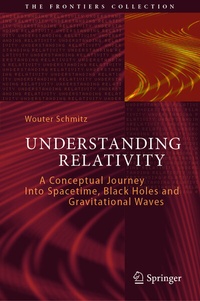
Understanding Relativity
Description

This book bridges the huge gap between popular science and mathematical treatments of Einstein's theories. It explains special and general relativity, gravity, black holes, and gravitational waves, also presenting current ideas about dark matter and dark energy. The explanations are entirely non-mathematical, using many color pictures and clear concepts. In this way, the reader is led to a much deeper understanding than any popular science book can provide.
The author has written this book for everyone who wants to go beyond superficial descriptions of relativity's remarkable phenomena, but is not equipped to read the professional literature and complicated math behind the theory. By providing a complete description in terms of concepts and pictures, the book answers many questions about why the theory works as it does. For example, it explains why and how momentum and pressure are related to gravity; why and how mass causes spacetime to curve and how curvature tells objects how to move; it also reveals the origin of the ring seen around the first ever image of a black hole. Not least, the reader will learn in detail how gravitational waves are produced and measured.
Since their conception, the theories of relativity have appealed to the public's imagination. Thanks to this book, readers now have the opportunity to convert their fascination with the topic to a deep understanding.More details
Other editions
Additional editions
Person
Wouter J.M. Schmitz, born 1970, studied physics in Amsterdam. He worked at CERN for an assignment at the Spin Muon Collaboration (SMC) and later as a summer student at a LEP experiment. He graduated at Nikhef Amsterdam in 1994. He has subsequently worked in IT and also holds an MBA degree. Today, Wouter works as a leading digital architect, retaining nonetheless a deep and informed interest in conceptual problems in physics.
His lifelong quest for a profound conceptual understanding of the foundations of physics has led him to develop and collect a substantial set of insights. In recent years Wouter managed to combine these insights into a consistent end-to-end story of how quantum field theory works conceptually. This, in turn, led to the publication of his highly praised book "Particles, Fields and Forces" (Springer, 2019). Until then, anyone seeking a deeper insight than popular science has to offer, was obliged to confront the mathematical treatment of the subject. But for those without mathematical training, this step is too challenging. Wouter's mission is to provide every interested person with a deeper insight into the workings of the universe without having to go through the math. His presentations thus bridge the huge gap between popular science and the mathematical treatment of fundamental theory. The present book on relativity follows the same concept.
Content
Introduction.- What is (the) matter?.- On the velocity of massless waves.- On the velocity of massive waves.- The relative, the absolute, and the paradoxical.- The Minkowski metric.- The equivalence principle.- The curvature of spacetime.- How waves change shapes and volumes.- The effects of curvature.- A journey to the centre of a black hole.- Black hole phenomena.- Gravitational waves.- All that matters in the dark universe.- An alternative theory and conclusion.- References and sources.
