

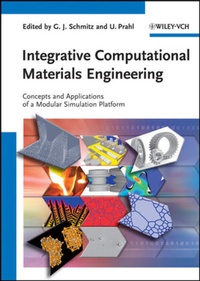
Integrative Computational Materials Engineering
Concepts and Applications of a Modular Simulation Platform
1st Edition
Published on 30. July 2012
XVI, 328 pages
978-3-527-64611-1 (ISBN)
Description

Presenting the results of an ambitious project, this book summarizes the efforts towards an open, web-based modular and extendable simulation platform for materials engineering that allows simulations bridging several length scales. In so doing, it covers processes along the entire value chain and even describes such different classes of materials as metallic alloys and polymers. It comprehensively describes all structural ideas, the underlying concepts, standard specifications, the verification results obtained for different test cases and additionally how to utilize the platform as a user and how to join it as a provider.
A resource for researchers, users and simulation software providers alike, the monograph provides an overview of the current status, serves as a generic manual for prospective users, and offers insights into the inner modular structure of the simulation platform.
A resource for researchers, users and simulation software providers alike, the monograph provides an overview of the current status, serves as a generic manual for prospective users, and offers insights into the inner modular structure of the simulation platform.
More details
Other editions
Additional editions
Georg J. Schmitz | Ulrich Prahl
Integrative Computational Materials Engineering
Concepts and Applications of a Modular Simulation Platform
Book
04/2012
1st Edition
Wiley-VCH
€169.00
Article exhausted; check different version
Software
04/2012
Wiley-VCH
€214.78
No shipping information available
Persons
Georg J. Schmitz earned his PhD in Materials Science in 1991 from RWTH Aachen University in the area of microstructure control in high temperature superconductors. At present he is senior scientist at ACCESS e.V., a private, non-profit research centre at the RWTH Aachen University. His research interests comprise microstructure formation in multi-component alloys, modeling of solidification phenomena, phase-field models and thermodynamics. He is the official agent for Thermo-Calc Software AB in Germany and provides global support for MICRESS®. At the RWTH Aachen University he coordinates an interdisciplinary team working on the subject of this book. Dr. Schmitz has been appointed as expert evaluator by the European Commission and acted as assessor for the Australian Research Council and the Royal Society, London. He is active member of the TMS committee on ICME, referee for several international journals and associate editor of Materials Transactions. Dr. Schmitz has published more than 100 scientific articles and filed 14 patents.
Ulrich Prahl received his PhD in Engineering Sciences in 2002 from RWTH Aachen University on the area of damage and failure prediction of high-strength fine grain pipeline steels. This work has been performed in the framework of the joined program 'Integrative Material Modelling' which aimed the development of materials models on various length scales. Since 2002 he is working as senior scientist at the department of ferrous metallurgy at RWTH Aachen University where he is heading the scientific working group 'Material Simulation'. Dr. Prahl is vice-coordinator in the AixViPMaP project which aims the definition of a modular integrative platform for the modelling of material processes on various length scales along the entire process chain. He has published more than 70 scientific articles.
Ulrich Prahl received his PhD in Engineering Sciences in 2002 from RWTH Aachen University on the area of damage and failure prediction of high-strength fine grain pipeline steels. This work has been performed in the framework of the joined program 'Integrative Material Modelling' which aimed the development of materials models on various length scales. Since 2002 he is working as senior scientist at the department of ferrous metallurgy at RWTH Aachen University where he is heading the scientific working group 'Material Simulation'. Dr. Prahl is vice-coordinator in the AixViPMaP project which aims the definition of a modular integrative platform for the modelling of material processes on various length scales along the entire process chain. He has published more than 70 scientific articles.
Content
PREFACE
PART I: Concepts
INTRODUCTION
Motivation
What Is ICME?
Historical Development of ICME
Current Activities toward ICME
Toward a Modular Standardized Platform for ICME
Scope of This Book
BASIC CONCEPT OF THE PLATFORM
Overview
Open Architecture
Modularity
Standardization
Web-Based Platform Operation
Benefits of the Platform Concept
Verification Using Test Cases
STATE-OF-THE-ART MODELS, SOFTWARE, AND FUTURE IMPROVEMENTS
Introduction
Overview of Existing Models and Software
Requirements for Models and Software in an ICME Framework
Benefits of Platform Operations for Individual Models
Strong and Weak Coupling of Platform Models
Conclusions
STANDARDIZATION
Overview
Standardization of Geometry and Result Data
Material Data
Application Programming Interface
Future Directions of Standardization
PREDICTION OF EFFECTIVE PROPERTIES
Introduction
Homogenization of Materials with Periodic Microstructure
Homogenization of Materials with Random Microstructure
Postprocessing of Macroscale Results: the Localization Step
Dedicated Homogenization Model: Two-Level Radial Homogenization of Semicrystalline Thermoplastics
Virtual Material Testing
Tools for the Determination of Effective Properties
Examples
Conclusions
DISTRIBUTED SIMULATIONS
Motivation
The AixViPMaP¿¿Simulation Platform Architecture
Data Integration
Web-Based User Interface for the Simulation Platform
VISUALIZATION
Motivation
Standardized Postprocessing
Integrated Visualization
Data History Tracking
PART II: Applications
TEST CASE LINE PIPE
Introduction
Materials
Process
Experiments
Experimental Process Chain
Simulation Models and Results
Conclusion and Benefits
TEST CASE GEARING COMPONENT
Introduction
Materials
The Process Chain
Experimental Procedures and Results
Simulation Chain and Results
Conclusions
TEST CASE: TECHNICAL PLASTIC PARTS
Introduction
Material
Process Chain
Modeling of the Phenomena along the Process Chain
Implementation of the Virtual Process Chain
Experimental Methods
Results
Summary and Conclusion
TEXTILE-REINFORCED PISTON ROD
Introduction
Experimental Process Chain
Simulation Chain
Conclusion/Benefits
TEST CASE STAINLESS STEEL BEARING HOUSING
Introduction
Materials
Processes
Phenomena
Simulation Chain
Results
Conclusions/Benefits
FUTURE ICME
Imperative Steps
Lessons Learned
Future Directions
Closing Remark
PART I: Concepts
INTRODUCTION
Motivation
What Is ICME?
Historical Development of ICME
Current Activities toward ICME
Toward a Modular Standardized Platform for ICME
Scope of This Book
BASIC CONCEPT OF THE PLATFORM
Overview
Open Architecture
Modularity
Standardization
Web-Based Platform Operation
Benefits of the Platform Concept
Verification Using Test Cases
STATE-OF-THE-ART MODELS, SOFTWARE, AND FUTURE IMPROVEMENTS
Introduction
Overview of Existing Models and Software
Requirements for Models and Software in an ICME Framework
Benefits of Platform Operations for Individual Models
Strong and Weak Coupling of Platform Models
Conclusions
STANDARDIZATION
Overview
Standardization of Geometry and Result Data
Material Data
Application Programming Interface
Future Directions of Standardization
PREDICTION OF EFFECTIVE PROPERTIES
Introduction
Homogenization of Materials with Periodic Microstructure
Homogenization of Materials with Random Microstructure
Postprocessing of Macroscale Results: the Localization Step
Dedicated Homogenization Model: Two-Level Radial Homogenization of Semicrystalline Thermoplastics
Virtual Material Testing
Tools for the Determination of Effective Properties
Examples
Conclusions
DISTRIBUTED SIMULATIONS
Motivation
The AixViPMaP¿¿Simulation Platform Architecture
Data Integration
Web-Based User Interface for the Simulation Platform
VISUALIZATION
Motivation
Standardized Postprocessing
Integrated Visualization
Data History Tracking
PART II: Applications
TEST CASE LINE PIPE
Introduction
Materials
Process
Experiments
Experimental Process Chain
Simulation Models and Results
Conclusion and Benefits
TEST CASE GEARING COMPONENT
Introduction
Materials
The Process Chain
Experimental Procedures and Results
Simulation Chain and Results
Conclusions
TEST CASE: TECHNICAL PLASTIC PARTS
Introduction
Material
Process Chain
Modeling of the Phenomena along the Process Chain
Implementation of the Virtual Process Chain
Experimental Methods
Results
Summary and Conclusion
TEXTILE-REINFORCED PISTON ROD
Introduction
Experimental Process Chain
Simulation Chain
Conclusion/Benefits
TEST CASE STAINLESS STEEL BEARING HOUSING
Introduction
Materials
Processes
Phenomena
Simulation Chain
Results
Conclusions/Benefits
FUTURE ICME
Imperative Steps
Lessons Learned
Future Directions
Closing Remark
