

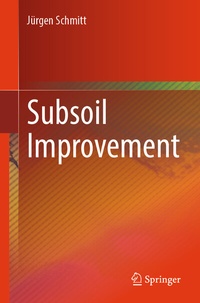
Subsoil Improvement
Description

This book provides a comparison of methods in the form of tables, which can be used to make a rough pre-selection of possible soil improvement methods.
The stability and serviceability of structures (ground failure, slope failure, settlement, slide safety, etc.) depend on the nature and magnitude of the forces acting and the physical properties of the ground. If the properties of the subsoil do not meet the requirements to be met, an improvement of the properties can be considered.
This book describes the most common and established methods for improving the properties of the subsoil. In addition to explaining the process, it provides the requirements for using the process and information such as the maximum depths that can be improved or the strengths that can be achieved.
The book is aimed primarily at students and practitioners in civil engineering, architecture, and engineering geology.
More details
Other editions
Additional editions
Person
Prof. Dr.-Ing. Jürgen Schmitt, born in 1970, studied civil engineering at the Technical University of Braunschweig and obtained his doctorate in tunneling. Prof. Schmitt gained many years of practical experience in various engineering companies in the fields of geotechnics, tunneling, and infrastructure planning. Since 2013, he has represented the research and teaching areas of geotechnics and tunneling at the Department of Civil and Environmental Engineering at Darmstadt University of Applied Sciences and has published numerous scientific papers and textbooks.
Content
1 Basics.- 2 Soil Exchange.- 3 Improvement Through Compaction.- 4 Improvement Through Consolidation.- 5 Injections.- 6 Ground Freezing.- 7 Comparison of Procedures.- 8 Standards and Recommendations.- References.
