

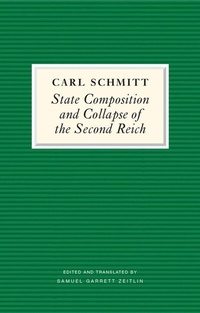
State Composition and Collapse of the Second Reich
Description

More details
Other editions
Additional editions
Persons
Content
Foreword by Reinhard Mehring
State Composition and Collapse of the Second Empire
Appendix: The Logic of Spiritual Subjection (1934)
Notes
Bibliography
"Spiritual Subjection"? On the "Tragic" Tone of Schmitt's Text
A Foreword to State Composition and the Collapse of the Second Reich
Reinhard Mehring
Schmitt's tight polemical text from early in the year 1934 is manifestly contemporary. Indeed, the questions concerning the relation between army and state, political constitution and military constitution, pose themselves anew after the "return of war" to Europe, in the Near East, and other regions of the world today, where the United States reorients itself toward a runoff with China and takes its distance from the "trans-Atlantic West." Everywhere in Europe, the European Union as well as NATO must newly adjust the mentality and constitution of state and society to military threats. Though it may sound odd, dissonant, crazy, or improbable, might a calculated National Socialist programmatic text by Carl Schmitt here be capable of stirring contemporary thought? Its critical questions concerning the "parliamentary army," "budgetary right," military service, and the constitutional weakening of political leadership and "unity" are, in any event, posed again today.
The brochure stands in a row of polemical and programmatic texts, which Schmitt published in swift succession after his decision for National Socialism: after the so-called Enabling Act (Ermächtigungsgesetz) of 24 March 1933, up until the summer of 1934 alongside a plethora of lectures, articles, and journal pieces.i If Schmitt was not only an opportunist and careerist, but rather a political author, constitutional theorist, and "thinker of order" who also disposed of fundamental answers and formational proposals, then this must show itself precisely in the programmatic brochures. As "crown jurist," Schmitt was already controversial in 1934: in April 1933, Schmitt, though not yet a member of the Nazi Party, was already participating as a legal-technical counselor in the formulation of the Reich Governors' Law (Reichstatthaltergesetz) for bringing the German states into line with Nazi policy, already lost in the course of the year 1933 as "state counsel" contact to Hermann Göring, and had to set himself more upon the Reichsrechtsführer Hans Frank, who did not belong among the first guard and the innermost circle with Hitler.
Schmitt's first programmatic text for the formation of the National Socialist Führer-state - State, Movement, People - remained extremely vague and recommended, according to the model of Göring's "state counsel," in terms of concrete constitutional politics little more than the erection of a "Führer's counsel" in parallel or as an alternative to the transmitted executive cabinet system; Hitler, however, persisted with the state and the Party. Up until the summer of 1934, Schmitt now wrote, from January 1934 onward, his brochures On the Three Types of Juristic Thinking, State Composition and Collapse as well as National Socialism and International Law, which all grew out of lectures. Up until 30 June 1934 and the liquidation of the heads of the Sturmabteilung (SA), as well as one-time opponents of Hitler, with a portion of whom Schmitt was personally as well as politically connected; Schmitt then reacted with a ground-shaking alteration of perspective and of strategy, which he immediately signaled multivalently in a highly contested article, Der Führer schützt das Recht [The Führer Protects the Law]. Schmitt's hope for a constitutional capacity of National Socialism, and his exertions (in Schmitt's terminology) to elevate a state of exception into the normal condition of a strong "Führer-state," had failed. From then on, Schmitt saw himself again within the state of exception, viewing National Socialism as the Leviathan, and for further political-theological legitimation, grasped strengthened in the semantic arsenal of anti-Semitism and of apocalypticism.
State Composition and Collapse of the Second Reich is Schmitt's most thoroughgoing attempt to define the relation between state and movement of Hitler's "legal revolution." The text proceeds from a lecture on "Army Order and Complete Political Structure" ["Heerwesen und politische Gesamtstruktur"], which Schmitt held on 24 January in the aula of the Berlin University, repeated on 13 February at the urgent request of his fellow-traveler Carl Bilfingerii in Halle, and which Schmitt promptly published in an abbreviated version under the title The Logic of Spiritual Subjection in the journal Deutsches Volkstum. Schmitt then rebuilt the text after the completion of Three Types of Juristic Thinking into the brochure. In his diary, Schmitt noted on 17 April, that, in the train en route "to Ernst Jünger and my godson" from Berlin to Goslar, he brought the manuscript "into order."iii
Since 1930, Schmitt was closely befriended with Ernst Jünger (1895-1998), a highly decorated war hero of the First World War, epitome of the idealized "Soldier." Jünger was an opponent of the Weimar Republic as well as of National Socialism. After a search raid on his house, Jünger withdrew from the firing line of Berlin to Goslar in December 1933. Despite the still-contrary assessment of National Socialism at the time, Jünger invited Schmittiv to assume the godfathership of his second son Carl Alexander, whom Schmitt called a "new Earth soldier" in a congratulatory letter dated to 15 March 1934.v The Hüter der Verfassung [Guardian of the Constitution] had approvingly cited Jünger's "total mobilization"; State Composition and Collapse repeats this.vi In 1932, Jünger published his famous essay, Der Arbeiter: Herrschaft und Gestalt [The Worker: Rule and Figure],vii to which Schmitt responded with his discourse of the "Victory of the Bourgeois Citizen over the Soldier." State Composition and Collapse speaks without Jünger's stately confidence rather resignedly of an "opposition of human types": "education and possession against blood and soil," and of strife "concerning the figuration of the German himself."
The brochured series edited by Schmitt, Der Deutsche Staat der Gegenwart [The Contemporary German State], in which Schmitt's programmatic texts appear as volumes 1 and 6, Ernst Rudolf Huber published as volume 2, at that time the economic-legal sketch Die Gestalt des deutschen Sozialismus [The Figuration of German Socialism]. In a letter dated to 1 May 1934 addressed to Huber, Schmitt mentions a "difference of opinion concerning the concept of figure,"viii which refers to a "very deep philosophic question." By this, is perhaps meant the anthropological or characterological shaping force: whether military service or the industrial economy and factory shapes the "type" more. Schmitt does not assertively participate in the then-present controversies concerning philosophic anthropology, although he knew all the main participants - Max Scheler, Helmuth Plessner, Paul Ludwig Landsberg, Arnold Gehlen - closely; the Concept of the Political in particular approvingly referred to Plessner's text Macht und menschliche Natur. Fundamentally, however, Schmitt, like Jünger, shunned disciplinary controversies. Constitution in the absolute sense, it is said at the outset of Constitutional Theory, means "the concrete way of being given by itself with every existing political unity."ix It exists positively in the "self-assertion" of a political will, which, according to Schmitt's Concept of the Political, shows itself also and precisely in the military self-assertion and in "readiness for death and killing."x This will to political existence: distinction between friend and enemy, Schmitt finds missing in the German citizen, who, under the influence of "liberal thought," no longer desires to be a soldier, but rather descends into the "bourgeois" and consumer. The questions were already posed by Oswald Spengler at the outset of the Weimar Republic in his text Preußentum und Sozialismus.xi Behind this stands Nietzsche's question concerning the "Übermenschen" and the expressionistic search for the "new Menschen." From Spengler to Jünger the questions were posed against the "left" labor movement and Marxism. Hitler and National Socialism saw themselves in this line.
Schmitt's search for the constitution, type, and figure of a "strong" state is mostly discussed in scholarship from the vantage of the end and decline of the Weimar Republic and the role of the presidential system: often in the alternative Papen or Schleicher, although Schmitt sought proximity to both, while Brüning and the Catholic Center Party thoroughly ignored him. Here begin the riddles around the constitutional-political interpretation of Schmitt's polemical text from 1934: instead of the decline...
