

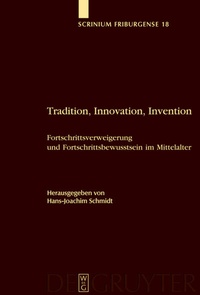
Tradition, Innovation, Invention
Description

This volume examines the antagonism between tradition and innovation in the Middle Ages. There were lines of thought which presume adherence to authoritative examples, but also believe in the purposefulness of history, in that, starting from an original state, there is a succession of redemptive actions, threats of danger and promises of happiness, and at times even the expectation of an ideal final state. New processes, new skills, new knowledge, new ethical attitudes and new forms of co-existence are seen as representing progressive steps which do not cease in the present and are directed towards the promise of future happiness. This view was, however, confronted with those which bemoaned change as a deviation from past ideals and as a decline, and which held that the present and future could only be improved through recourse to tried and tested states legitimised through tradition. There was, therefore, the legitimation through tradition, but at the same time there was a commitment to innovation, which was judged to be an improvement. The image of dwarves who stand on the shoulders of giants, but are thus able to see farther, demonstrates the dichotomous attitude of the Middle Ages. The volume presents papers from a variety of disciplines involved in medieval studies.
The papers focus on views of time and change, technological invention, the accumulation of goods and profit, reform and innovation in communities and the state, the increase in knowledge, innovation in art and literature, and the possibilities and boundaries of progress in human knowledge.
Reviews / Votes
"Der Band bietet perspektivenreiche Analysen einer "fundamentalen Denkfigur des Okzidents". Der interdisziplinäre Zugriff des Projekts wird der komplexen Thematik in besonderer Weise gerecht."Tobias Davids in: Das Mittelalter 2/2006More details
Other editions
Additional editions
Person
Hans-Joachim Schmidt ist Ordinarius für Geschichte des Mittelalters an der Universität Freiburg/Schweiz.
Content
- Intro
- Einleitung: Ist das Neue das Bessere? Überlegungen zu Denkfiguren und Denkblockaden im Mittelalter
- I. Zeit, Epoche, Veränderung / Temp, époque, changement
- Novitas - Inventores. Die ,Erfindung der Erfinder' im Spätmittelalter
- Goldenes Zeitalter, Zyklus, Aufbruch ins Unbekannte - Geschichtskonzeptionen der italienischen Renaissance
- Die Zeit im Werk von Albertus Magnus
- II. Technik, Wirtschaft und Vermehrung der Güter / Technique, économie et augmentation des biens
- Technique et augmentation des biens économiques
- Tradition, nécessité et modernisme: les travaux sanitaires accomplis dans les villes du Royaume de France et des grands fiefs, à la fin du Moyen Age
- Politique économique et "Innovation". L'exemple des infrastructures (Brabant, Flandre, fin XIIe-XVe siècles)
- Fortschrittsverweigerung? Die Haltung der deutschen Handelsherren gegenüber der italienischen Banktechnik bis 1475
- III. Neues und altes Wissen / Savoir ancien et nouveau
- The Sense of Innovation in the Writings of Peter Abelard
- Paris Theologians and Responses to Social Change in the Thirteenth Century
- Prophanae novitates et doctrinae peregrinae. La méfiance à l'égard des innovations théoriques aux XIIIe et XIVe siècles
- Visualisierte Weltenträume. Tradition und Innovation in den Weltkarten der Beatustradition des 10. bis 13. Jahrhunderts
- Spes proficiendi. Travail intellectuel et progrès individuel au Moyen Age
- IV. Gesellschaft, Politik und Kirche / Société, politique et église
- Gesetze finden - Gesetze erfinden
- Die Reaktion auf die frühe kommunale Bewegung vom Ende des 11. bis zur Mitte des 12. Jahrhunderts
- La crise de la royauté française au XlVe siècle: réformation et innovation dans le Songe du Vieil Pelerin (1389) de Philippe de Mézières
- Tradition und Neuerung im Kloster. Ekkehard IV. von St. Gallen und die monastische Reform
- Tradition und Innovation im hochmittelalterlichen Mönchtum. Kontroversen zwischen Cluniazensern und Zisterziensern im 12. Jahrhundert
- V. Literarische Verfahren / Procédés littéaires
- La création littéraire du XIIe siècle vis-à-vis de la tradition: fidélités et ruptures
- Wann werden Klassiker klassisch? Überlegungen zur Wirkungsweise und zum Geltungsbereich literarisch-ästhetischer Innovation im deutschen Hochmittelalter
