

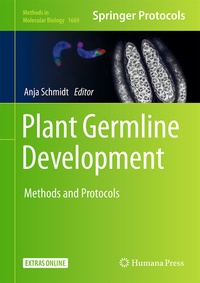
Plant Germline Development
Description

Authoritative and practical, Plant Germline Development: Methods and Protocols serves as a comprehensive guide not only to studying basic questions related to different aspects of plant reproductive development but also for state of the art methods, in addition to being a source of inspiration for new approaches and research questions in many laboratories.
More details
Other editions
Additional editions
Content
An Introduction to Male Germline Development.- Apomixis: Engineering the Ability to Harness Hybrid Vigor in Crop Plants.- 3D Imaging of Whole-Mount Ovules at Cellular Resolution to Study Female Germline Development in Rice.- Live-Cell Imaging of F-Actin Dynamics During Fertilization in Arabidopsis thaliana.- Development and Observation of Mature Megagametophyte Cell-Specific Fluorescent Markers.- Analysis of Fluorescent Reporter Activity in the Male Germline During Pollen Development by Confocal Microscopy.- In Vivo Ploidy Determination of Arabidopsis thaliana Male and Female Gametophytes.- Staining and Clearing of Arabidopsis Reproductive Tissue for Imaging of Fluorescent Proteins.- Live Cell Imaging of Auxin and Cytokinin Signaling in Maize Female Gametophytes.- Imaging Ca 2+ Dynamics in Wild-Type and NADPH Oxidase-Deficient Mutant Pollen Tubes with Yellow Cameleon and Confocal Laser Scanning Microscopy.- Immunolocalization of AGPs and Pectins in Quercus suber Gametophytic Structures.- Optimization of Cell Spreading and Image Quality for the Study of Chromosomes in Plant Tissues.- Whole Mount RNA-FISH on Ovules and Developing Seeds.- Analysis of Peroxisome Biogenesis in Pollen by Confocal Microscopy and Transmission Electron Microscopy.- Transmission Electron Microscopy (TEM) to Study Histology of Pollen and Pollen Tubes.- Isolation of Arabidopsis Pollen, Sperm Cells, and Vegetative Nuclei by Fluorescence-Activated Cell Sorting (FACS).- Isolation of Rice Sperm Cells for Transcriptional Profiling.- Manual Isolation of Living Cells from the Arabidopsis thaliana Female Gametophyte by Micromanipulation.- Isolation and Detection of Small RNAs from Pollen.- Analysis of Proteins Enriched in Rice Gamete.- Phosphoprotein Enrichment from Tobacco Mature Pollen Crude Protein Extract.- Identification of Cis -Regulatory Modules that Function in the Male Germline of Flowering Plants.- RNA-Seq Data Analysis: From Raw Data Quality Control to Differential Expression Analysis.- RNA-Seq Data Analysis Protocol: Combining In-House and Publicly Available Data.- Impedance Flow Cytometry as a Tool to Analyze Microspore and Pollen Quality.- Agrobacterium -Mediated Sorghum Transformation.- Use of the Cas9 Orthologues from Streptococcus thermophilus and Staphylococcus aureus for Non-Homologous End-Joining Mediated Site-Specific Mutagenesis in Arabidopsis thaliana.- Transgenic Reproductive Cell Ablation.- In Vivo Reporters for Protein Half-Life.- Conditional Modulation of Biological Processes by Low-Temperature Degrons.
