

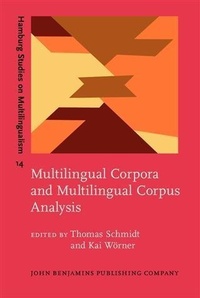
Multilingual Corpora and Multilingual Corpus Analysis
1st Edition
Published on 15. November 2012
XIII, 407 pages
978-90-272-7344-4 (ISBN)
Description

This volume deals with different aspects of the creation and use of multilingual corpora. The term 'multilingual corpus' is understood in a comprehensive sense, meaning any systematic collection of empirical language data enabling linguists to carry out analyses of multilingual individuals, multilingual societies or multilingual communication. The individual contributions are thus concerned with a variety of spoken and written corpora ranging from learner and attrition corpora, language contact corpora and interpreting corpora to comparable and parallel corpora. The overarching aim of the volume is first to take stock of the variety of existing multilingual corpora, documenting possible corpus designs and uses, second to discuss methodological and technological challenges in the creation and analysis of multilingual corpora, and third to provide examples of linguistic analyses that were carried out on the basis of multilingual corpora.
More details
Other editions
Additional editions
Thomas Schmidt | Kai Woerner
Multilingual Corpora and Multilingual Corpus Analysis
Book
11/2012
John Benjamins Publishing Co
€79.50
Shipment within 10-15 days
Persons
Content
Introduction
Thomas Schmidt and Kai Wörner
Section 1. Learner and attrition corpora
The LeaP corpus: A multilingual corpus of spoken learner German and learner English
Ulrike Gut
Technological and methodological challenges in creating, annotating and sharing a learner corpus of spoken German
Hanna Hedeland and Thomas Schmidt
Creation and analysis of a reading comprehension exercise corpus: Towards evaluating meaning in context
Niels Ott, Ramon Ziai and Detmar Meurers
The ALeSKo learner corpus: Design - annotation - quantitative analyses
Heike Zinsmeister and Margit Breckle
Corpora of spoken Spanish by simultaneous and successive German-Spanish bilingual and Spanish monolingual children
Marta Saceda Ulloa, Conxita Lleó and Izarbe Garcia Sanchez
Monolingual and bilingual phonoprosodic corpora of child German and child Spanish
Conxita Lleó
Pragmatic corpus analysis, exemplified by Turkish-German bilingual and monolingual data
Annette Herkenrath and Jochen Rehbein
Corpus of Polish spoken in Germany: Collecting and analysing written & spoken data for investigating contact-induced change
Agnieszka Czachór
The HABLA-corpus (German-French and German-Italian)
Tanja Kupisch, Dagmar Barton, Giulia Bianchi and Ilse Stangen
Section 2. Language contact corpora
The Hamburg Corpus of Argentinean Spanish (HaCASpa)
Christoph Gabriel
Ad hoc contact phenomena or established features of a contact variety?: Evidence from corpus analysis
Karoline H. Kühl
Phonoprosodic corpus of spoken Catalan (PhonCAT)
Ariadna Benet, Susana Cortés and Conxita Lleó
Researching the intelligibility of a (German) dialect
Magdalena Putz
Annotating ambiguity: Insights from a corpus-based study on syntactic change in Old Swedish
Steffen Höder
Section 3. Interpreting corpora
Sharing community interpreting corpora: A pilot study
Philipp Sebastian Angermeyer, Bernd Meyer and Thomas Schmidt
CoSi - A Corpus of Consecutive and Simultaneous Interpreting
Juliane House-Edmondson, Bernd Meyer and Thomas Schmidt
The corpus "Interpreting in Hospitals": Possible applications for research and communication training
Kristin Bührig, Ortrun Kliche, Bernd Meyer and Birte Pawlack
Section 4. Comparable and parallel corpora
The GeWiss corpus: Comparing spoken academic German, English and Polish
Christian Fandrych, Cordula Meißner and Adriana Slavcheva
Korpus C4: A distributed corpus of German varieties
Henrik Dittmann, Matej Durco, Alexander Geyken, Tobias Roth and Kai Zimmer
Treebanks in translation studies: The CroCo Dependency Treebank
Oliver Culo and Silvia Hansen-Schirra
Section 5. Corpus tools
Multilingual phonological corpus analysis: The tools behind the PhonBank Project
Yvan Rose
Finding the balance between strict defaults and total openness: Collecting and managing metadata for spoken language corpora with the EXMARaLDA Corpus Manager
Kai Wörner
General index
Corpora index
Language index
Thomas Schmidt and Kai Wörner
Section 1. Learner and attrition corpora
The LeaP corpus: A multilingual corpus of spoken learner German and learner English
Ulrike Gut
Technological and methodological challenges in creating, annotating and sharing a learner corpus of spoken German
Hanna Hedeland and Thomas Schmidt
Creation and analysis of a reading comprehension exercise corpus: Towards evaluating meaning in context
Niels Ott, Ramon Ziai and Detmar Meurers
The ALeSKo learner corpus: Design - annotation - quantitative analyses
Heike Zinsmeister and Margit Breckle
Corpora of spoken Spanish by simultaneous and successive German-Spanish bilingual and Spanish monolingual children
Marta Saceda Ulloa, Conxita Lleó and Izarbe Garcia Sanchez
Monolingual and bilingual phonoprosodic corpora of child German and child Spanish
Conxita Lleó
Pragmatic corpus analysis, exemplified by Turkish-German bilingual and monolingual data
Annette Herkenrath and Jochen Rehbein
Corpus of Polish spoken in Germany: Collecting and analysing written & spoken data for investigating contact-induced change
Agnieszka Czachór
The HABLA-corpus (German-French and German-Italian)
Tanja Kupisch, Dagmar Barton, Giulia Bianchi and Ilse Stangen
Section 2. Language contact corpora
The Hamburg Corpus of Argentinean Spanish (HaCASpa)
Christoph Gabriel
Ad hoc contact phenomena or established features of a contact variety?: Evidence from corpus analysis
Karoline H. Kühl
Phonoprosodic corpus of spoken Catalan (PhonCAT)
Ariadna Benet, Susana Cortés and Conxita Lleó
Researching the intelligibility of a (German) dialect
Magdalena Putz
Annotating ambiguity: Insights from a corpus-based study on syntactic change in Old Swedish
Steffen Höder
Section 3. Interpreting corpora
Sharing community interpreting corpora: A pilot study
Philipp Sebastian Angermeyer, Bernd Meyer and Thomas Schmidt
CoSi - A Corpus of Consecutive and Simultaneous Interpreting
Juliane House-Edmondson, Bernd Meyer and Thomas Schmidt
The corpus "Interpreting in Hospitals": Possible applications for research and communication training
Kristin Bührig, Ortrun Kliche, Bernd Meyer and Birte Pawlack
Section 4. Comparable and parallel corpora
The GeWiss corpus: Comparing spoken academic German, English and Polish
Christian Fandrych, Cordula Meißner and Adriana Slavcheva
Korpus C4: A distributed corpus of German varieties
Henrik Dittmann, Matej Durco, Alexander Geyken, Tobias Roth and Kai Zimmer
Treebanks in translation studies: The CroCo Dependency Treebank
Oliver Culo and Silvia Hansen-Schirra
Section 5. Corpus tools
Multilingual phonological corpus analysis: The tools behind the PhonBank Project
Yvan Rose
Finding the balance between strict defaults and total openness: Collecting and managing metadata for spoken language corpora with the EXMARaLDA Corpus Manager
Kai Wörner
General index
Corpora index
Language index
