

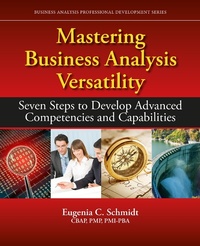
Mastering Business Analysis Versatility
Seven Steps to Developing Advanced Competencies and Capabilities
Published on 5. November 2019
344 pages
978-1-60427-813-2 (ISBN)
Description

This volume in the Business Analysis Professional Development Series by leading expert Eugenia Schmidt is for experienced business analysis practitioners and others conducting business analysis activities at an intermediate level who wish to master the essential art of versatility and develop other advanced capabilities and leadership skills needed to further their careers to the expert competency level. Practitioners will learn to develop the enterprise-level mindset required to accurately identify an organization's needs; determine the best solutions; and adapt the best approach, tools, and techniques to fit the project, culture, risks, and ever-changing situations that may arise. This guide will provide practitioners with the skills to perform successfully on virtually any project, in any organization and industry, and lead others to achieve desired results.
More details
Other editions
Additional editions
Eugenia C. Schmidt
Mastering Business Analysis Versatility
Seven Steps to Developing Advanced Competencies and Capabilities
Book
08/2019
J Ross Publishing
€89.33
Shipment within 10-20 days
Content
- Front Cover
- Title Page
- Copyright
- Contents
- Preface
- Acknowledgments
- About the Author
- WAVT Page
- Chapter 1: Introduction
- Purpose of Business Analysis
- Being an Expert
- Business Analysis as a Process
- The Need for Organizational Business Analysis Capabilities
- Behaviors to Advance Professional Capabilities
- Be a Leader
- Build Trust
- Exhibit Courage and Confidence
- Promote Collaboration
- Accept Change
- Summary
- Questions
- Notes
- Chapter 2: Step One-Move to an Enterprise Mindset
- Enhance Enterprise or Strategic Mindset
- Expanding Cultural Understanding
- Collaborating with Executive-Level Management
- Strengthening Vendor Relationships
- Conducting Benchmarking and Competitor Research
- Addressing Enterprise Risks
- Building Governance Relationships
- Considering Strategic Outcomes
- Strategic Roles for the BA
- Business Architect
- Change Agent
- Summary
- Questions
- Notes
- Chapter 3: Step Two-Adapt to the Life-Cycle Approach
- Life-Cycle Approaches and Stages
- Solution Life Cycle
- Predictive Life-Cycle Approach
- Hybrid Life-Cycle Approach
- Adaptive Life-Cycle Approach
- Project Approach Adjustments
- Requirement Attributes
- Addressing the Scope Expectation Gap
- Addressing the Time Expectation Gap
- Approach Integration Across Projects
- Summary
- Questions
- Notes
- Chapter 4: Step Three-Consider Uniqueness
- Best Practice Models
- BACCM
- Context
- Change
- Stakeholder
- Value
- Needs
- Solution
- Applying BACCM
- Areas of Focus
- Perspectives
- Routes and the WBS
- Mostly Predictive Types
- Enterprise-Wide
- Process-Driven
- Mostly Adaptive Types
- User-Focused
- Small Enhancements and Maintenance
- Mostly Hybrid Types
- Vendor Package Focus
- Data-Driven
- Technology-Driven
- Industry-Specific Focus
- Government
- Nonprofits
- Manufacturing
- Services
- Industry Domain Knowledge
- Summary
- Questions
- Notes
- Chapter 5: Step Four-Adjust Based on Risks
- Risk Overview
- Risks and Business Analysis
- Risks and Life-Cycle Approaches
- Predictive Life-Cycle Risk Management
- Hybrid Life-Cycle Approach Risk Management
- Adaptive Life-Cycle Approach Risk Management
- Potential Risk by Initiative Type
- Vendor Package Risks
- Process-Driven Risks
- Data-Driven Risks
- User-Focused Risks
- Enterprise-Wide Focus
- Technology-Driven Risks
- People Risks
- Business and Organizational Risks
- Risk Culture
- Summary
- Questions
- Notes
- Chapter 6: Step Five-Always Focus on Value
- What Is Value
- Be a Value Manager
- The Role
- Create a Value Story
- Move from Intangible to Tangible
- Start with Value Propositions
- Business Requirements Example
- Move from Potential Value to Real Value
- Value Versatility at the Enterprise Level
- Value Versatility at the Program Level
- Showing Value at the Requirements Level (Within Projects or Iterations)
- Evaluate Solution for Real Value
- Showing Your Own Value
- Our Opportunity Story
- Support the Business Advocate and User
- Summary
- Questions
- Notes
- Chapter 7: Step Six-Bridge the Capability Gap
- Assessments
- Competencies and Capabilities
- Competencies Are Transferable to Other Roles
- Proficiencies
- Individual Assessment
- Organizational Assessment
- Organizational Maturity Impact
- BA Role Expansion
- Business Analysis Competency Center
- Program and Project Management.
- RMP Adjustments Based on Maturity
- Close Capability Gaps
- Leverage Intellectual Assets
- Share Knowledge
- Expand the People Knowledge Network
- Be a Mentor
- Your Own Development
- A Few Challenges
- Finding the Time to Learn
- Knowledge Transfer
- Person Is Not Coachable
- No Opportunities to Gain Experience
- Summary
- Questions
- Notes
- Chapter 8: Step Seven-Build Up the Tool Chest
- Techniques
- Techniques Overview
- Techniques Across Life Cycles and Areas of Focus
- Applying Progressive Elaboration to Techniques
- Applying the Right Level of Robustness
- Estimate Variations
- Leveraging the Diversity of Tables
- Business Analysis Tool Types
- Homegrown and Single-Purpose Tools
- Transitional Tools
- End-to-End Tools
- Technique Challenges and Opportunities
- Transferable Techniques
- Technique Conflicts
- Summary
- Questions
- Notes
- Epilogue
- Appendix A: Templates, Checklists, and Examples
- Appendix B: Answers to End-of-Chapter Questions Business Analysis Techniques Glossary
- Appendix C: BA Competency and Capability Development Tools
- Index
