

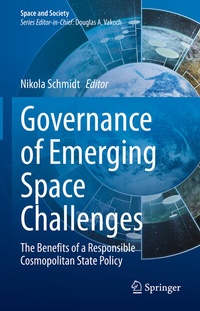
Governance of Emerging Space Challenges
Description

This edited volume discusses how even small nation states can make a significant difference in the future of space governance.
The book is divided into three main sections covering political theory, case studies, and space technology and applications. Key topics of discussion include planetary defense, space mining, and high-power systems in space. Through these timely subjects, the book presents strategies for developing a truly global governance framework in space, based on the concept of a responsible cosmopolitan state.
Authored by a multidisciplinary group of researchers from the Czech Republic, the volume will appeal to other scientific teams and policymakers looking to become pioneers of cosmopolitan space policies at a national and global level.
More details
Other editions
Additional editions
Person
Dr. Nikola Schmidt (born 1982 in Prague, Czech Republic) was, while working on this project, a research fellow at the Institute of Political Studies, Faculty of Social Sciences, Charles University, Czech Republic and currently heads the Center for Governance of Emerging Technologies at the Institute of International Relations, Prague, Czech Republic. He studied sociology at Charles University Prague (BA), and international relations and security at the Metropolitan University Prague (MA). He received his PhD from Charles University in 2016. He participated in a European Space Agency and NASA-funded planetary defense team project organized by the International Space University in 2015. The subject of his professional interests varies between international relations theory, science and technology studies with focus on space, and cyber and the general relation between technology, politics, and global governance. This book is a result of a multidisciplinary project he led for 4 years with participation from astronomers, space engineers, international lawyers, and political scientists. The objective was to devise a strategy for planetary defense and asteroid mining policy as key topics of a cosmopolitan responsible state. He has edited and authored a number of recent works, including the Springer volume Planetary Defense: Global Collaboration for Defending Earth From Asteroids and Comets, as well as articles in Acta Astronautica, Space Policy, New Space, Alternatives, and Bulletin of the Atomic Scientists. Prior to re-entering academia, he founded and led two software development companies and worked on a nongovernmental organization-driven food facility project in Afghanistan.
