

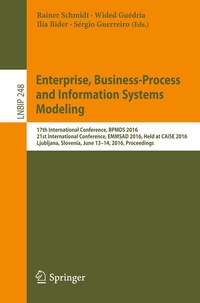
Enterprise, Business-Process and Information Systems Modeling
17th International Conference, BPMDS 2016, 21st International Conference, EMMSAD 2016, Held at CAiSE 2016, Ljubljana, Slovenia, June 13-14,2016 , Proceedings
Published on 6. June 2016
XVI, 496 pages
978-3-319-39429-9 (ISBN)
Description

This book contains the refereed proceedings of the 17th International Conference on Business Process Modeling, Development and Support, BPMDS 2016, and the 21st International Conference on Exploring Modeling Methods for Systems Analysis and Design, EMMSAD 2016, held together with the 28th International Conference on Advanced Information Systems Engineering (CAiSE 2016) in Ljubljana, Slovenia, in June 2016.The focus theme for BPMDS 2016 papers was "Business Processes in a Connected World", for which three subthemes were identified: business processes for connecting people, connecting intelligent objects to business processes and connecting information/data/knowledge to business processes. The 17 full and 1 short paper accepted for BPMDS were selected from 48 submissions and are grouped into topical sections on process execution support; improving usability of process models; social and human perspectives; new directions in process modeling; consistency, correctness and compliance; process and data mining; and process variability.The intention of EMMSAD is to solicit papers related to the field of information systems analysis and design including numerous information modeling methods and notations that are typically evolving. These ongoing changes significantly impact the way information systems, enterprises, and business processes are being analyzed and designed in practice. The 12 full papers accepted for EMMSAD were chosen from 19 submissions and are grouped into topical sections on fundamental issues in modeling; requirements and regulations; enterprise and software ecosystem modeling; information and process model quality; meta-modeling and domain specific modeling and model composition; and modeling of architecture and design.
More details
Series
Edition
1st ed. 2016
Language
English
Place of publication
Cham
Switzerland
Publishing group
Springer International Publishing
Target group
Professional and scholarly
Product notice
Reflowable
Illustrations
XVI, 496 p. 169 illus.
File size
49,83 MB
ISBN-13
978-3-319-39429-9 (9783319394299)
DOI
10.1007/978-3-319-39429-9
Schweitzer Classification
Other editions
Additional editions
Rainer Schmidt | Wided Guédria | Bider Ilia
Enterprise, Business-Process and Information Systems Modeling
17th International Conference, BPMDS 2016, 21st International Conference, EMMSAD 2016, Held at CAiSE 2016, Ljubljana, Slovenia, June 13-14,2016 , Proceedings
Book
06/2016
Springer
€53.49
Shipment within 10-15 days
Content
- Intro
- Preface
- EMMSAD 2016
- Organization
- Contents
- Process Execution Support
- Enabling Self-adaptive Workflows for Cyber-physical Systems
- 1 Introduction
- 2 Towards Cyber-physical Consistency for Processes
- 2.1 Cyber-physical Consistency
- 2.2 MAPE-K Control Loops for Ensuring CPS Consistency
- 3 Modelling Self-adaptive CPS Workflows
- 4 Executing Self-adaptive CPS Workflows
- 4.1 MAPE-K Components
- 4.2 MAPE-K Phases in Process Execution
- 5 Smart Lighting Case Study
- 6 Discussion
- 7 Related Work
- 8 Conclusion
- References
- Using the Guard-Stage-Milestone Notation for Monitoring BPMN-based Processes
- 1 Introduction
- 2 E-GSM
- 3 Transformation Rules
- 3.1 Basic Elements
- 3.2 Normal Flow
- 3.3 Exceptional Flow
- 4 Validation
- 4.1 An Error-Free Execution
- 4.2 A Catastrophic Execution
- 4.3 A Troublesome yet Recoverable Execution
- 5 Related Work
- 6 Conclusions and Future Work
- References
- Modelling the Process of Process Execution: A Process Model-Driven Approach to Customising User Inte ...
- Abstract
- 1 Introduction
- 2 The S-BPM Approach to Business Process Modelling
- 3 Modelling Process Execution as a Process
- 3.1 Modelling UI Workflow
- 3.2 Modelling UI Content
- 3.3 Connecting the UI Process to the Core Process
- 4 Example: Customising UIs for a Shopfloor Process
- 5 Related Work
- 6 Conclusion
- Acknowledgements
- References
- Improving Usability of Process Models
- Integrating Textual and Model-Based Process Descriptions for Comprehensive Process Search
- 1 Introduction
- 2 Background
- 2.1 Motivating Example
- 2.2 Related Work
- 3 Conceptual Approach
- 3.1 Overview
- 3.2 A Unified Format for Integrating Textual and Model-Based Process Descriptions
- 3.3 Parsing Textual Process Descriptions
- 3.4 Parsing Model-Based Process Descriptions
- 3.5 Querying the Unified Data Store
- 4 Evaluation
- 4.1 Setup
- 4.2 Data
- 4.3 Implementation
- 4.4 Results
- 5 Conclusion
- References
- Application of Business Process Diagrams' Complexity Management Technique Based on Highlights
- 1 Introduction
- 2 Research Background
- 2.1 Business Process Diagrams and Notations
- 2.2 Business Process Modeling Tools
- 2.3 Business Process Diagrams' Complexity
- 2.4 Business Process Diagrams Complexity Management
- 3 Proposed Solution
- 3.1 Theoretical Foundations
- 3.2 Proposed Highlights for Business Process Diagrams
- 3.3 Analysis of the Case Diagram
- 3.3.1 Complexity Analysis of the Case Diagram
- 4 Proof and Analysis of a Prototype IT Solution
- 4.1 Technical Aspects
- 4.2 Functional Aspect
- 4.3 Analysis of a Use Case Scenario
- 5 Discussion
- References
- A Methodology and Implementing Tool for Semantic Business Process Annotation
- 1 Introduction
- 2 Goals and Motivations
- 3 State of the Art
- 4 Methodology
- 4.1 Meta-Model
- 4.2 Structural and Domain Ontologies
- 5 Implementation
- 5.1 BPMN Model
- 5.2 OWL Model
- 5.3 BPMN2OWL Converter
- 6 Example
- 7 Conclusions and Future Works
- References
- Social and Human Perspective
- Considering Social Distance as an Influence Factor in the Process of Process Modeling
- 1 Introduction
- 2 Background on Construal Level Theory
- 3 Gamification, Virtual World, and 3D Scenario
- 4 Research Question and Experiment Definition
- 4.1 Context Selection and Goal Definition
- 4.2 Hypothesis Formulation
- 4.3 Experimental Setup
- 4.4 Experimental Design
- 4.5 Risk Analysis
- 5 Experiment Operation
- 5.1 Experiment Preparation
- 5.2 Experiment Execution
- 5.3 Data Validation
- 5.4 Threats to Validation
- 6 Data Analysis & Interpretation
- 6.1 Data Analysis and Descriptive Statistics
- 6.2 Data Set Reduction
- 6.3 Hypothesis Testing
- 6.4 Discussion
- 7 Related Work
- 8 Conclusion
- References
- What Have We Unlearned Since the Early Days of the Process Movement?
- 1 Introduction
- 2 Outcome vs. Tasks
- 3 Scope of the Process or Who is the Customer
- 4 BPM Missing the Big Picture
- 5 Collaboration Over Task Orchestration
- 6 Related Work
- 7 The Loss of the Big Picture in BPMDS
- 8 Conclusions
- References
- New Directions in Process Modeling
- Towards Impact Analysis of Data in Business Processes
- 1 Introduction
- 2 Running Example
- 3 Basic Definitions for Data Impact Analysis
- 4 Primitives for Data Impact Analysis
- 5 The Data Impact Analysis Approach
- 5.1 The Infrastructure of the Approach
- 5.2 Analyzing Data Impact for Redesign Scenarios
- 5.3 Analyzing Data Impact for Value Change Scenarios
- 5.4 Implementation and Preliminary Results
- 6 Related Work
- 7 Conclusion and Future Work
- Acknowledgment
- References
- Semi-automatic Derivation of RESTful Interactions from Choreography Diagrams
- 1 Introduction
- 2 Preliminaries
- 2.1 Choreography Diagram
- 2.2 RESTful Choreography Diagram
- 3 Semi-Automatic Generation of RESTful Choreography
- 3.1 Foundations
- 3.2 REST Verb Derivation via Natural Language Analysis
- 3.3 REST Request Generation
- 4 Evaluation
- 4.1 Evaluation Setup
- 4.2 Evaluation Results
- 4.3 Discussion
- 5 Related Work
- 6 Conclusions and Future Work
- References
- Controlling Time-Awareness in Modularized Processes
- 1 Introduction
- 2 Background and Related Work
- 3 Characterization of Time-Aware Processes
- 4 DC-Checking of Modularized Time-Aware Processes
- 5 Proof of Concept
- 6 Conclusions
- References
- Consistency, Correctness and Compliance
- A Systematic Literature Review of Consistency Among Business Process Models
- 1 Introduction
- 2 Inter Model Consistency: Key Terms and Concepts
- 3 Method Applied for the SLR
- 3.1 Research Questions and Search Process
- 3.2 Inclusion/Exclusion Criteria and Quality Assessment
- 4 Results
- 4.1 Search Results
- 4.2 Quality Evaluation of Primary Studies
- 4.3 Analysis of Results and Discussion
- 5 Towards Categorizing Approaches Related to Inter-model Consistency: A Reference Framework
- 6 Conclusion
- References
- Automatic Signature Generation for Anomaly Detection in Business Process Instance Data
- 1 Introduction
- 2 Signatures on Textual Process Instance Data
- 3 Generating Signatures
- 4 Evaluation
- 5 Related Work
- 6 Conclusion
- References
- Hybrid Diagnosis Applied to Multiple Instances in Business Processes
- 1 Introduction
- 2 Using Business Data Constraints. A Motivating Example
- 3 Applying Model-Based Diagnosis to Business Processes
- 3.1 Fundamentals of Model-Based Diagnosis
- 3.2 System Description: Relational Database Model and Business Data Constraints
- 3.3 Observational Model: Tuples of the Database
- 4 Constraint Programming for Hybrid Business Process Diagnosis Models
- 4.1 Fundamentals of Constraint Programming
- 4.2 Compliance Verification by Means of the Observational Model
- 4.3 Min-CSP Applied to Model-Based Diagnosis
- 4.4 Calculation of the MinLik Parameter
- 4.5 Diagnosing the Example
- 5 Evaluation
- 6 Related Works
- 7 Conclusions and Future Work
- References
- Process and Data Mining
- Connecting Databases with Process Mining: A Meta Model and Toolset
- 1 Introduction
- 2 Running Example
- 3 Meta Model
- 3.1 Requirements
- 3.2 Formalization
- 4 Implementation
- 5 Evaluation
- 5.1 Meta Model Completion Scenarios
- 5.2 Database Redo Logs
- 5.3 In-Table Versioning
- 5.4 SAP-style Change Table
- 5.5 Resulting Meta Model
- 6 Related Work
- 7 Conclusion
- References
- Towards a Formal Framework for Business Process Re-Design Based on Data Mining
- 1 Introduction
- 2 Background
- 2.1 Data Mining
- 2.2 Artifact-Centric Business Process Modeling
- 2.3 Semantically Annotated Business Processes
- 3 Motivation
- 3.1 Running Example
- 3.2 Research Problems
- 4 Framework
- 4.1 Overview
- 4.2 Definitions
- 4.3 Algorithms for Business Process Re-Design
- 4.4 Implementation
- 5 Related Work
- 6 Conclusions
- References
- Repairing Alignments: Striking the Right Nerve
- 1 Introduction
- 2 Preliminaries
- 2.1 Sequences, Bags and Event Logs
- 2.2 Process Trees
- 2.3 Alignments
- 3 Repairing Alignments
- 3.1 Repairing Alignments: A Concrete Example
- 3.2 Optimality of Repaired Alignments
- 3.3 Feasibility of Repaired Alignments
- 4 Evaluation
- 4.1 Experimental Set-Up
- 4.2 Running Time
- 4.3 Alignment Quality
- 5 Related Work
- 6 Conclusion
- References
- Process Variability
- A Process Variant Modeling Method Comparison: Experience Report
- 1 Introduction
- 2 The Design of the Process Variant Modeling Study
- 2.1 The Organization and the Need for Variant Modeling
- 2.2 Process Variant Modeling Method Selection
- 2.3 Purpose of the Study
- 2.4 Process Variant Modeling Plan
- 3 Applying the Decomposition Driven Method
- 3.1 Step 1 - Model the Main Process
- 3.2 Step 2 - Identify Variation Drivers
- 3.3 Step 3 - Assess the Relative Strength of Variation Drivers
- 3.4 Step 4 - Identify the Variations in Each Subprocess
- 3.5 Step 5 - Perform Similarity Assessment of Variants for Each Subprocess
- 3.6 Step 6 - Construct the Variation Map
- 3.7 Step 7 - Configure a Specific Process Variant
- 4 Applying the Provop Method
- 4.1 Step 1 - Design a Base Process
- 4.2 Step 2 - Define Adjustment Points
- 4.3 Step 3 - Design and Model the Options
- 4.4 Step 4 - Configure Variants
- 5 Evaluating the Results
- 5.1 Guidelines for Process Variant Modeling Method Selection
- 6 Conclusion
- References
- Fundamental Issues in Modeling
- Representing Dynamic Invariants in Ontologically Well-Founded Conceptual Models
- 1 Introduction
- 2 Requirements for the Representation of Dynamic Aspects
- 3 A Standard OCL Temporal Extension
- 3.1 Temporal Extension Approach
- 3.2 Underlying the World-Reified Model of Background
- 3.3 Temporal OCL Navigations
- 3.4 World Structures
- 3.5 Standard OCL Operations Revisited
- 4 Representing Dynamic Invariants (the Modeler's View)
- 5 Related Work
- 6 Concluding Remarks
- Acknowledgements
- References
- Requirements and Regulations
- MATRA: A Framework for Assessing Model-Based Approaches on the Transformation Between Requirements a ...
- 1 Introduction
- 2 Background
- 3 Model-Based Transformation Approaches
- 3.1 The CBSP Technique
- 3.2 The ATRIUM Methodology
- 3.3 The STREAM Process
- 3.4 The 4SRS-SoaML Method
- 4 The MATRA Framework
- 4.1 Representation Models and Transformation Method
- 4.2 Transformation and Evaluation
- 5 Discussion
- 6 Conclusion
- References
- Enterprise and Software Ecosystem Modeling
- Data Accountability in Socio-Technical Systems
- 1 Introduction
- 2 Background and Related Work
- 2.1 Data Governance
- 2.2 Accountability
- 3 A Structured Method for Designing an Accountability Architecture
- 4 A Generic Model for Socio-Technical Systems
- 5 Interaction Types in STS
- 6 Case Study
- 7 Conclusion and Future Work
- References
- Analysis of Imprecise Enterprise Models
- 1 Introduction
- 2 Modeling with Imprecise Information
- 3 Automated Analysis
- 4 Analyzing Imprecise Enterprise Models
- 4.1 Impact of Imprecision in Analysis Methods
- 4.2 Sensitivity of Analysis Methods for Imprecise Models
- 5 Conclusions
- References
- Enterprise Process Modeling in Practice - Experiences from a Case Study in the Healthcare Sector
- 1 Introduction
- 2 Modeling of Business Processes in Enterprise Development
- 3 Combining Top-Down and Bottom-up Modeling
- 3.1 Combining Ought-to-be Models with as-is and to-be Models
- 4 Case Study
- 4.1 Model Management and Use
- 5 Discussion, Conclusion and Further Work
- 6 Conclusion and Further Work
- References
- Information and Process Model Quality
- How Modeling Language Shapes Decisions: Problem-Theoretical Arguments and Illustration of an Example Case
- 1 Introduction
- 2 On Decisions and Problems
- 3 How Language Shapes Decisions: An Example Case
- 3.1 Scenario Setting
- 3.2 Perspective 1: The Situation as a Choice
- 3.3 Perspective 2: The Situation as an Entanglement of Causes
- 3.4 Perspective 3: The Situation as a Goal Conflict
- 3.5 Perspective 4: The Situation as a Net of Probabilistic Influences
- 4 Discussion and Implications
- 5 Conclusions
- References
- On Suitability of Standard UML Notation for Relational Database Schema Representation
- 1 Introduction
- 2 Related Work
- 3 Suitability of isID Meta-attribute
- 4 Alternative Representation of Keys
- 5 Forward Engineering of Relational Database
- 6 Conclusion
- References
- Meta-modeling and Domain Specific Modeling and Model Composition
- Towards a Meta-Model for Networked Enterprise
- Abstract
- 1 Introduction
- 2 Research Methodology
- 3 Conceptual Definition - Related Work and Positioning
- 3.1 Networked Enterprise
- 3.2 The Ontology of Enterprise Interoperability
- 3.3 Interoperability Requirements
- 4 Construction Stage - The Networked Enterprise Meta-Model
- 5 Evaluation Using a Case Study
- 6 Conclusion and Future Work
- Acknowledgements
- References
- PoN-S: A Systematic Approach for Applying the Physics of Notation (PoN)
- 1 Introduction
- 2 Fundamentals of the Physics of Notation (PoN)
- 3 PoN Systematized (PoN-S)
- 4 Applying PoN-S: A Case Study
- 5 Related Work
- 6 Final Considerations
- References
- How Cognitively Effective is a Visual Notation? On the Inherent Difficulty of Operationalizing the Physics of Notations
- 1 Introduction
- 2 PoN Principles Overview
- 3 An Analysis of PoN Operationalization
- 3.1 A Set-Theoretical Framework for PoN
- 3.2 Operationalization Analysis
- 4 Summary and Identified Concerns
- 5 Concluding Outlook
- References
- Modeling of Architecture and Design
- Modeling and Analysis of Vehicles Platoon Safety in a Dynamic Environment Based on GSPN
- 1 Introduction
- 2 Related Works
- 3 Generalized Stochastic Petri Nets for Modeling and Quantitative Analysis
- 4 Vehicles Platoon System in a Dynamic Environment
- 5 The GSPN Model for Vehicles Platoon System
- 6 Safety Analysis and Results
- 6.1 The Impact of the Number of Faulty Vehicles (n) per platoon Unsafe S(t)
- 6.2 Failure Rate Impact on Platoon Unsafe S(t)
- 6.3 Appearance Frequency of External Perturbation Impact on Platoon Unsafe S(t)
- 7 Conclusion
- References
- Use Case Diagrams for Mobile and Multi-channel Information Systems: Experimental Comparison of Colour and Icon Annotations
- 1 Introduction
- 2 Motivation and Hypotheses
- 3 Experiment Design
- 4 Results
- 5 Discussion and Threats to Validity
- 6 Related Work
- 7 Conclusions and Further Work
- References
- Author Index
