

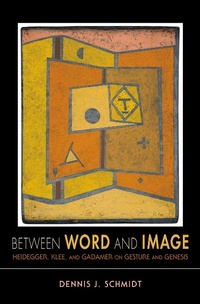
Between Word and Image
Heidegger, Klee, and Gadamer on Gesture and Genesis
Published on 1. November 2018
201 pages
978-0-253-00622-6 (ISBN)
Description

A groundbreaking examination of word and image through the lenses of modern art and Continental philosophy: "Probing and lucid" (Stephen H. Watson, University of Notre Dame).
Engagement with the image has played a decisive role in the formulation of the very idea of philosophy since Plato. Identifying pivotal moments in the history of philosophy, Dennis J. Schmidt develops the question of philosophy's regard of the image by considering painting¿where the image most clearly calls attention to itself as an image.
Focusing on the philosophies of Martin Heidegger and Hans-Georg Gadamer and the art of Paul Klee, Schmidt pursues larger issues in the relationship between word, image, and truth. As he investigates alternative ways of thinking about truth through word and image, Schmidt shows how the form of art can indeed possess the capacity to change its viewers.
Engagement with the image has played a decisive role in the formulation of the very idea of philosophy since Plato. Identifying pivotal moments in the history of philosophy, Dennis J. Schmidt develops the question of philosophy's regard of the image by considering painting¿where the image most clearly calls attention to itself as an image.
Focusing on the philosophies of Martin Heidegger and Hans-Georg Gadamer and the art of Paul Klee, Schmidt pursues larger issues in the relationship between word, image, and truth. As he investigates alternative ways of thinking about truth through word and image, Schmidt shows how the form of art can indeed possess the capacity to change its viewers.
More details
Other editions
Additional editions
Book
11/2012
Indiana University Press
€77.99
Article exhausted; check different version
Book
11/2012
Indiana University Press
€25.50
Shipment within 10-20 days
Person
Dennis J. Schmidt is Liberal Arts Professor of Philosophy, Comparative Literature, and German at Pennsylvania State University. He is author of On Germans and Other Greeks: Tragedy and Ethical Life (IUP, 2001).
Content
- Intro
- Title Page
- Copyright Page
- Dedication Page
- Contents
- Acknowledgments
- Introduction - The Genesis of the Question
- Chapter 1 - Unfolding the Question: An Excentric History
- Chapter 2 - Heidegger and Klee: An Attempt at a New Beginning
- Chapter 3 - On Word, Image, and Gesture: Another Attempt at a Beginning
- Afterword: The Question of Genesis for Now
- Notes
- Bibliography
- Index
