

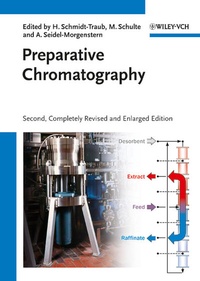
Preparative Chromatography
2nd Edition
Published on 28. September 2012
XXX, 536 pages
978-3-527-64931-0 (ISBN)
Description

Completely revised to reflect advances in this fast-changing field, this new edition features 35 % new content. It retains the interdisciplinary approach that elegantly combines the chemistry and engineering to explore the fundamentals and optimization processes involved.
Reviews / Votes
"I would not hesitate to recommend it to anyone working in this field."Chromatographia
"Overall the coverage is a bit uneven - nevertheless the volume does compile some useful material... In conclusion, this is a comprehensive reference text, which should find its way into the libraries of all companies who are serious about process scale preparative chromatography, whether internally or via outsource contracts."
Organic Process Research and Development
"This special volume is essential for chemists and engineers working in chemical and pharmaceutical industries, as well as for food technologies, due to the interdisciplinary nature of these preparative chromatographic processes."
Advances in Food Sciences
More details
Other editions
Additional editions
Henner Schmidt-Traub | Michael Schulte | Andreas Seidel-Morgenstern
Preparative Chromatography
Book
10/2012
2nd Edition
Wiley-VCH
€155.00
Article exhausted; check for reprint
Persons
Professor Schmidt-Traub was Professor for Plant and Process Design at the Department of Biochemical and Chemical Engineering, University of Dortmund, Germany until his retirement in 2006. He is still active in the research community and his main areas of research focus on preparative chromatography, down stream processing, integrated processes, plant design and innovative energy transfer. Prior to his academic appointment, Prof. Schmidt-Traub gained 15 years of industrial experience in plant engineering.
Prof. Seidel-Morgenstern is the Director of the Max Planck Institute for Dynamics of Complex Technical Systems, Magdeburg, Germany and holds the Chair in Chemical Process Engineering at the Otto-von-Guericke-Universität, Magdeburg, Germany. He received his Ph.D. in 1987 at the Institute of Physical Chemistry of the Academy of Sciences in Berlin. From there he went on to work as postdoctoral fellow at the University of Tennessee, Knoxville, USA. In 1994 he finished his habilitation at the Technical University in Berlin. His research is focused on New Reactor Concepts, Chromatographic Reactors, Membrane Reactors, Adsorption and Preparative Chromatography and Separation of Enantiomers amongst others.
Dr. Michael Schulte is Senior Director Emerging Businesses Energy at Merck KGaA Performance Materials, Darmstadt, Germany. In his Ph.D. thesis at the University of Münster, Germany he developed new chiral stationary phases for chromatographic enantioseparations. In 1995 he joined Merck and has since then been responsible for research and development in the area of preparative chromatography, including the development of new stationary phases, new separation processes and the implementation of Simulated Moving Bed-technology at Merck. In his current position one of his areas of research is the use of Ionic Liquids for separation processes.
Prof. Seidel-Morgenstern is the Director of the Max Planck Institute for Dynamics of Complex Technical Systems, Magdeburg, Germany and holds the Chair in Chemical Process Engineering at the Otto-von-Guericke-Universität, Magdeburg, Germany. He received his Ph.D. in 1987 at the Institute of Physical Chemistry of the Academy of Sciences in Berlin. From there he went on to work as postdoctoral fellow at the University of Tennessee, Knoxville, USA. In 1994 he finished his habilitation at the Technical University in Berlin. His research is focused on New Reactor Concepts, Chromatographic Reactors, Membrane Reactors, Adsorption and Preparative Chromatography and Separation of Enantiomers amongst others.
Dr. Michael Schulte is Senior Director Emerging Businesses Energy at Merck KGaA Performance Materials, Darmstadt, Germany. In his Ph.D. thesis at the University of Münster, Germany he developed new chiral stationary phases for chromatographic enantioseparations. In 1995 he joined Merck and has since then been responsible for research and development in the area of preparative chromatography, including the development of new stationary phases, new separation processes and the implementation of Simulated Moving Bed-technology at Merck. In his current position one of his areas of research is the use of Ionic Liquids for separation processes.
Content
Preface
INTRODUCTION
On the Development of Chromatography
Focus of the Book
Recommendation to read this Book
FUNDAMENTALS AND GENERAL TERMINOLOGY
Principles of Adsorption Chromatography
Basic Effects and Chromatographic Definitions
Fluid Dynamics
Mass Transfer Phenomena
Equilibrium Thermodynamics
Thermodynamic Effects on Mass Separation
STATIONARY PHASES AND CHROMATOGRAPHIC SYSTEMS
Column Packings
Selection of Chromatographic Systems
CHROMATOGRAPHY EQUIPMENT: ENGINEERING AND OPERATION
Introduction
Engineering and Operational Challenges
Chromatography Columns Market
Chromatography Systems Market
Process Control
Packing Methods
Process Troubleshooting
Disposable Technology for Bio-Separations
PROCESS CONCEPTS
Discontinuous Processes
Continuous Processes
Choice of Process Concepts
MODELING AND MODEL PARAMETERS
Introduction
Models for Single Chromatographic Columns
Modeling HPLC plants
Calculations Methods
Parameter Determination
Experimental Validation of Column Models
MODEL BASED DESIGN, OPTIMIZATION AND CONTROL
Basic Principles and Definitions
Batch Chromatography
Recycling Chromatography
Conventional Isocratic SMB Chromatography
Isocratic SMB Chromatography under Variable Operating Parameters
Gradient SMB Chromatography
Multicolumn Systems for Bioseparations
Chromatographic SMB Reactors
Advanced Process Control
APPENDIX B
Data of Test Systems
Symbol Description Units ai Coefficient of the Langmuir isotherm cm3 g−1 as Specific surface area cm2 g−1 A Area cm2 Ac Cross section of the column cm2 Ai Coefficient in the Van Deemter equation cm As Surface area of the adsorbent cm2 ASP Cross section-specific productivity g cm−2 s−1 bi Coefficient of the Langmuir isotherm cm3 g−1 B Column permeability m2 Bi Coefficient in the Van Deemter equation cm2 s−1 ci Concentration in the mobile phase g cm−3 cp,i Concentration of the solute inside the particle pores g cm−3 C Annual costs € Ci Coefficient in the Van Deemter equation s CDL,i Dimensionless concentration in the liquid phase — Cp,DL,i Dimensionless concentration of the solute inside the particle pores — Cspec Specific costs € g−1 dc Diameter of the column cm dp Average diameter of the particle cm dpore Average diameter of the pores cm Dan Angular dispersion coefficient cm2 s−1 Dapp,i Apparent dispersion coefficient cm2 s−1 Dapp,pore Apparent dispersion coefficient inside the pores cm2 s−1 Dax Axial dispersion coefficient cm2 s−1 Dm Molecular diffusion coefficient cm2 s−1 Dpore,i Diffusion coefficient inside the pores cm2 s−1 Dsolid,i Diffusion coefficient on the particle surface cm2 s−1 Da Damkoehler number — EC Eluent consumption cm3 g−1 F Prices € l−1, € g−1 fi Fugacity — h Reduced plate height — hRf Retardation factor — Δhvap Heat of vaporization kJ mol−1 Hi Henry coefficient — Hp Prediction horizon — Hr Control horizon — HETP Height of an equivalent theoretical plate cm kads,i Adsorption rate constant cm3 g−1 s−1 kdes,i Desorption rate constant cm3 g−1 s−1 keff,i Effective mass transfer coefficient cm2 s−1 Keq Equilibrium constant Miscellaneous KEQ Dimensionless equilibrium coefficient — kfilm,i Boundary or film mass transfer coefficient cm s−1 Retention factor — Modified retention factor — k0 Pressure drop coefficient — kreac Rate constant Miscellaneous LF Loading factor — Lc Length of the column cm Mass flow g s−1 mi Mass g mj Dimensionless mass flow rate in section j — ms Total mass g ni Molar cross section of component i — nT Pore connectivity — N Column efficiency, number of plates — Ncol Number of columns — Ncomp Number of components — Np Number of particles per volume element — Δp Pressure drop Pa Pe Péclet number — Pri Productivity g cm3 h−1 Ps Selectivity point — Pui Purity % qi Solid load g cm−3 qi∗ Total load g cm−3 Averaged particle load g cm−3 qsat,i Saturation capacity of the stationary phase g cm−3 QDL,i Dimensionless concentration in the stationary phase — r Radial coordinate cm ri Reaction rate Miscellaneous rp Particle radius cm Rf Retardation factor — Ri Regulation term — Rs Resolution — Re Reynolds number — SBET Specific surface area m2 g−1 Sc Schmidt number — Sh Sherwood number — St Stanton number — t Time s t0 Dead time of the column (for total liquid holdup) s t0,int Dead time of the column (for interstitial liquid holdup) s tcycle Cycle time s tg Gradient time s tinj Injection time s tlife Lifetime of adsorbent h tplant Dead time of the plant without column s tR,i Retention time s tR,i,net Net retention...
INTRODUCTION
On the Development of Chromatography
Focus of the Book
Recommendation to read this Book
FUNDAMENTALS AND GENERAL TERMINOLOGY
Principles of Adsorption Chromatography
Basic Effects and Chromatographic Definitions
Fluid Dynamics
Mass Transfer Phenomena
Equilibrium Thermodynamics
Thermodynamic Effects on Mass Separation
STATIONARY PHASES AND CHROMATOGRAPHIC SYSTEMS
Column Packings
Selection of Chromatographic Systems
CHROMATOGRAPHY EQUIPMENT: ENGINEERING AND OPERATION
Introduction
Engineering and Operational Challenges
Chromatography Columns Market
Chromatography Systems Market
Process Control
Packing Methods
Process Troubleshooting
Disposable Technology for Bio-Separations
PROCESS CONCEPTS
Discontinuous Processes
Continuous Processes
Choice of Process Concepts
MODELING AND MODEL PARAMETERS
Introduction
Models for Single Chromatographic Columns
Modeling HPLC plants
Calculations Methods
Parameter Determination
Experimental Validation of Column Models
MODEL BASED DESIGN, OPTIMIZATION AND CONTROL
Basic Principles and Definitions
Batch Chromatography
Recycling Chromatography
Conventional Isocratic SMB Chromatography
Isocratic SMB Chromatography under Variable Operating Parameters
Gradient SMB Chromatography
Multicolumn Systems for Bioseparations
Chromatographic SMB Reactors
Advanced Process Control
APPENDIX B
Data of Test Systems
Notation
Symbols
Symbol Description Units ai Coefficient of the Langmuir isotherm cm3 g−1 as Specific surface area cm2 g−1 A Area cm2 Ac Cross section of the column cm2 Ai Coefficient in the Van Deemter equation cm As Surface area of the adsorbent cm2 ASP Cross section-specific productivity g cm−2 s−1 bi Coefficient of the Langmuir isotherm cm3 g−1 B Column permeability m2 Bi Coefficient in the Van Deemter equation cm2 s−1 ci Concentration in the mobile phase g cm−3 cp,i Concentration of the solute inside the particle pores g cm−3 C Annual costs € Ci Coefficient in the Van Deemter equation s CDL,i Dimensionless concentration in the liquid phase — Cp,DL,i Dimensionless concentration of the solute inside the particle pores — Cspec Specific costs € g−1 dc Diameter of the column cm dp Average diameter of the particle cm dpore Average diameter of the pores cm Dan Angular dispersion coefficient cm2 s−1 Dapp,i Apparent dispersion coefficient cm2 s−1 Dapp,pore Apparent dispersion coefficient inside the pores cm2 s−1 Dax Axial dispersion coefficient cm2 s−1 Dm Molecular diffusion coefficient cm2 s−1 Dpore,i Diffusion coefficient inside the pores cm2 s−1 Dsolid,i Diffusion coefficient on the particle surface cm2 s−1 Da Damkoehler number — EC Eluent consumption cm3 g−1 F Prices € l−1, € g−1 fi Fugacity — h Reduced plate height — hRf Retardation factor — Δhvap Heat of vaporization kJ mol−1 Hi Henry coefficient — Hp Prediction horizon — Hr Control horizon — HETP Height of an equivalent theoretical plate cm kads,i Adsorption rate constant cm3 g−1 s−1 kdes,i Desorption rate constant cm3 g−1 s−1 keff,i Effective mass transfer coefficient cm2 s−1 Keq Equilibrium constant Miscellaneous KEQ Dimensionless equilibrium coefficient — kfilm,i Boundary or film mass transfer coefficient cm s−1 Retention factor — Modified retention factor — k0 Pressure drop coefficient — kreac Rate constant Miscellaneous LF Loading factor — Lc Length of the column cm Mass flow g s−1 mi Mass g mj Dimensionless mass flow rate in section j — ms Total mass g ni Molar cross section of component i — nT Pore connectivity — N Column efficiency, number of plates — Ncol Number of columns — Ncomp Number of components — Np Number of particles per volume element — Δp Pressure drop Pa Pe Péclet number — Pri Productivity g cm3 h−1 Ps Selectivity point — Pui Purity % qi Solid load g cm−3 qi∗ Total load g cm−3 Averaged particle load g cm−3 qsat,i Saturation capacity of the stationary phase g cm−3 QDL,i Dimensionless concentration in the stationary phase — r Radial coordinate cm ri Reaction rate Miscellaneous rp Particle radius cm Rf Retardation factor — Ri Regulation term — Rs Resolution — Re Reynolds number — SBET Specific surface area m2 g−1 Sc Schmidt number — Sh Sherwood number — St Stanton number — t Time s t0 Dead time of the column (for total liquid holdup) s t0,int Dead time of the column (for interstitial liquid holdup) s tcycle Cycle time s tg Gradient time s tinj Injection time s tlife Lifetime of adsorbent h tplant Dead time of the plant without column s tR,i Retention time s tR,i,net Net retention...
