
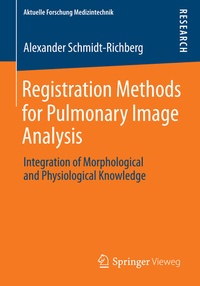
Registration Methods for Pulmonary Image Analysis
Description
Alles über E-Books | Antworten auf Fragen rund um E-Books, Kopierschutz und Dateiformate finden Sie in unserem Info- & Hilfebereich.
Various applications in the field of pulmonary image analysis require a registration of CT images of the lung. For example, a registration-based estimation of the breathing motion is employed to increase the accuracy of dose distribution in radiotherapy. Alexander Schmidt-Richberg develops methods to explicitly model morphological and physiological knowledge about respiration in algorithms for the registration of thoracic CT images. The author focusses on two lung-specific issues: on the one hand, the alignment of the interlobular fissures and on the other hand, the estimation of sliding motion at the lung boundaries. He shows that by explicitly considering these aspects based on a segmentation of the respective structure, registration accuracy can be significantly improved.
More details
Other editions
Additional editions
Person
Alexander Schmidt-Richberg works as a research scientist with a focus on image registration and segmentation. He received his PhD at the Institute of Medical Informatics, University of Lübeck, Germany, in 2013. Currently, he is a member of the Biomedical Image Analysis Group, Imperial College London, UK.

Content
System requirements
File format: PDF
Copy protection: Watermark-DRM (Digital Rights Management)
System requirements:
- Computer (Windows; MacOS X; Linux): Use the free software Adobe Reader, Adobe Digital Editions, or any other PDF viewer of your choice (see eBook Help).
- Tablet/Smartphone (Android; iOS): Install the free app Adobe Digital Editions or another reading app for eBooks, e.g., PocketBook (see eBook Help).
- E-reader: Bookeen, Kobo, Pocketbook, Sony, Tolino and many more (only limited: Kindle).
The file format PDF always displays a book page identically on any hardware. This makes PDF suitable for complex layouts such as those used in textbooks and reference books (images, tables, columns, footnotes). Unfortunately, on the small screens of e-readers or smartphones, PDFs are rather annoying, requiring too much scrolling.
This eBook uses Watermark-DRM, a „soft” copy protection. This means that there are no technical restrictions to prevent illegal distribution. However, there is a personalised watermark embedded in the eBook that can be used to identify the purchaser of the eBook in the event of misuse and to provide evidence for legal purposes.
For more information, see our eBook Help page.