

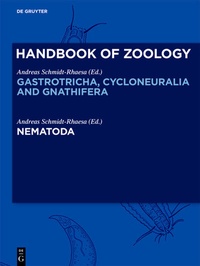
Nematoda
Description

This section of the Handbook of Zoology is intended as a comprehensive and exhaustive account of the biology of the taxa Gastrotricha, Nematoda, Nematomorpha, Priapulida, Kinorhyncha, Loricifera, Gnathostomulida, Micrognathozoa, Rotifera, Seisonida and Acanthocephala, covering all relevant topics such as morphology, ecology, phylogeny and diversity. The series is intended to be a detailed and up-to-date account of these taxa. As was the case with the first edition, the Handbook is intended to serve as a reliable resource for decades.
Many of the taxa of this volume are comparatively unknown to many biologists, despite their diversity and importance for example in meiofaunal communities (Gastrotricha, Rotifera, Gnathostomulida), their fascinating recent discoveries (Loricifera and Micrognathozoa), their importance as parasites (many nematodes, Nematomorpha, Acanthocephala) and their importance for evolutionary questions (e.g. Priapulida, Gastrotricha). The groups covered range from those poor in species (such as Micrognathozoa with 2 known species) to the species-rich and diverse Nematoda and their ca. 20.000 described species. While each taxon is covered by one chapter, nematodes are treated in several chapters dedicated to their structural, taxonomic and ecological diversity.
More details
Other editions
Additional editions
Persons
Content
2 - 1 Morphology of Nematoda [Seite 17]
2.1 - 1.1 General and external morphology [Seite 17]
2.2 - 1.2 Integument or body wall [Seite 21]
2.3 - 1.3 Musculature (Fig. 1.5 A-F) [Seite 28]
2.4 - 1.4 Nervous system [Seite 31]
2.5 - 1.5 Sensory structures [Seite 35]
2.6 - 1.6 The digestive system [Seite 45]
2.7 - 1.7 Body cavity or pseudocoel [Seite 51]
2.8 - 1.8 Secretory-excretory system (S-E system) (Fig. 1.13) [Seite 53]
2.9 - 1.9 Reproductive system and related reproduction [Seite 56]
2.10 - 1.10 Gametes-gametogenesis [Seite 63]
2.11 - Literature [Seite 67]
3 - 2 Reproduction and development in Nematodes [Seite 77]
3.1 - 2.1 Introduction [Seite 77]
3.2 - 2.2 Reproduction [Seite 78]
3.3 - 2.3 Sex determination [Seite 79]
3.4 - 2.4 Embryonic development [Seite 81]
3.5 - 2.5 Postembryonic development [Seite 107]
3.6 - 2.6 Concluding remarks [Seite 119]
3.7 - Literature [Seite 119]
4 - 3 Ecology of free-living marine nematodes [Seite 125]
4.1 - 3.1 General introduction [Seite 125]
4.2 - 3.2 Spatial distribution patterns [Seite 125]
4.3 - 3.3 Nematode abundance and diversity across marine habitats [Seite 128]
4.4 - 3.4 Nematode biomass patterns [Seite 133]
4.5 - 3.5 Nematode community composition patterns across marine habitats [Seite 134]
4.6 - 3.6 Disturbance and pollution [Seite 137]
4.7 - 3.7 Dispersal, colonization, population genetic structure and cryptic diversity of marine nematodes [Seite 141]
4.8 - 3.8 Feeding ecology [Seite 144]
4.9 - 3.9 Marine nematodes and energy flow [Seite 150]
4.10 - 3.10 Trophic and non-trophic interactions with macrofauna [Seite 152]
4.11 - 3.11 Nematodes and ecosystem functioning [Seite 153]
4.12 - Literature [Seite 156]
5 - 4 Ecology of Freshwater Nematodes [Seite 169]
5.1 - 4.1 Morphology, collection and identification [Seite 169]
5.2 - 4.2 Species richness [Seite 170]
5.3 - 4.3 Abundance and species composition [Seite 172]
5.4 - 4.4 Autecology of freshwater nematodes [Seite 175]
5.5 - 4.5 Feeding types of freshwater nematodes [Seite 176]
5.6 - 4.6 Role of nematodes in the benthic food web [Seite 177]
5.7 - 4.7 Production and biomass [Seite 180]
5.8 - 4.8 Ecotoxicology and applied ecology [Seite 181]
5.9 - 4.9 Conclusion [Seite 181]
5.10 - Literature [Seite 182]
6 - 5 Outline on nematode phylogeny [Seite 187]
6.1 - Literature [Seite 187]
7 - 6 Palaeontology of nematodes [Seite 189]
7.1 - 6.1 Introduction [Seite 189]
7.2 - 6.2 Types of nematode fossils [Seite 189]
7.3 - 6.3 Systematics of fossil nematodes [Seite 190]
7.4 - 6.4 Questionable fossil nematodes [Seite 193]
7.5 - 6.5 Summary [Seite 193]
7.6 - Literature [Seite 194]
8 - 7 Taxonomy [Seite 195]
8.1 - 7.1 Order Benthimermithida Tchesunov, 1995 [Seite 195]
8.1.1 - 7.1.1 Diagnosis [Seite 195]
8.1.2 - 7.1.2 Distribution, biology and ecology [Seite 195]
8.1.3 - 7.1.3 Sytematics and phylogeny [Seite 197]
8.1.4 - 7.1.4 Key to genera [Seite 201]
8.1.5 - Literature [Seite 201]
8.2 - 7.2 Order Rhaptothyreida Tchesunov, 1995 [Seite 203]
8.2.1 - 7.2.1 Diagnosis [Seite 203]
8.2.2 - 7.2.2 Distribution, biology, and ecology [Seite 203]
8.2.3 - 7.2.3 Systematics and phylogeny [Seite 206]
8.2.4 - Literature [Seite 208]
8.3 - 7.3 Order Enoplida [Seite 209]
8.3.1 - 7.3.1 Introduction [Seite 209]
8.3.2 - 7.3.2 Morphology [Seite 209]
8.3.3 - 7.3.3 Classification [Seite 214]
8.3.4 - Acknowledgements [Seite 262]
8.3.5 - Literature [Seite 262]
8.4 - 7.4 Order Triplonchida Cobb, 1919 [Seite 267]
8.4.1 - 7.4.1 Introduction [Seite 267]
8.4.2 - 7.4.2 Morphology [Seite 267]
8.4.3 - 7.4.3 Phylogeny and taxonomy [Seite 267]
8.4.4 - 7.4.4 Tobrilidae De Coninck, 1965 [Seite 268]
8.4.5 - 7.4.5 Tripylidae de Man, 1876 [Seite 273]
8.4.6 - 7.4.6 Onchulidae Andrássy, 1963 [Seite 275]
8.4.7 - 7.4.7 Prismatolaimidae Micoletzky, 1922 [Seite 278]
8.4.8 - 7.4.8 Bastianiidae De Coninck, 1965 [Seite 281]
8.4.9 - 7.4.9 Odontolaimidae Gerlach & Riemann, 1974 [Seite 283]
8.4.10 - 7.4.10 Triodontolaimidae De Coninck, 1965 [Seite 284]
8.4.11 - 7.4.11 Rhabdodemaniidae Filipjev, 1934 [Seite 284]
8.4.12 - 7.4.12 Pandolaimidae Belogurov, 1980 [Seite 286]
8.4.13 - 7.4.13 Diphterophoridae Micoletzky, 1922 [Seite 287]
8.4.14 - 7.4.14 Trichodoridae Thorne, 1935 [Seite 289]
9 - Literature [Seite 291]
9.1 - 7.5 Order Dorylaimida Pearse, 1942 [Seite 293]
9.1.1 - 7.5.1 Diagnosis [Seite 293]
9.1.2 - 7.5.2 Morphology [Seite 293]
9.1.3 - 7.5.3 Diversity and systematics [Seite 297]
9.1.4 - 7.5.4 Notes on the biology of Dorylaimida [Seite 312]
9.1.5 - Acknowledgments [Seite 312]
9.1.6 - Literature [Seite 312]
9.2 - 7.6 Order Mononchida Jairajpuri, 1969 [Seite 315]
9.2.1 - 7.6.1 Diagnosis [Seite 315]
9.2.2 - 7.6.2 General morphology of Mononchina [Seite 315]
9.2.3 - 7.6.3 General morphology of Bathyodontina [Seite 319]
9.2.4 - 7.6.4 Diversity and taxonomy [Seite 321]
9.2.5 - 7.6.5 Notes on their biology [Seite 326]
9.2.6 - Acknowledgments [Seite 327]
9.2.7 - Literature [Seite 327]
9.3 - 7.7 Order Isolaimiida Cobb, 1920 [Seite 329]
9.3.1 - 7.7.1 Introduction [Seite 329]
9.3.2 - 7.7.2 Isolaimiidae Timm, 1969 [Seite 329]
9.3.3 - Literature [Seite 332]
9.4 - 7.8 Order Dioctophymatida [Seite 333]
9.4.1 - 7.8.1 Introduction [Seite 333]
9.4.2 - 7.8.2 Morphology [Seite 334]
9.4.3 - 7.8.3 Reproduction and development [Seite 336]
9.4.4 - 7.8.4 Phylogeny and taxonomy [Seite 336]
9.4.5 - 7.8.5 Genus Dioctophyme Collet-Meygret, 1802 [Seite 336]
9.4.6 - 7.8.6 Eustrongylides Jägerskiöld, 1909 [Seite 337]
9.4.7 - 7.8.7 Hystrichis Dujardin, 1845 [Seite 342]
9.4.8 - 7.8.8 Soboliphyme Petrow, 1930 [Seite 344]
9.4.9 - Acknowledgements [Seite 347]
9.4.10 - Literature [Seite 347]
9.5 - 7.9 Order Muspiceida [Seite 351]
9.5.1 - 7.9.1 Historical diagnosis [Seite 351]
9.5.2 - 7.9.2 Morphology [Seite 352]
9.5.3 - 7.9.3 Life cycle [Seite 356]
9.5.4 - 7.9.4 Diversity and taxonomy [Seite 356]
9.5.5 - 7.9.5 Superfamily Muspiceoidea Roman, 1965 [Seite 358]
9.5.6 - Literature [Seite 358]
9.6 - 7.10 Order Marimermithida Rubtzov 1980, emend. Tchesunov 1995 [Seite 361]
9.6.1 - 7.10.1 Diagnosis [Seite 361]
9.6.2 - 7.10.2 Distribution, biology and ecology [Seite 361]
9.6.3 - 7.10.3 Systematics and phylogeny [Seite 363]
9.6.4 - 7.10.4 Key to genera [Seite 363]
9.6.5 - 7.10.5 Notes on systematics of Marimermithida [Seite 365]
9.6.6 - Literature [Seite 366]
9.7 - 7.11 Order Desmoscolecida [Seite 367]
9.7.1 - 7.11.1 Distribution and ecology (Fig. 7.83) [Seite 367]
9.7.2 - 7.11.2 Morphology [Seite 368]
9.7.3 - 7.11.3 Systematics [Seite 377]
9.7.4 - Literature [Seite 386]
9.8 - 7.12 Order Chromadorida Chitwood, 1933 [Seite 389]
9.8.1 - 7.12.1 Family Chromadoridae Filipjev, 1917 [Seite 389]
9.8.2 - 7.12.2 Family Cyatholaimidae Filipjev, 1918 [Seite 400]
9.8.3 - 7.12.3 Family Achromadoridae Gerlach & Riemann, 1973 [Seite 406]
9.8.4 - 7.12.4 Family Ethmolaimidae Filipjev & Schuurmans Stekhoven, 1941 [Seite 406]
9.8.5 - 7.12.5 Family Neotonchidae Wieser & Hopper, 1966 [Seite 406]
9.8.6 - 7.12.6 Family Selachinematidae Cobb, 1915 [Seite 408]
9.8.7 - Literature [Seite 412]
9.9 - 7.13 Order Desmodorida De Coninck, 1965 [Seite 415]
9.9.1 - 7.13.1 Superfamily Desmodoroidea Filipjev, 1922 [Seite 415]
9.9.2 - 7.13.2 Superfamily Microlaimoidea Micoletzky, 1922 [Seite 435]
9.9.3 - Literature [Seite 448]
9.10 - 7.14 Order Monhysterida Filipjev, 1929 [Seite 451]
9.10.1 - 7.14.1 Superfamily Siphonolaimoidea Filipjev, 1918 [Seite 451]
9.10.2 - 7.14.2 Superfamily Sphaerolaimoidea Filipjev, 1918 [Seite 460]
9.10.3 - 7.14.3 Superfamily Monhysteroidea Filipjev, 1929 [Seite 476]
9.10.4 - Acknowledgments [Seite 479]
9.10.5 - Literature [Seite 479]
9.11 - 7.15 Order Araeolaimida De Coninck, & Schuurmans Stekhoven, 1933 [Seite 483]
9.11.1 - 7.15.1 Family Axonolaimidae Filipjev, 1918 [Seite 483]
9.11.2 - 7.15.2 Family Bodonematidae [Seite 488]
9.11.3 - 7.15.3 Family Comesomatidae Filipjev, 1918 [Seite 489]
9.11.4 - 7.15.4 Family Coninckiidae Lorenzen, 1981 [Seite 496]
9.11.5 - 7.15.5 Family Diplopeltidae Filipjev, 1918 [Seite 497]
9.11.6 - Acknowledgments [Seite 501]
9.11.7 - Literature [Seite 501]
9.12 - 7.16 Order Plectida Gadea, 1973 [Seite 503]
9.12.1 - 7.16.1 Introduction [Seite 503]
9.12.2 - 7.16.2 Suborder Plectina [Seite 504]
9.12.3 - 7.16.3 Suborder Ceramonematina [Seite 534]
9.12.4 - Acknowledgments [Seite 549]
9.12.5 - Literature [Seite 549]
9.13 - 7.17 Order Rhabditina: "Rhabditidae" [Seite 553]
9.13.1 - 7.17.1 Scientific significance of "Rhabditidae" [Seite 553]
9.13.2 - 7.17.2 "Rhabditidae" as a paraphyletic taxon [Seite 553]
9.13.3 - 7.17.3 Stemspecies pattern of "Rhabditidae" (Rhabditina) [Seite 553]
9.13.4 - 7.17.4 Systematics [Seite 555]
9.13.5 - 7.17.5 Habitats and modes of life [Seite 555]
9.13.6 - 7.17.6 Convergences or parallelisms in morphology - a view on diversity [Seite 556]
9.13.7 - 7.17.7 Striking characteristics of single lineages [Seite 564]
9.13.8 - 7.17.8 Biogeography [Seite 567]
9.13.9 - 7.17.9 Speciation [Seite 567]
9.13.10 - Literature [Seite 569]
9.14 - 7.18 Order Strongylida (Railliet & Henry, 1913) [Seite 573]
9.14.1 - 7.18.1 Introduction [Seite 573]
9.14.2 - 7.18.2 Morphology and taxonomy [Seite 573]
9.14.3 - 7.18.3 Phylogeny [Seite 574]
9.14.4 - 7.18.4 Biology and ecology [Seite 577]
9.14.5 - 7.18.5 Suborder Strongylina (Weinland, 1858 superfamily) Durette-Desset & Chabaud, 1993 [Seite 578]
9.14.6 - 7.18.6 Suborder Ancylostomatina (Looss, 1905 subfamily) Durette-Desset & Chabaud, 1993 [Seite 587]
9.14.7 - 7.18.7 Suborder Trichostrongylina (Leiper 1908, family) Durette-Desset & Chabaud, 1993 [Seite 590]
9.14.8 - 7.18.8 Suborder Metastrongylina (Lane, 1917 superfamily) Durette-Desset & Chabaud, 1993 [Seite 616]
9.14.9 - Literature [Seite 624]
9.15 - 7.19 Order Tylenchida Thorne, 1949 [Seite 629]
9.15.1 - 7.19.1 Origin of Tylenchida [Seite 629]
9.15.2 - 7.19.2 Suborder Tylenchina Chitwood in Chitwood and Chitwood, 1950 [Seite 631]
9.15.3 - 7.19.3 Suborder Hoplolaimina Chizhov & Berezina, 1988 [Seite 633]
9.15.4 - 7.19.4 Suborder Criconematina Siddiqi, 1980 [Seite 645]
9.15.5 - 7.19.5 Suborder Hexatylina Siddiqi, 1980 [Seite 648]
9.15.6 - Literature [Seite 651]
9.16 - 7.20 Order Camallanida: Superfamilies Anguillicoloidea and Camallanoidea [Seite 653]
9.16.1 - 7.20.1 Superfamily Anguillicoloidea [Seite 653]
9.16.2 - 7.20.2 Superfamily Camallanoidea [Seite 654]
9.16.3 - Acknowledgements [Seite 658]
9.16.4 - Appendix [Seite 659]
9.16.5 - Literature [Seite 674]
9.17 - 7.21 Order Spirurida [Seite 677]
9.17.1 - 7.21.1 Introduction [Seite 677]
9.17.2 - 7.21.2 Superfamily Gnathostomatoidea Railliet, 1895 [Seite 678]
9.17.3 - 7.21.3 Superfamily Physalopteroidea Railliet, 1893 [Seite 682]
9.17.4 - 7.21.4 Superfamily Rictularioidea Hall, 1913 [Seite 687]
9.17.5 - 7.21.5 Superfamily Thelazioidea Skrjabin, 1915 [Seite 691]
9.17.6 - 7.21.6 Superfamily Spiruroidea Oerley, 1885 [Seite 697]
9.17.7 - 7.21.7 Superfamily Habronematoidea Chitwood & Wehr, 1932 [Seite 703]
9.17.8 - 7.21.8 Superfamily Acuarioidea Railliet, Henry & Sisoff, 1912 [Seite 709]
9.17.9 - 7.21.9 Superfamily Aproctoidea Yorke & Maplestone, 1926 [Seite 717]
9.17.10 - 7.21.10 Superfamily Diplotriaenoidea Skrjabin, 1916 [Seite 721]
9.17.11 - 7.21.11 Superfamily Filarioidea Weinland, 1858 [Seite 724]
9.17.12 - Acknowledgements [Seite 735]
9.17.13 - Literature [Seite 735]
9.17.14 - Glossary [Seite 748]
10 - Index [Seite 749]
