

11
Description

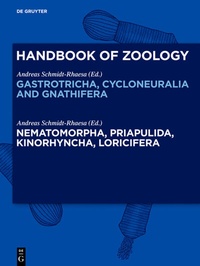
This section of the Handbook of Zoology is intended as a comprehensive and exhaustive account of the biology of the taxa Gastrotricha, Nematoda, Nematomorpha, Priapulida, Kinorhyncha, Loricifera, Gnathostomulida, Micrognathozoa, Rotifera, Seisonida and Acanthocephala, covering all relevant topics such as morphology, ecology, phylogeny and diversity. The series is intended to be a detailed and up-to-date account of these taxa. As was the case with the first edition, the Handbook is intended to serve as a reliable resource for decades.
Many of the taxa of this volume are comparatively unknown to many biologists, despite their diversity and importance for example in meiofaunal communities (Gastrotricha, Rotifera, Gnathostomulida), their fascinating recent discoveries (Loricifera and Micrognathozoa), their importance as parasites (many nematodes, Nematomorpha, Acanthocephala) and their importance for evolutionary questions (e.g. Priapulida, Gastrotricha). The groups covered range from those poor in species (such as Micrognathozoa with 2 known species) to the species-rich and diverse Nematoda and their ca. 20.000 described species. While each taxon is covered by one chapter, nematodes are treated in several chapters dedicated to their structural, taxonomic and ecological diversity.
More details
Other editions
Additional editions
Persons
Content
2 - 1. Gastrotricha, Cycloneuralia and Gnathifera: General History and Phylogeny [Seite 11]
2.1 - 1.1. The large worms [Seite 11]
2.2 - 1.2. The discovery of microscopically small animals [Seite 11]
2.3 - 1.3. Changing relationships [Seite 12]
2.4 - 1.4. From typological classification to phylogenetic systematics [Seite 14]
2.5 - 1.5. The contribution of molecular studies [Seite 16]
2.6 - 1.6. Outlook [Seite 17]
3 - 2. Gastrotricha, Cycloneuralia and Gnathifera: The Fossil Record [Seite 21]
3.1 - 2.1. Gastrotricha [Seite 21]
3.2 - 2.2. Gnathifera [Seite 21]
3.3 - 2.3. Cycloneuralia [Seite 21]
4 - 3. Nematomorpha [Seite 39]
4.1 - Introduction [Seite 39]
4.2 - 3.1. Morphology [Seite 39]
4.3 - 3.2. Reproduction and development [Seite 72]
4.4 - 3.3. Physiology [Seite 105]
4.5 - 3.4. Phylogeny [Seite 106]
4.6 - 3.5. Systematics [Seite 106]
4.7 - 3.6. Biogeography [Seite 132]
4.8 - 3.7. Paleontology [Seite 132]
4.9 - 3.8. Ecology [Seite 133]
5 - 4. Priapulida [Seite 157]
5.1 - Introduction [Seite 157]
5.2 - 4.1. Morphology [Seite 157]
5.3 - 4.2. Reproduction and development [Seite 173]
5.4 - 4.3. Physiology [Seite 174]
5.5 - 4.4. Phylogeny [Seite 175]
5.6 - 4.5. Systematics [Seite 176]
5.7 - 4.6. Biogeography [Seite 184]
5.8 - 4.7. Palaeontology [Seite 185]
5.9 - 4.8. Ecology [Seite 186]
6 - 5. Kinorhyncha (= Echinodera) [Seite 191]
6.1 - Introduction [Seite 191]
6.2 - 5.1. Morphology [Seite 193]
6.3 - 5.2. Reproduction and development [Seite 270]
6.4 - 5.3. Physiology [Seite 281]
6.5 - 5.4. Phylogeny [Seite 281]
6.6 - 5.5. Systematics [Seite 283]
6.7 - 5.6. Biogeography [Seite 318]
6.8 - 5.7. Paleontology [Seite 333]
6.9 - 5.8. Ecology [Seite 333]
7 - 6. Loricifera [Seite 359]
7.1 - Introduction [Seite 359]
7.2 - 6.1. Morphology [Seite 359]
7.3 - 6.2. Reproduction and development [Seite 372]
7.4 - 6.3. Phylogeny [Seite 374]
7.5 - 6.4. Diversity [Seite 375]
7.6 - 6.5. Ecology [Seite 380]
