

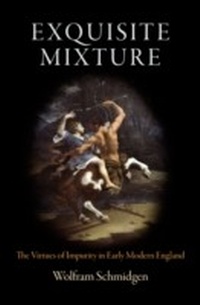
Exquisite Mixture
The Virtues of Impurity in Early Modern England
1st Edition
Published on 29. November 2012
256 pages
978-0-8122-0718-7 (ISBN)
Description

The culture of late seventeenth- and early eighteenth-century Britain is rarely credited with tolerance of diversity; this period saw a rising pride in national identity, the expansion of colonialism, and glorification of the Anglo-Saxon roots of the country. Yet at the same time, Wolfram Schmidgen observes, the concept of mixture became a critical element of Britons' belief in their own superiority. While the scientific, political, and religious establishment of the early 1600s could not imagine that anything truly formed, virtuous, or durable could be produced by mixing unlike kinds or merging absolute forms, intellectuals at the end of the century asserted that mixture could produce superior languages, new species, flawless ideas, and resilient civil societies.
Exquisite Mixture examines the writing of Robert Boyle, John Locke, Daniel Defoe, and others who challenged the primacy of the one over the many, the whole over the parts, and form over matter. Schmidgen traces the emergence of the valuation of mixture to the political and scientific revolutions of the seventeenth century. The recurrent threat of absolutism in this period helped foster alliances within a broad range of writers and fields of inquiry, from geography, embryology, and chemistry to political science and philosophy. By retrieving early modern arguments for the civilizing effects of mixture, Schmidgen invites us to rethink the stories we tell about the development of modern society. Not merely the fruit of postmodernism, the theorization and valuation of hybridity have their roots in centuries past.
Exquisite Mixture examines the writing of Robert Boyle, John Locke, Daniel Defoe, and others who challenged the primacy of the one over the many, the whole over the parts, and form over matter. Schmidgen traces the emergence of the valuation of mixture to the political and scientific revolutions of the seventeenth century. The recurrent threat of absolutism in this period helped foster alliances within a broad range of writers and fields of inquiry, from geography, embryology, and chemistry to political science and philosophy. By retrieving early modern arguments for the civilizing effects of mixture, Schmidgen invites us to rethink the stories we tell about the development of modern society. Not merely the fruit of postmodernism, the theorization and valuation of hybridity have their roots in centuries past.
Reviews / Votes
"For Wolfram Schmidgen, mixture used to be construed as a transgressor or a threat, but in the new globalized context it has become the norm. His book will stimulate readers to think afresh on issues that have not gone away. Western culture still has to work out how to accommodate diversity, not least when it comes to sectarian categories based on race, gender, class, or religion." (TLS) "[Schmidgen] has set a new agenda for intellectual historians of the English Enlightenment." (Journal of Modern History) "Brilliant and erudite. Wolfram Schmidgen shows that literary, scientific, and philosophical writers in early modern England often go beyond contemporary thinkers in their affirmation of the virtues of multiplicity and mixture. An important contribution to the intellectual history of seventeenth- and eighteenth-century Britain that illuminates contemporary discussions of identity, postcoloniality, migration, and globalization." (Michael Hardt, Duke University) "With Exquisite Mixture, Wolfram Schmidgen shows us why mixture was not derivative and secondary but an active and productive process: it offered natural philosophers like Boyle a way to study complex living things, and it allowed a wide spectrum of political and religious thinkers a way to understand politics as communal, dependent upon the multitude, contingent and therefore open to transformation." (William Warner, University of California, Santa Barbara) "This is an impressive piece of work written by a talented and well-informed author who has spent a lot of time thinking about mixture, multitudes, hybridity and bastardy-a book that is sure to have a large influence." (Jonathan Lamb, Vanderbilt University)More details
Series
Language
English
Place of publication
Pennsylvania
United States
Target group
College/higher education
ISBN-13
978-0-8122-0718-7 (9780812207187)
Copyright in bibliographic data and cover images is held by Nielsen Book Services Limited or by the publishers or by their respective licensors: all rights reserved.
Schweitzer Classification
Other editions
Additional editions
Book
10/2012
University of Pennsylvania Press
€79.23
Article not available at the moment
Person
Wolfram Schmidgen is Professor of English at Washington University in St. Louis. He is also the author of Eighteenth-Century Fiction and the Law of Property.
Content
Preface
Introduction: England's Mixed Genius
Chapter 1. The Science of Mixture
Chapter 2. The Politics of Deformity
Chapter 3. Locke's Mixed Liberty
Conclusion: Undividing Modernity
Notes
Bibliography
Index
Acknowledgments
Introduction: England's Mixed Genius
Chapter 1. The Science of Mixture
Chapter 2. The Politics of Deformity
Chapter 3. Locke's Mixed Liberty
Conclusion: Undividing Modernity
Notes
Bibliography
Index
Acknowledgments
