

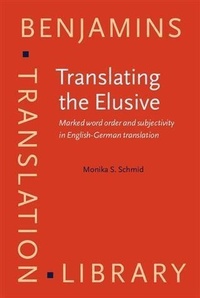
Translating the Elusive
Marked word order and subjectivity in English-German translation
1st Edition
Published on 15. December 1999
XII, 174 pages
978-90-272-8399-3 (ISBN)
Description

This work presents an in-depth analysis of text- and speaker-based meaning of non-canonical word order in English and ways to preserve this in English-German translation. Among the sentence structures under discussion are subject-verb inversion, Left Dislocation, Topicalization as well as wh-cleft and it -cleft sentences. Various approaches to the description and analysis of the meaning potential of these structures are presented and discussed, among them theories of grammaticalization, subjectivity, empathy and information structure.
English as a rigid word order language has quite different means of creating meaning by syntactic variation than a free word order language like German. Contrastive analyses of English and German have emphasized structural differences due to the fact that English uses word order to encode the assignment of grammatical roles, while in German this is achieved mainly by morphological means. For most 'marked' constructions in English a corresponding, structure-preserving translation does not lead to an ungrammatical or unacceptable German sentence. The temptation for the translator to preserve these structures is therefore great. A case study discusses more than 200 example sentences drawn from recent works of US-American fiction and offers possible strategies for their translation.
English as a rigid word order language has quite different means of creating meaning by syntactic variation than a free word order language like German. Contrastive analyses of English and German have emphasized structural differences due to the fact that English uses word order to encode the assignment of grammatical roles, while in German this is achieved mainly by morphological means. For most 'marked' constructions in English a corresponding, structure-preserving translation does not lead to an ungrammatical or unacceptable German sentence. The temptation for the translator to preserve these structures is therefore great. A case study discusses more than 200 example sentences drawn from recent works of US-American fiction and offers possible strategies for their translation.
More details
Other editions
Additional editions
Monika S. Schmid
Translating the Elusive
Marked word order and subjectivity in English-German translation
Book
12/1999
John Benjamins Publishing Co
€100.70
Shipment within 10-15 days
Person
Content
- TRANSLATING THE ELUSIVE MARKED WORD ORDER AND SUBJECTIVITY IN ENGLISH-GERMAN TRANSLATION
- Editorial page
- Title page
- Copyright page
- Dedication
- Table of contents
- Abbreviations
- Acknowledgment
- Introduction
- Chapter 1. Notions of speaker attitude
- 1.1 Subjectivity
- 1.1.1 Traugot's theory of grammaticalization
- 1.1.1.1 Semantic bleaching
- 1.1.1.2 Pragmatic strengthening-modality
- 1.1.2 Langacker 's theory of subjectivity
- 1.1.2.1 Subjectification
- 1.1.2.2 Modality
- 1.2 Empathy
- 1.2.1 Kuno's theory of empathy
- 1.2.2 Empathy and topicality
- Chapter 2. Information structure
- 2.1 Functional approaches to word order
- 2.1.1 Theme-Rheme
- 2.1.2 Functional Sentence Perspective
- 2.1.3 The given/new distinction
- 2.1.4 Topic-Focus
- 2.2 Iconicity in Syntax
- 2.2.7 Marked Syntax
- 2.2.2 Marked Topics
- Chapter 3. Non-canonical word order
- 3.1 Inversion
- 3.1.1 Structure
- 3.1.2 Full inversion
- 3.1.2.1 The 'emotional component
- 3.1.2.2 The presentative function
- 3.1.2.3 Information status
- 3.1.3 Subject-auxiliary inversion
- 3.2 Left dislocation and topicalization
- 3.2.1 Structure
- 3.2.2 Functions
- 3.2.2.1 Left dislocation
- 3.2.2.1.1 Information status
- 3.2.2.1.2 Topicality/persistence
- 3.2.2.2 Topicalization
- 3.3 Cleft sentences
- 3.3.1 Structure
- 3.3.2 A comparison of WH-clefts and it-clefts
- 3.3.3 Information status
- 3.3.3.1 WH-clefts
- 3.33.2 It-clefts
- 3.4 Subjectification and presupposition in marked sentence structures
- Chapter 4. Translatability
- 4.1 Inversions
- 4.1.2 FI-the presentative function
- 4.1.3 SAI
- 4.2 Left dislocation
- 4.2.1 LD and topic management
- 4.2.2 Deictic LD
- 4.2.3 LD as a marker of foreigner-talk'
- 4.3 Topicalization
- 4.4 Cleft sentences
- 4.4.1 WH-clefts
- 4.4.1.1 Information status and presupposition
- 4.4.1.2 Contrastive focus
- 4.4.2 It-clefts
- 4.4.2.1 Information status and presupposition
- 4.4.2.2 Exclusiveness
- 4.5 Synthesis
- Conclusion
- Notes
- Texts
- Bibliography
- Subject Index
- Author Index
