

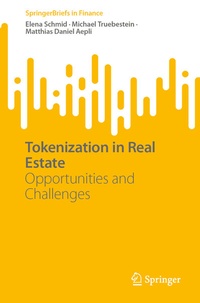
Tokenization in Real Estate
Description

Traditionally, real estate has been burdened by challenges such as illiquidity, limited accessibility, opacity, complex transactions, high costs, and substantial capital requirements. However, tokenization emerges as a potential solution to many of these issues. In this book, the authors thoroughly investigate the innovative concept of tokenization in the real estate domain. Tokenization involves digitizing real estate assets and ownership, complemented by fractionalization, facilitated through blockchain technology. The book elucidates the fundamental principles, technologies, opportunities, and impediments associated with real estate tokenization. To fully capitalize on the theoretical advantages, the book furnishes specific recommendations for the overall market landscape and active participants, providing crucial guidance to encourage wider adoption and successful realization of the benefits offered by tokenized real estate.
More details
Other editions
Additional editions
Persons
Elena Schmid has been working as an analyst at JLL Switzerland since 2020. She graduated with a Bachelor's degree from EHL Hospitality Business School with a major in Real Estate and Finance. She holds an MScRE degree from Lucerne University (HSLU) in Switzerland. During her research, she especially focused on investments with blockchain and tokens.
Michael Truebestein is a Professor of Real Estate Management and Investments and Head of the Master of Science in Real Estate program at the University of Lucerne (HSLU) in Switzerland. Furthermore, he was elected president of the RICS in Switzerland in 2020. Michael Truebestein is the author of various publications in the fields of real estate strategies, real estate investments, asset management, real estate markets, and digitization. In 2014, he initiated the annual study on "Real Estate Investments and Asset Management" of institutional investors (in cooperation with the ASIP /Swiss Pension Fund Association) and carried out the world's first tokenization of a property in 2019, the "Hello World" in Baar (Switzerland). In 2021, the media elected him to be part of the 100 leading and most important people in the Swiss Real Estate industry.
Matthias Daniel Aepli is a Lecturer at the University of Lucerne (HSLU) in Switzerland with experience in real estate management and investments, corporate finance, and risk management. In addition to lecturing in the Master of Science programs in Real Estate as well as International Financial Management and Banking and Finance, he is a serial entrepreneur in the real estate sector.
Content
Introduction.- Technological Background.- Tokenization in Real Estate.- Methodology.- Case Studies and Expert Interviews.- Conclusion and Recommendations.- Summary and Outlook
