

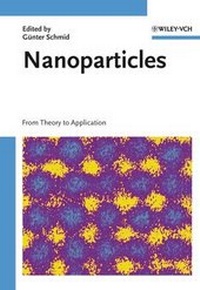
Nanoparticles
From Theory to Application
1st Edition
Published on 6. March 2006
X, 434 pages
978-3-527-60404-3 (ISBN)
Description

An introduction to the science of nanoparticles, from fundamental principles to their use in novel applications.
As a basis for understanding nanoparticle behavior, the book first outlines the principles of quantum size behavior, nanoparticles architecture, formation of semiconductor and metal nanoparticles. It then goes on to describe the chemical syntheses of nanoparticles with defined characteristics, their structural, electrical and magnetic properties, as well as current methods to monitor these properties.
Among others, the following nanoparticle-based applications are discussed:
* Single-electron devices
* Ultra dense recording media
* Bioelectronic devices and sensors
* Labeling of proteins, nucleic acids and other biomaterials.
With its clear structure and comprehensive coverage, backed by numerous examples from the recent literature, this is a prime reference for chemists and materials scientists working with and developing nanoparticle systems.
As a basis for understanding nanoparticle behavior, the book first outlines the principles of quantum size behavior, nanoparticles architecture, formation of semiconductor and metal nanoparticles. It then goes on to describe the chemical syntheses of nanoparticles with defined characteristics, their structural, electrical and magnetic properties, as well as current methods to monitor these properties.
Among others, the following nanoparticle-based applications are discussed:
* Single-electron devices
* Ultra dense recording media
* Bioelectronic devices and sensors
* Labeling of proteins, nucleic acids and other biomaterials.
With its clear structure and comprehensive coverage, backed by numerous examples from the recent literature, this is a prime reference for chemists and materials scientists working with and developing nanoparticle systems.
Reviews / Votes
"Günter Schmid, the Editor of 'Nanoparticles', is successful in securing the participation of prominent leading experts; he also excels in integrating the chapters in such a way that there is no disjointedness between the different topics which is a great advantage for the reader."ChemPhysChem
"...this book is useful for chemists interested in novel methods of wet-chemical nanoparticle synthesis but also for anyone looking for an introduction into the understanding of the electrical, optical and magnetic properties of nanoparticles."
Particle Characterization & Particle Systems
"Biogenetic magnetite provides great inspiration to laboratories active in nanotechnology, as for instance the book by Günther Schmid testifies to."
"With its clear structure and comprehensive coverage, backed by numerous examples from the recent literature, this is a prime reference for chemists and materials scientists working with and developing nanoparticle systems."
Zeitschrift für Kristallographie
"This information resource would be of a great value for graduate students and scientists working with nanoparticle systems."
E-STREAMS
"...a homogeneous, integrated, well-crafted, and highly readable volume--I strongly recommend that instructors take a serious look at this text--it is also of extraordinary value as a resource for the established researcher..."
Journal of the American Society
"The book succeeds in conveying important developments in the field, as well as providing useful information for solving actual research problems ... it is addressing practitioners in industry, as well as university libraries. I definitely recommend this text."
Applied Organometallic Chemistry
"...impressive..."
Ultramicroscopy
More details
Other editions
New editions
E-Book
08/2010
2nd Edition
Wiley-VCH
€174.99
Available for download
Additional editions
Book
01/2004
1st Edition
Wiley-VCH
€175.00
Article exhausted; check for reprint
Person
Content
1. Introduction
2. Quantum Dots
3. Synthesis
3.1. Semiconductor Nanoparticles
3.2. Metal Nanoparticles
4. Organization of Nanoparticles
4.1 Semiconductor Nanoparticles
4.2 Metal Nanoparticles
5. Properties
5.1. Semiconductor Nanoparticles
5.2. Metal Nanoparticles
6. Hybrid Systems
2. Quantum Dots
3. Synthesis
3.1. Semiconductor Nanoparticles
3.2. Metal Nanoparticles
4. Organization of Nanoparticles
4.1 Semiconductor Nanoparticles
4.2 Metal Nanoparticles
5. Properties
5.1. Semiconductor Nanoparticles
5.2. Metal Nanoparticles
6. Hybrid Systems
