

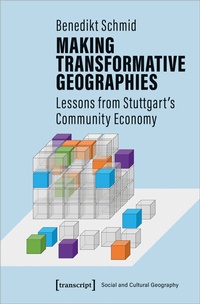
Making Transformative Geographies
Lessons from Stuttgart's Community Economy
1st Edition
Published on 3. June 2020
340 pages
978-3-8394-5140-3 (ISBN)
Description

In the light of social and environmental unsustainability and injustice, the continuing attachment to the idea that a growth-based economy is reconcilable with human prosperity and ecological limits seems increasingly implausible. Tracing and dissecting the complexities of social change, »Making Transformative Geographies« speaks about the development of visions, alternatives, and strategies for a radical transformation beyond accumulation and growth. Covering an empirical sample of 24 eco-social organizations, projects, and groupings in the city of Stuttgart (Germany), the book drills down into the social, spatial, and strategic dimensions of transformation. It advances a conceptually and empirically grounded assessment of the possibilities and limitations of community activism and civic engagement for shifting transformative geographies towards a degrowth trajectory.
Reviews / Votes
Besprochen in:ORLIS, 9 (2020)www.kommunalweb.de, 9 (2020)Urban Geography, 27.01.2021, Ella HubbardEurasian Geography and Economics, 63/1 (2022), Jan Bartsch/Markus SattlerMore details
Series
Thesis
Doctoral thesis
2019
Universität Luxembourg
Language
English
Place of publication
Bielefeld
Germany
Target group
Professional and scholarly
Illustrations
18
18 s/w Abbildungen
Klebebindung, 24 SW-Abbildungen
File size
7,98 MB
ISBN-13
978-3-8394-5140-3 (9783839451403)
DOI
10.14361/9783839451403
Schweitzer Classification
Other editions
Additional editions
Book
06/2020
1st Edition
transcript
€30.00
Shipment within 7-9 days
Person
Author
Benedikt Schmid, Albert-Ludwigs-Universität Freiburg, Deutschland
Benedikt Schmid (Dr.), geb. 1988, ist Akademischer Mitarbeiter am Lehrstuhl Geographie des Globalen Wandels an der Albert-Ludwigs-Universität Freiburg. In seiner Forschung untersucht er die Institutionalisierung von Praktiken und Organisationsformen mit sozial-ökologischen Zielsetzungen mit besonderem Fokus auf Transformationsprozessen hin zu nachhaltigen und wachstumsunabhängigen Wirtschaftsformen.
ISNI:
Content
- Cover
- Contents
- Introduction
- Focus and research question
- Contributions
- Limitations
- Structure
- Part I: From a growing economy to a-growth economies
- Chapter 1: Growth in the Capitalocene
- Why are we growth addicted?
- Escalation
- Limits
- Green growth - an oxymoron?
- Why grow in the first place?
- Interim conclusion
- Chapter 2: Alternative economies
- Alterity and diversity
- Degrowth
- Postcapitalism
- Towards a radical theory and praxis
- Chapter 3: Transformation, transition, and agency
- Sustainability transition research
- Grassroots innovations and the social economy
- Agents and allies of transformation
- Transition, transformation, and politics
- Interlude I: Geographies of change
- Part II: Transformative geographies: space, politics and change
- Chapter 4: Reimagining togetherness
- Community
- Community economy
- Economic diversity
- Poststructuralist transformative geographies
- Epistemic fallacy?
- Chapter 5: Materialization
- From regimes of signification to practice
- Practice theories
- Working with the concept of practice
- Institutions and organizations in practice
- Chapter 6: Scale and power in transformative geographies
- Scale
- Power
- Chapter 7: From transformative geographies to a degrowth transition
- Interventions in practice
- Towards a degrowth transition
- Degrowth practices and politics
- Operationalization: the diverse logics perspective
- Interlude II: Strategies for transformation
- Part III: Researching transformative geographies
- Chapter 8: A practice theory methodology
- Chapter 9: Planning and conducting research on a degrowth case study
- The case of Stuttgart
- Research design
- Chapter 10: Research as practice
- Participatory action research
- Positionality and self-reflection
- Chapter 11: Data analysis
- Coding and coding frames: an overview
- From conceptual framework to coding frames
- Triangulation and final coding
- Part IV: Stuttgart's community economy
- Of infidels and agnostics
- Chapter 12: Alternatives
- Slow technology - supporting sufficiency and subsistence
- Unlocking a sustainable local economy
- A politics of pragmatism
- Trust-based economies
- Cultivating subjects for other worlds
- Chapter 13: Constraints
- Consuming to save the planet?
- Money makes the world go 'round
- For-profit policy
- The tragedy of (artificial) scarcity
- Me, myself, and I
- Chapter 14: Enablement
- Supportive infrastructures
- Sustainability-related business models
- Institutional support
- In community we trust
- Trusted subjectivities and devotion
- Chapter 15: Compromise
- Trade-off
- Alternative income sources, charity projects, and social tariffs
- Diversified business and Trojan Horse?
- Self-restriction
- Grey zones
- Self-management
- Non-confrontative confrontation
- Interlude III: Of transition
- Part V: A degrowth transition in practice
- Chapter 16: Sketching a degrowth transition
- Stuttgart's politics of place beyond place
- Economy
- Governance
- Communality
- Subjectivity
- Technology
- A multifaceted transition
- Chapter 17: Degrowth practices
- Repair
- Sharing
- Chapter 18: Degrowth organizations
- Symbiotic organizations
- Interstitial organizations
- Pragmatic organizations
- Chapter 19: Degrowth strategies
- Transformative Infrastructures
- Politics of hybridity
- Hybrid infrastructures
- Chapter 20: Transformative geographies and socio-spatial strategies
- Networked interstitial strategies for economic transformation
- Territorial ruptural strategies for transformations in governance
- Place-based symbiotic strategies for transformations in communality
- Putting socio-spatial strategies into perspective
- Concluding thoughts on making transformative geographies
- Advancing research on transformative geographies
- Autocritique and potentials for future research
- A false sense of realism
- Skeptical hope
- Acknowledgements
- References
