

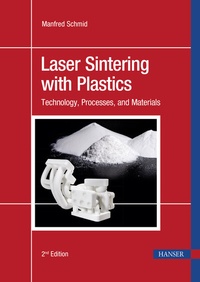
Laser Sintering with Plastics
Technology, Processes, and Materials
2nd Edition
Published on 8. April 2024
260 pages
978-1-56990-929-4 (ISBN)
Description

Powder bed-based additive manufacturing with polymers (PBF-P) has a special position in the world of 3D printing. On the one hand, the components are manufactured without support structures, and on the other hand, the property profile of the components is similar to that of series components, as is also known from injection molding, but with clear advantages in terms of component complexity.
In laser sintering (LS), individual component layers are fused with the aid of suitable laser radiation. In recent years, LS components have gained widespread use in industrial applications, so that today one can already speak of an established technology. Nevertheless, there are still many hurdles for LS to overcome in the future in order to free itself from the status of a niche technology. Material diversity and industry-compliant, quality-assurance measures are among the challenges to be mentioned here.
To this end, the second edition of this book sheds light on the current state of the art in terms of machine technology and process flow, and specifically on the requirements for the materials used. In addition, the following topics are presented:
- Implementation of LS in industrial process chains
- Status of international standardization
- Innovations in the field of LS materials
- Properties of LS components
- Selected application examples
The second edition has been updated throughout; in particular, the material and machine specifications have been extensively revised.
More details
Other editions
Additional editions
Book
04/2024
2nd Edition
Hanser Publications
€139.99
Shipment within 3-4 weeks

E-Book
04/2024
2nd Edition
Hanser Publications
€139.99
Available for download
Person
Author
Dr. Manfred Schmid studied chemistry in Bayreuth, Germany, and received his doctorate in polymer chemistry. Until 1997 he was employed as a chemist in polyamide research at EMS-Chemie. Subsequently, Mr. Schmid was project manager in the field of plastics analysis/biopolymers at EMPA. Since 2008 he has been head of research and development for SLS at Inspire AG, irpd, Switzerland.
Content
- Intro
- The Author
- Foreword
- Contents
- 1 Introduction
- 1.1 Manufacturing Technology
- 1.2 Additive Manufacturing
- 1.2.1 Application Areas and Technology Drivers
- 1.2.2 Main Groups of Additive Manufacturing
- 1.3 Additive Manufacturing with Plastics
- 1.3.1 Vat Photopolymerization (VPP)
- 1.3.2 Material Extrusion (MEX)
- 1.3.3 Material Jetting Technology (MJT)
- 1.3.4 Powder Bed Fusion (PBF)
- 1.3.5 Comparison of AM Processes for Plastics
- 1.4 Laser Sintering (LS) with Plastics
- 2 Laser Sintering Technology
- 2.1 Machine Technology
- 2.1.1 Machine Configuration
- 2.1.2 Temperature Control
- 2.1.2.1 Heat Sources
- 2.1.2.2 Surface Temperature at the Build Area
- 2.1.2.3 Laser Energy Input, Andrew Number (AN)
- 2.1.3 Powder Supply and Powder Application
- 2.1.3.1 Internal and External Powder Supply
- 2.1.3.2 Powder State (Conditioning)
- 2.1.4 Powder Application
- 2.1.4.1 Blade and Powder Cartridge
- 2.1.4.2 Roll Coater
- 2.1.4.3 Combined Coating Systems
- 2.1.5 Optical Components
- 2.1.5.1 Laser Beam Positioning
- 2.1.5.2 Focus Correction
- 2.2 Machine Market
- 2.2.1 Industrial Laser Sintering Equipment
- 2.2.1.1 Company: Electro Optical Systems, EOS (Germany)
- 2.2.1.2 Company: 3D Systems (USA)
- 2.2.1.3 Company: Farsoon Technologies (China)
- 2.2.1.4 Other Manufacturers of LS Equipment
- 2.2.2 Pilot Plant and Research & Development Facilities
- 2.2.2.1 R&D Plants with CO2 Lasers
- 2.2.2.2 R&D Systems with Laser Diodes
- 3 The Laser Sintering Process
- 3.1 Process Chain
- 3.1.1 Powder Supply
- 3.1.2 Data Preparation and Build Job
- 3.1.3 Build Process
- 3.1.3.1 Heating Up
- 3.1.3.2 Process Flow
- 3.1.3.3 Parts and Building Chamber Parameters
- 3.1.3.4 Exposure Strategy
- 3.1.3.5 Cooling and Unpacking
- 3.1.4 Process Error
- 3.1.4.1 Deformation of the Parts
- 3.1.4.2 Surface Defects: Orange Peel
- 3.1.4.3 Other Process Errors
- 3.2 Qualification for Industrial Series Production
- 3.2.1 Product-Related Processes
- 3.2.1.1 Pre-Process
- 3.2.1.2 In-Process
- 3.2.1.3 Post-Process
- 3.2.1.4 Process Validation
- 3.2.2 Functional Processes
- 3.2.2.1 Feedstock Management
- 3.2.2.2 Qualification of the Laser Sintering Machine
- 3.2.2.3 Qualification of the Laser Sintering Process
- 3.2.3 Status of Standardization
- 4 Laser Sintering Materials: Polymer Properties
- 4.1 Polymers
- 4.1.1 Polymerization
- 4.1.2 Chemical Structure (Morphology)
- 4.1.3 Thermal Behavior
- 4.1.4 Polymer Processing
- 4.1.5 Viscosity and Molecular Weight
- 4.2 Key Properties of LS Polymers
- 4.2.1 Thermal Properties
- 4.2.1.1 Crystallization and Melting (Sintering Window)
- 4.2.1.2 Heat Capacity (cp) and Enthalpy (?Hc, ?Hm)
- 4.2.1.3 Thermal Conductivity and Thermal Radiation
- 4.2.1.4 Modeling of the Processes in the Sintering Window
- 4.2.2 Rheology of the Polymer Melt
- 4.2.2.1 Melt Viscosity
- 4.2.2.2 Surface Tension
- 4.2.3 Optical Properties
- 4.2.3.1 Absorption
- 4.2.3.2 Transmission and (Diffuse) Reflection
- 5 Laser Sintering Materials: Polymer Powder
- 5.1 Powder Production for Laser Sintering
- 5.1.1 Emulsion, Suspension, and Solution Polymerization
- 5.1.2 Precipitation from Solutions
- 5.1.3 Grinding and Mechanical Comminution
- 5.1.4 Melt Emulsification
- 5.1.5 Laser Sintering Powder Production at a Glance
- 5.1.6 Other Powder Manufacturing Processes
- 5.2 Powder Properties for Laser Sintering
- 5.2.1 Powder Density
- 5.2.1.1 Particle Shape and Surface
- 5.2.1.2 Particle Size Distribution (Number and Volume Distribution)
- 5.2.2 Powder Rheology
- 5.2.3 Measurement of Powder Flowability
- 5.2.3.1 Hausner Ratio (HR)
- 5.2.3.2 Rotating Powder Analysis
- 5.2.3.3 Flow Agents
- 6 Laser Sintering Materials: Commercial Materials
- 6.1 Polyamide (Nylon)
- 6.1.1 Polyamide 12 (PA 12)
- 6.1.1.1 Particle Size Distribution and Particle Form
- 6.1.1.2 Thermal Properties
- 6.1.1.3 Crystal Structure
- 6.1.1.4 Molecular Weight and Post-Condensation
- 6.1.1.5 Powder Aging
- 6.1.1.6 Property Combination of PA 12
- 6.1.2 Polyamide 11 (PA 11)
- 6.1.3 Comparison of PA 12 and PA 11
- 6.1.4 Compound Materials of PA 12 and PA 11
- 6.1.5 Flame-Retardant Materials Based on PA 12 and PA 11
- 6.1.6 Other Polyamides (PA 6, PA 613, PA 1212)
- 6.2 Other Laser Sintering Polymers
- 6.2.1 Thermoplastic Elastomers (TPU, TPA, TPC)
- 6.2.2 High-Performance Polymers (PAEK, PPS)
- 6.2.3 Polyolefins (PP, PE)
- 6.2.4 Polyesters (PBT, PET)
- 6.2.5 Thermosets
- 7 Laser-Sintered Parts
- 7.1 Component Properties
- 7.1.1 Mechanical Properties
- 7.1.1.1 Short-Term Loading: Tensile Test
- 7.1.1.2 Laser Sintering Parameters
- 7.1.1.3 Component Density
- 7.1.1.4 Partial Melting (DoPM)
- 7.1.1.5 Anisotropy of Component Properties
- 7.1.1.6 Long-Term Resistance
- 7.1.2 Component Surfaces
- 7.1.2.1 Influencing Parameters
- 7.1.2.2 Roughness Determination
- 7.1.2.3 Surface Processing
- 7.1.2.4 Finishing
- 7.2 Applications and Examples
- 7.2.1 Prototype Construction and Small Series
- 7.2.2 Function Integration
- 7.2.3 Part List Reduction
- 7.2.4 Individualization and Personalization
- 7.2.5 Business Models and Outlook
- Index
1 Introduction
2 Laser Sintering Technology
3 The Laser Sintering Process
4 Laser Sintering Materials: Polymer Properties
5 Laser Sintering Materials: Polymer Powder
6 Laser Sintering Materials: Commercial Materials
7 Laser-Sintered Parts
