

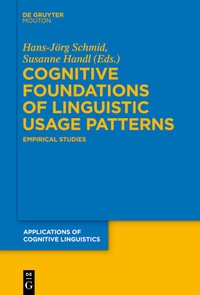
Cognitive Foundations of Linguistic Usage Patterns
Description

The volume presents an up-to-date collection of methodologically sensitive contributions providing mainly enthusiastic, at times also critical support for the cognitive-linguistic enterprise. The book is important for the advancement of cognitive linguistics because the contributions demonstrate the seriousness of its ambitions to develop into a set of testable linguistic approaches. For the same reason, the volume is a contribution to our understanding of language in general, since it puts a promising modern approach on firmer ground. Assets of the book include the wide range of linguistic phenomena studied (individual concepts, fundamental semantic problems like vagueness and polysemy, grammatical issues incl. gender and tense, collocations, constructions and speech acts) and the scope of applied perspectives including lexicographical, computational, developmental and critical discourse ones. The languages investigated are English, German, Dutch, Polish and Italian.
Common to the contributions is the desire to bring together observed patterns of linguistic usage with concepts and models established in cognitive linguistics. In addition, all contributions have an empirical basis and emphasize the need to rely on a sound methodology. The linguistic phenomena investigated span the range from the lexico-conceptual and collocational level to constructions, grammatical categories and functions.
Two complementary perspectives of language and cognition are represented in the volume: In one group, the established methods of psycholinguistic experimentation, quantitative corpus analysis and computational simulation are exploited to demonstrate the viability and to increase the plausibility of cognitive-linguistic thinking. The second group tests well-known cognitive-linguistic approaches like Conceptual Metaphor Theory, the Theory of Idealized Cognitive Models and Construction Grammar against authentic data demonstrating their applicability and explanatory potential. Both groups include contributions reaching beyond the scope of traditional cognitive-linguistic topics, e.g. by taking a critical stance of reductionist cognitive thinking.
The volume is of interest to cognitive linguists, psycholinguists, theoretical linguists, lexicologists, and lexicographers.
More details
Other editions
Additional editions
Persons
Content
2 - Introduction [Seite 11]
3 - Part I: Lexical patterns [Seite 21]
3.1 - A computational model of the ambiguity-vagueness spectrum [Seite 23]
3.2 - Questions of life and death: Denotational boundary disputes [Seite 43]
3.3 - Breakthroughs and disasters: The politics and ethics of metaphor use in the media [Seite 73]
3.4 - Synonyme, lexical fields, and grammatical constructions. A study in usage-based cognitive semantics [Seite 99]
3.5 - Collocation, anchoring, and the mental lexicon - an ontogenetic perspective [Seite 129]
4 - Part II: Grammatical patterns [Seite 159]
4.1 - The mean lean grammar machine meets the human mind: Empirical investigations of the mental status of linguistic rules [Seite 161]
4.2 - Motivating grammatical and conceptual gender agreement in German [Seite 181]
4.3 - Computed or entrenched? The French imparfait de politesse [Seite 205]
4.4 - Valency constructions and clause constructions or how, if at all, valency grammarians might sneeze the foam off the cappuccino [Seite 235]
4.5 - What exactly is the question-assertion distinction based on? An exploration in experimental speech act theory [Seite 267]
5 - Index [Seite 285]
