

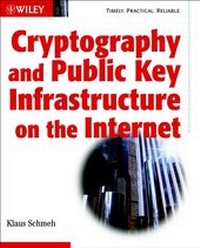
Cryptography and Public Key Infrastructure on the Internet
Published on 4. January 2006
488 pages
978-0-470-86248-3 (ISBN)
Description

A practical guide to Cryptography and its use in the Internet andother communication networks.
This overview takes the reader through basic issues and on to moreadvanced concepts, to cover all levels of interest. Coverageincludes all key mathematical concepts, standardisation,authentication, elliptic curve cryptography, and algorithm modesand protocols (including SSL, TLS, IPSec, SMIME, & PGPprotocols).
* Details what the risks on the internet are and how cryptographycan help
* Includes a chapter on interception which is unique amongstcompeting books in this field
* Explains Public Key Infrastructures (PKIs) - currently the mostimportant issue when using cryptography in a largeorganisation
* Includes up-to-date referencing of people, organisations, booksand Web sites and the latest information about recent acts andstandards affecting encryption practice
* Tackles the practical issues such as the difference between SSLand IPSec, which companies are active on the market and where toget further information
This overview takes the reader through basic issues and on to moreadvanced concepts, to cover all levels of interest. Coverageincludes all key mathematical concepts, standardisation,authentication, elliptic curve cryptography, and algorithm modesand protocols (including SSL, TLS, IPSec, SMIME, & PGPprotocols).
* Details what the risks on the internet are and how cryptographycan help
* Includes a chapter on interception which is unique amongstcompeting books in this field
* Explains Public Key Infrastructures (PKIs) - currently the mostimportant issue when using cryptography in a largeorganisation
* Includes up-to-date referencing of people, organisations, booksand Web sites and the latest information about recent acts andstandards affecting encryption practice
* Tackles the practical issues such as the difference between SSLand IPSec, which companies are active on the market and where toget further information
More details
Other editions
Additional editions
Book
04/2003
1st Edition
Wiley
Unfortunately, price unknown
Article exhausted; check different version
Person
Klaus Schmeh is the author of Cryptography and Public Key Infrastructure on the Internet, published by Wiley.
Content
Foreword by Carl Ellison.
PART 1: WHY CRYPTOGRAPHY ON THE INTERNET?
1. Introduction.
2. What is cryptography and why is it so important?
3. How is it possible to eavesdrop on the Internet?
PART 2: THE PRINCIPLES OF CRYPTOGRAPHY.
4. Symmetric encryption.
5. Modern symmetric encryption algorithms.
6. Asymmetrical encryption.
7. Digital signatures.
8. Cryptographic hash functions.
9. Cryptographic random generators.
PART 3: ADVANCED CRYPTOGRAPHY.
10. Standardisation in cryptography.
11. Block cipher modes of operation and data transformation forasymmetrical algorithms.
12. Cryptographic protocols.
13. Authentication.
14. Cryptosystems based on elliptic curves.
15. Implementating cryptography.
PART 4: PUBLIC KEY INFRASTRUCTURES.
16. Public key infrastructures.
17. How a PKI works.
18. Digital certificates.
19. Certificate servers.
20. Practical aspects of PKI construction.
PART 5: CRYPTO PROTOCOLS FOR THE INTERNET.
21. The Internet and the OSI model.
22. Crypto standards for OSI Layers 1 and 2.
23. IPSec (Layer 3).
24. SSL, TLS and WTLS (Layer 4).
25. Cryptographic standards for the World Wide Web (Layer7).
26. E-mail encryption standards (Layer 7).
27. Internet payment systems (Layer 7).
28. Further Application Layer protocols.
PART 6: MORE ABOUT CRYPTOGRAPHY.
29. Political aspects of cryptography.
30. People who play a role in cryptography.
31. Where to find out more about cryptography.
32. The last chapter.
Appendix A: List of abbreviations.
Appendix B: Bibliography.
Index.
PART 1: WHY CRYPTOGRAPHY ON THE INTERNET?
1. Introduction.
2. What is cryptography and why is it so important?
3. How is it possible to eavesdrop on the Internet?
PART 2: THE PRINCIPLES OF CRYPTOGRAPHY.
4. Symmetric encryption.
5. Modern symmetric encryption algorithms.
6. Asymmetrical encryption.
7. Digital signatures.
8. Cryptographic hash functions.
9. Cryptographic random generators.
PART 3: ADVANCED CRYPTOGRAPHY.
10. Standardisation in cryptography.
11. Block cipher modes of operation and data transformation forasymmetrical algorithms.
12. Cryptographic protocols.
13. Authentication.
14. Cryptosystems based on elliptic curves.
15. Implementating cryptography.
PART 4: PUBLIC KEY INFRASTRUCTURES.
16. Public key infrastructures.
17. How a PKI works.
18. Digital certificates.
19. Certificate servers.
20. Practical aspects of PKI construction.
PART 5: CRYPTO PROTOCOLS FOR THE INTERNET.
21. The Internet and the OSI model.
22. Crypto standards for OSI Layers 1 and 2.
23. IPSec (Layer 3).
24. SSL, TLS and WTLS (Layer 4).
25. Cryptographic standards for the World Wide Web (Layer7).
26. E-mail encryption standards (Layer 7).
27. Internet payment systems (Layer 7).
28. Further Application Layer protocols.
PART 6: MORE ABOUT CRYPTOGRAPHY.
29. Political aspects of cryptography.
30. People who play a role in cryptography.
31. Where to find out more about cryptography.
32. The last chapter.
Appendix A: List of abbreviations.
Appendix B: Bibliography.
Index.
