

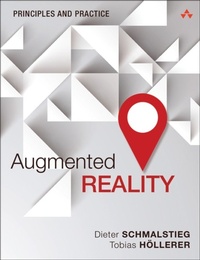
Augmented Reality
Principles and Practice
1st Edition
Published on 1. June 2016
528 pages
978-0-13-315320-0 (ISBN)
Description

Today's Comprehensive and Authoritative Guide to Augmented Reality
By overlaying computer-generated information on the real world, augmented reality (AR) amplifies human perception and cognition in remarkable ways. Working in this fast-growing field requires knowledge of multiple disciplines, including computer vision, computer graphics, and human-computer interaction. Augmented Reality: Principles and Practice integrates all this knowledge into a single-source reference, presenting today's most significant work with scrupulous accuracy. Pioneering researchers Dieter Schmalstieg and Tobias Hoellerer carefully balance principles and practice, illuminating AR from technical, methodological, and user perspectives.
Coverage includes
Displays: head-mounted, handheld, projective, auditory, and haptic
Tracking/sensing, including physical principles, sensor fusion, and real-time computer vision
Calibration/registration, ensuring repeatable, accurate, coherent behavior
Seamless blending of real and virtual objects
Visualization to enhance intuitive understanding
Interaction-from situated browsing to full 3D interaction
Modeling new geometric content
Authoring AR presentations and databases
Architecting AR systems with real-time, multimedia, and distributed elements
This guide is indispensable for anyone interested in AR, including developers, engineers, students, instructors, researchers, and serious hobbyists.
By overlaying computer-generated information on the real world, augmented reality (AR) amplifies human perception and cognition in remarkable ways. Working in this fast-growing field requires knowledge of multiple disciplines, including computer vision, computer graphics, and human-computer interaction. Augmented Reality: Principles and Practice integrates all this knowledge into a single-source reference, presenting today's most significant work with scrupulous accuracy. Pioneering researchers Dieter Schmalstieg and Tobias Hoellerer carefully balance principles and practice, illuminating AR from technical, methodological, and user perspectives.
Coverage includes
Displays: head-mounted, handheld, projective, auditory, and haptic
Tracking/sensing, including physical principles, sensor fusion, and real-time computer vision
Calibration/registration, ensuring repeatable, accurate, coherent behavior
Seamless blending of real and virtual objects
Visualization to enhance intuitive understanding
Interaction-from situated browsing to full 3D interaction
Modeling new geometric content
Authoring AR presentations and databases
Architecting AR systems with real-time, multimedia, and distributed elements
This guide is indispensable for anyone interested in AR, including developers, engineers, students, instructors, researchers, and serious hobbyists.
More details
Series
Language
English
Place of publication
Boston
United States
Publishing group
Pearson Education (US)
Target group
College/higher education
ISBN-13
978-0-13-315320-0 (9780133153200)
Copyright in bibliographic data and cover images is held by Nielsen Book Services Limited or by the publishers or by their respective licensors: all rights reserved.
Schweitzer Classification
Other editions
Additional editions
Dieter Schmalstieg | Tobias Hollerer
Augmented Reality: Principles and Practice
Principles and Practice
Book
06/2016
1st Edition
Addison Wesley
€56.00
Shipment within 10-20 days
Persons
Dieter Schmalstieg is professor and head of the Institute for Computer Graphics and Vision at Graz University of Technology (TUG), Austria. His current research interests are augmented reality, virtual reality, real-time graphics, 3D user interfaces, and visualization. He received Dipl.-Ing. (1993), Dr. techn. (1997) and Habilitation (2001) degrees from Vienna University of Technology. He is author and coauthor of more than two hundred peer-reviewed scientific publications, associate editor of IEEE Transactions on Visualization and Computer Graphics, member of the editorial advisory board of computers and graphics and of Springer Virtual Reality, member of the steering committee of the IEEE International Symposium on Mixed and Augmented Reality, chair of the EUROGRAPHICS working group on Virtual Environments (1999-2010), advisor of the K-Plus Competence Center for Virtual Reality and Visualization in Vienna, and member of the Austrian Academy of Science. In 2002, he received the START career award presented by the Austrian Science Fund. In 2012, he received the IEEE Virtual Reality Technical Achievement Award for seminal contributions to the field of augmented reality. Since 2008, he is also director of the Christian Doppler Laboratory for Handheld Augmented Reality.
Tobias Hoellerer is professor of computer science at the University of California, Santa Barbara, where he leads the Four Eyes Laboratory, conducting research in the four I's of Imaging, Interaction, and Innovative Interfaces. Dr. Hoellerer holds a Diplom in informatics from the Technical University of Berlin, as well as an M.S. and Ph.D. in computer science from Columbia University. He is a recipient of the U.S. National Science Foundation's CAREER award for his work on "Anywhere Augmentation." enabling mobile computer users to place annotations in 3D space wherever they go. In 2013, he was named an ACM Distinguished Scientist. Dr. Hoellerer is author of more than one hundred fifty peer-reviewed journal and conference publications in the areas of augmented and virtual reality, information visualization, 3D displays and interaction, mobile and wearable computing, and social computing. Several of these publications have been selected for best paper or honorable mention awards at such venues as the IEEE International Symposium on Mixed and Augmented Reality (ISMAR), IEEE Virtual Reality (VR), ACM Virtual Reality Software and Technology, ACM User Interface Software and Technology, ACM MobileHCI, IEEE SocialCom, and IEEE CogSIMA. Dr. Hoellerer is an associate editor of IEEE Transactions on Visualization and Computer Graphics. Among his many organizational roles for scientific conferences he served as program chair for IEEE VR 2015, ICAT 2013, IEEE ISMAR 2010 and 2009; as general chair of IEEE ISMAR 2006; and as member of the steering committee of IEEE ISMAR.
Tobias Hoellerer is professor of computer science at the University of California, Santa Barbara, where he leads the Four Eyes Laboratory, conducting research in the four I's of Imaging, Interaction, and Innovative Interfaces. Dr. Hoellerer holds a Diplom in informatics from the Technical University of Berlin, as well as an M.S. and Ph.D. in computer science from Columbia University. He is a recipient of the U.S. National Science Foundation's CAREER award for his work on "Anywhere Augmentation." enabling mobile computer users to place annotations in 3D space wherever they go. In 2013, he was named an ACM Distinguished Scientist. Dr. Hoellerer is author of more than one hundred fifty peer-reviewed journal and conference publications in the areas of augmented and virtual reality, information visualization, 3D displays and interaction, mobile and wearable computing, and social computing. Several of these publications have been selected for best paper or honorable mention awards at such venues as the IEEE International Symposium on Mixed and Augmented Reality (ISMAR), IEEE Virtual Reality (VR), ACM Virtual Reality Software and Technology, ACM User Interface Software and Technology, ACM MobileHCI, IEEE SocialCom, and IEEE CogSIMA. Dr. Hoellerer is an associate editor of IEEE Transactions on Visualization and Computer Graphics. Among his many organizational roles for scientific conferences he served as program chair for IEEE VR 2015, ICAT 2013, IEEE ISMAR 2010 and 2009; as general chair of IEEE ISMAR 2006; and as member of the steering committee of IEEE ISMAR.
Content
Chapter 1: Introduction to Augmented Reality
Chapter 2: Displays
Chapter 3: Tracking
Chapter 4: Computer Vision for Augmented Reality
Chapter 5: Calibration and Registration
Chapter 6: Visual Coherence
Chapter 7: Situated Visualization
Chapter 8: Interaction
Chapter 9: Modeling and Annotation
Chapter 10: Authoring
Chapter 11: Navigation
Chapter 12: Collaboration
Chapter 13: Software Architecture
Chapter 14: The Future
References
Index
Chapter 2: Displays
Chapter 3: Tracking
Chapter 4: Computer Vision for Augmented Reality
Chapter 5: Calibration and Registration
Chapter 6: Visual Coherence
Chapter 7: Situated Visualization
Chapter 8: Interaction
Chapter 9: Modeling and Annotation
Chapter 10: Authoring
Chapter 11: Navigation
Chapter 12: Collaboration
Chapter 13: Software Architecture
Chapter 14: The Future
References
Index
