

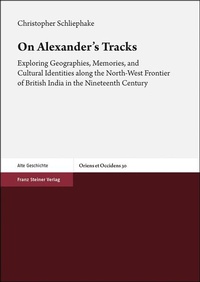
On Alexander's Tracks
Description

How did British officers, geographers, and adventurers use the motif of 'travelling' in Alexander's 'footsteps' during their respective missions in Central Asia? Christopher Schliephake shows how the reception of Alexander the Great became an integral part of imperial self-representation and colonial identity in the nineteenth century. As Schliephake argues, the experiential framework of the exploration and conquest of regions like the Punjab or Afghanistan turned the abstract notion of following in Alexander's 'tracks' into a highly relevant category for negotiating the relationship between the present and the past, Europe and Asia. However, the further the British explorers advanced, they realized that Alexander had already been waiting for them - he came in the guise of Sikander or Iskander and some local indigenous tribes even claimed direct descent from him. The way the writings of the travelers reacted to the cultural confrontation between a 'Western' and an 'Eastern' Alexander will be one of the main themes of this e-book.
More details
Other editions
Additional editions
Person
Content
- Intro
- Acknowledgments
- Table of Contents
- Chapter I Introduction
- 1.1 Alexander the Great and the British Empire: Classical Reception in Context
- 1.2 Travel Writing as a Mode of Classical Reception
- 1.3 The Reception of Alexander between Cultural Memory and Cultural Encounter
- 1.4 Summary of the Chapters
- Chapter II Setting the Stage
- 2.1 Major James Rennell, Geography, and the Mapping of Alexander's Indian Conquest
- 2.2 The Memory of Alexander Between Enlightenment Philosophy and Geopolitics in Napoleonic Times
- 2.3 Diplomatic Missions and the First Explorations Beyond the 'Frontier'
- 2.4 The Next Generation of Trans-Frontier Exploration and the Russian Threat
- Chapter III Romancing Alexander
- 3.1 Afghanistan, Imagination, and the Imitation of Alexander the Great
- 3.2 Up the Indus and Through Afghanistan: Sir Alexander Burnes in the Footsteps of Alexander the Great - The Identities of Places and People
- 3.3 'General' Josiah Harlan's Reception of Alexander the Great: The Macedonian as Political and Personal Model
- 3.4 "The Man Who Would Be King" and the Cultural Imagination of Imperial Aspirations Fashioned on the Reception of Alexander the Great
- Chapter IV The Material Fabrics of Memory and the Possession of the Past
- 4.1 Early Explorers and the Beginnings of Indo-Afghan Archaeology
- 4.2 The Case of Charles Masson
- 4.3 Alexander Cunningham and the Archaeological Survey of India
- 4.4 Sir Aurel Stein on Alexander's Tracks
- 4.5 The Legacy of Colonial Archaeology
- Chapter V Contested Memories and Collective Identities
- 5.1 The Military Aspects of Alexander's Memory along the North-West Frontier
- 5.2 Alexander's Descendants: Colonial Ethnography and the Strange Case of the Kafirs
- 5.3 Thomas Hungerford Holdich, Alexander's Memory, and the Political Geography of Empire
- 5.4 Coming Full Circle: Holdich and the Memory of Frontier Exploration from Alexander to the British Empire
- Chapter VI Epilogue
- List of Figures
- Bibliography
- Ancient Texts (Editions, Commentaries, Translations)
- Primary Sources
- Modern Studies
- Index
