

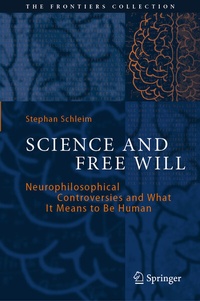
Science and Free Will
Description

Free will is one of the most discussed topics in neuroscience, psychology and philosophy. Many even assume that our view of human nature and our social order are at stake. This book shows that the academic debate is often conducted under misleading assumptions: Practical freedom should not only be explored in quixotic laboratory experiments. Therefore, in the second part of Science and Free Will the problem is related to real decisions in our everyday lives.
But first, important basic knowledge from over 2,500 years of our cultural history is conveyed. Learn how already Socrates rejected the idea that humans are only the sum of their physical parts. The book then shows how the dispute over free will in Christianity almost led to a civil war. From the 18th century onwards, scientifically influenced ideas became increasingly important. Biology, physiology and physics have an extensive say before psychology and brain research take over the topic.
Science and Free Will explains why the endless debate over determinism is not the core of the problem. Well-known physicists such as Max Planck, Albert Einstein and Anton Zeilinger are discussed. The question is not whether our decisions are causally determined, but rather what causes play a role. What this means for the law, science and how we can still be free is discussed in detail at the end.
More details
Other editions
Additional editions
Person
Stephan Schleim has a PhD in cognitive science and is Associate Professor for Theory and History of Psychology at the University of Groningen (Netherlands). Previously, he was Professor for Neurophilosophy at the Ludwig-Maximilians-University Munich. Since 20 years, he informs a wide audience about advances in psychology, psychiatry, and the neurosciences as a science writer and regular commentator in various media.
Content
1. Introduction: Humans as natural or cultural beings.- 2. Philosophical preliminaries to free will.- 3. Max Planck's argument.- 4. Determinism and causality.- 5. Today's physicists on free will.- 6. Free will in biology and neuroscience.- 7. Interim conclusion.- 8. Freedom and responsibility in law and morality.- 9. Scientists are also just humans.- 10. All too human neuro-fallacies.- 11. Psychology: What we can positively say about freedom.- Epilogue and acknowledgements.- A. Max Planck's original essay from 1939: On the nature of free will.- B. Suggestions for further thinking and for teaching.
