

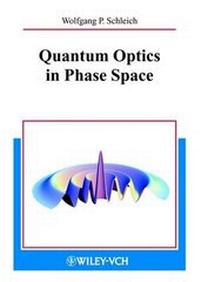
Quantum Optics in Phase Space
1st Edition
Published on 28. February 2011
XX, 696 pages
978-3-527-63500-9 (ISBN)
Description

Quantum Optics in Phase Space provides a concise introduction to the rapidly moving field of quantum optics from the point of view of phase space. Modern in style and didactically skillful, Quantum Optics in Phase Space prepares students for their own research by presenting detailed derivations, many illustrations and a large set of workable problems at the end of each chapter. Often, the theoretical treatments are accompanied by the corresponding experiments. An exhaustive list of references provides a guide to the literature. Quantum Optics in Phase Space also serves advanced researchers as a comprehensive reference book.
Starting with an extensive review of the experiments that define quantum optics and a brief summary of the foundations of quantum mechanics the author Wolfgang P. Schleich illustrates the properties of quantum states with the help of the Wigner phase space distribution function. His description of waves ala WKB connects semi-classical phase space with the Berry phase. These semi-classical techniques provide deeper insight into the timely topics of wave packet dynamics, fractional revivals and the Talbot effect.
Whereas the first half of the book deals with mechanical oscillators such as ions in a trap or atoms in a standing wave the second half addresses problems where the quantization of the radiation field is of importance. Such topics extensively discussed include optical interferometry, the atom-field interaction, quantum state preparation and measurement, entanglement, decoherence, the one-atom maser and atom optics in quantized light fields.
Quantum Optics in Phase Space presents the subject of quantum optics as transparently as possible. Giving wide-ranging references, it enables students to study and solve problems with modern scientific literature. The result is a remarkably concise yet comprehensive and accessible text- and reference book - an inspiring source of information and insight for students, teachers and researchers alike.
Starting with an extensive review of the experiments that define quantum optics and a brief summary of the foundations of quantum mechanics the author Wolfgang P. Schleich illustrates the properties of quantum states with the help of the Wigner phase space distribution function. His description of waves ala WKB connects semi-classical phase space with the Berry phase. These semi-classical techniques provide deeper insight into the timely topics of wave packet dynamics, fractional revivals and the Talbot effect.
Whereas the first half of the book deals with mechanical oscillators such as ions in a trap or atoms in a standing wave the second half addresses problems where the quantization of the radiation field is of importance. Such topics extensively discussed include optical interferometry, the atom-field interaction, quantum state preparation and measurement, entanglement, decoherence, the one-atom maser and atom optics in quantized light fields.
Quantum Optics in Phase Space presents the subject of quantum optics as transparently as possible. Giving wide-ranging references, it enables students to study and solve problems with modern scientific literature. The result is a remarkably concise yet comprehensive and accessible text- and reference book - an inspiring source of information and insight for students, teachers and researchers alike.
Reviews / Votes
"Quantum Optics in Phase Space" has been successful in preparing students and researchers for their quest of unravelling the mysteries of nature. Niels Bohr used to say that if you are not confused by quantum mechanics, then you really do not understand it. I guess same applies for quantum optics. This book first introduces you to the stunning results and then explains them in a crystal clear way. All encompassing derivations with the challenging set of problems brings out the best from within the reader. Each chapter and element hasbeen scrutinized ensuring clarity and accuracy.
The first experiments that led to the development of quantum optics as a subject have been described in fullest detail. The book tries to explain the entanglement of matter and waves by likening mechanical oscillators to standing waves. Classical experiments in optics have been re-explained with the help of quantum optics. Atom-field interaction has also been discussed in detail.
The explanation is based on semi-classical ideas which I believe is the best way because ultra-modern explanation can become very difficult to understand for those who are reading the subject for the first time.
I believe that "Quantum Optics in Phase Space" will prepare students for future endeavours by contributing to the enhancement of quantum." A reader from Atlanta, GA, USA for Amazon.com
"A new contribution to physics travel literature, and it deserves praise as a guidebook? Suitable for almost any physicist... Is there anything for the student that should be here that is not? I doubt it. My strong recommendation is to sign on and enjoy the tour." Physics Today, August 2002
"...for a researcher in quantum optics it would be invaluable: a comprehensive textbook for the beginner, and an excellent reference volume for the more experienced."
T.Harker, University College London, for LTSN Physical Sciences
"The book is generally very carefully written, with a very good selection of challendging problems at the end of each chapter. Mathematical details are elaborated in about a hundred pages appendices. ... for a researcher in quantum optics it would be invaluable."
Optik 115, No 9 (2004)
More details
Other editions
Additional editions
Wolfgang P. Schleich
Quantum Optics in Phase Space
Book
02/2001
1st Edition
Wiley-VCH
€169.00
Shipment within 5-7 days
Person
- Recipient of the Max Planck Research Award 2002
Content
What is Quantum Optics?
Ante
The Wigner Function
Quantum States in Phase Space
Waves á la WKB
WKB Wave Functions and Berry's Phase
Interference in Phase Space
Applications of Interference in Phase Space
Wave Packet Dynamics
Quantization of the Radiation Field
Quantum States of the Radiation Field
Phase Space Functions
Optical Interferometry
Atom-Field Interaction
Dynamics of Jaynes-Cummings-Paul Model
State Preparation and Entanglement
The Paul Trap
Damping and Amplification
Atom Optics in Quantized Light Fields
Wigner Functions in Atom Optics
Appendix
Time Dependent Operators - Derivation of Equations Determining the Moyal Function - Energy Wave Functions of Harmonic Oscillator - Method of Stationary Phase - Radial Equation - Airy Function - Asymptotic Expansion of the Poisson Distribution - Area of Overlap - P-Distributions - Homodyne Detection Kernel - Effective Hamiltonian - Spontaneous Emission - A Model for the Square Root of a Delta Function - Bessel Functions
Ante
The Wigner Function
Quantum States in Phase Space
Waves á la WKB
WKB Wave Functions and Berry's Phase
Interference in Phase Space
Applications of Interference in Phase Space
Wave Packet Dynamics
Quantization of the Radiation Field
Quantum States of the Radiation Field
Phase Space Functions
Optical Interferometry
Atom-Field Interaction
Dynamics of Jaynes-Cummings-Paul Model
State Preparation and Entanglement
The Paul Trap
Damping and Amplification
Atom Optics in Quantized Light Fields
Wigner Functions in Atom Optics
Appendix
Time Dependent Operators - Derivation of Equations Determining the Moyal Function - Energy Wave Functions of Harmonic Oscillator - Method of Stationary Phase - Radial Equation - Airy Function - Asymptotic Expansion of the Poisson Distribution - Area of Overlap - P-Distributions - Homodyne Detection Kernel - Effective Hamiltonian - Spontaneous Emission - A Model for the Square Root of a Delta Function - Bessel Functions
