

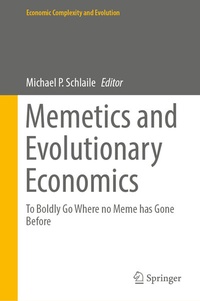
Memetics and Evolutionary Economics
Description

This book explores the question of whether and how meme theory or "memetics" can be fruitfully utilized in evolutionary economics and proposes an approach known as "economemetics" which is a combination of meme theory and complexity theory that has the potential to combat the fragmentation of evolutionary economics while re-connecting the field with cultural evolutionary theory. By studying the intersection of cultural and economic evolution, complexity economics, computational economics, and network science, the authors establish a connection between memetics and evolutionary economics at different levels of investigation.
The book first demonstrates how a memetic approach to economic evolution can help to reveal links and build bridges between different but complementary concepts in evolutionary economics. Secondly, it shows how organizational memetics can help to capture the complexity of organizational culture using meme mapping. Thirdly, it presents an agent-based simulation model of knowledge diffusion and assimilation in innovation networks from a memetic perspective. The authors then use agent-based modeling and social network analysis to evaluate the diffusion pattern of the Ice Bucket Challenge as an example of a "viral meme." Lastly, the book discusses the central issues of agency, creativity, and normativity in the context of economemetics and suggests promising avenues for further research.
More details
Other editions
Additional editions
Person
Michael P. Schlaile (ORCID 0000-0002-9269-0306) has been a Research Associate at the Department of Innovation Economics at the University of Hohenheim (Germany) since November 2016. From 2012 to 2016, Michael was a member of the scientific staff at the Department of Business Ethics. In early 2018, he also became an external Fellow at the Center for Applied Cultural Evolution in Eugene, OR, USA. Michael's research focuses on responsibility and the interplay of cultural and economic evolution in complex socio-economic systems. He has published in various journals, such as Cognitive Systems Research, the International Journal of Computational Economics and Econometrics , Journal of Business Ethics , Journal of Business Research , Journal of Evolutionary Economics , Philosophy of Management , and Sustainability .
Content
Editorial Introduction: We are the Memes, Resistance is Futile.- A Brief Overview of Memetics and Some Essential Context.- It's more than Complicated! Using Organizational Memetics to Capture the Complexity of Organizational Culture.- A Case for Economemetics?.- It's a Match! Simulating Compatibility-based Learning in a Network of Networks.- Viral Ice Buckets.- General Discussion: Economemetics and Agency, Creativity, and Normativity.- Conclusion and the Way(s) Forward.
