

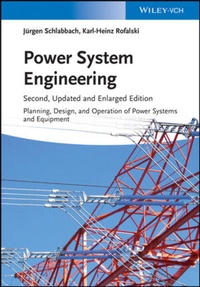
Power System Engineering
Planning, Design, and Operation of Power Systems and Equipment
2nd Edition
Published on 4. April 2014
400 pages
978-3-527-67905-8 (ISBN)
Description

This book, and in particular the new contents of this second edition, provides a systematic presentation of the main concepts referring to the electrical systems planning and operation, with the particularly interesting inclusion of many practical data, frequent reference to the IEC standards, and a detached view on the main approaches used in practice. The selection of the material makes it possible for the operator to retrieve in the book both concepts and indications on the applications, without needing to take a look at many manufacturer?s data or huge handbooks.
The authors focus on the findings that have already reached the level of practical applications and have been incorporated in the evolving legislation and international (ICE) standards. This leads to an essentially practical book containing key references for the current applications, with up-to-date information.
Describing in detail how electrical power systems are planned and designed, this monograph illustrates the required structures of systems, substations and equipment using international standards and latest computer methods. The authors discuss both the advantages and disadvantages of the different arrangements within switchyards and of the topologies of the power systems, describing methods to determine the main design parameters of cables, overhead lines, and transformers needed to realize the supply task, as well as the influence of environmental conditions on the design and the permissible loading of the equipment. Additionally, general requirements for protection schemes and the main schemes related to the various protection tasks are given.
The new edition lays a special emphasis on renewable energy sources. A completely new chapter is devoted to the power connection of distributed generation by e.g. solar plants or wind turbines, and reflects the current state of the art. All the electrical system operators may benefit of a systematic illustration of the new concepts concerning the grid connection of local generation sources, most of which come from renewable energy sources.
Next to professional operators and engineers willing to enhance their knowledge in the electrical systems field, also electricity distributors, energy service companies and ICT companies active in the smart grids area might be interested in using this book as a reference. Master students at university will benefit of this literature in order to get a background in the electrical systems field.
The authors focus on the findings that have already reached the level of practical applications and have been incorporated in the evolving legislation and international (ICE) standards. This leads to an essentially practical book containing key references for the current applications, with up-to-date information.
Describing in detail how electrical power systems are planned and designed, this monograph illustrates the required structures of systems, substations and equipment using international standards and latest computer methods. The authors discuss both the advantages and disadvantages of the different arrangements within switchyards and of the topologies of the power systems, describing methods to determine the main design parameters of cables, overhead lines, and transformers needed to realize the supply task, as well as the influence of environmental conditions on the design and the permissible loading of the equipment. Additionally, general requirements for protection schemes and the main schemes related to the various protection tasks are given.
The new edition lays a special emphasis on renewable energy sources. A completely new chapter is devoted to the power connection of distributed generation by e.g. solar plants or wind turbines, and reflects the current state of the art. All the electrical system operators may benefit of a systematic illustration of the new concepts concerning the grid connection of local generation sources, most of which come from renewable energy sources.
Next to professional operators and engineers willing to enhance their knowledge in the electrical systems field, also electricity distributors, energy service companies and ICT companies active in the smart grids area might be interested in using this book as a reference. Master students at university will benefit of this literature in order to get a background in the electrical systems field.
More details
Other editions
Additional editions
Juergen Schlabbach | Karl-Heinz Rofalski
Power System Engineering
Planning, Design, and Operation of Power Systems and Equipment
Book
06/2014
2nd Edition
Wiley-VCH
€142.00
Shipment within 5-7 days
Juergen Schlabbach | Karl-Heinz Rofalski
Power System Engineering 2e - Planning, Design and, Operation of Power Systems and Equipment
Software
04/2014
Wiley-VCH
€173.48
No shipping information available
Previous edition
Juergen Schlabbach | Karl-Heinz Rofalski
Power System Engineering
Planning, Design, and Operation of Power Systems and Equipment
E-Book
09/2008
1st Edition
Wiley-VCH
€147.99
Available for download
Persons
Juergen Schlabbach holds a professorship in power system engineering and renewable energies at the University of Applied Sciences in Bielefeld, Germany. He studied at the Technical University of Darmstadt, where he received his Ph.D. on the topic of digital protection of power systems in 1982. For ten years, he worked in a consulting firm in the field of power system planning, disturbance analysis and design of FACTS. During several years in Arabian and Asian countries he advised local utilities in design, planning and operation of power systems and in organizational matters. Professor Schlabbach's areas of expertise are power system planning, grid connection of renewable energy, EMC and operational training. He also works as independent consulting engineer.
Karl-Heinz Rofalski has been working for more than thirty years as consulting engineer in a world-wide operating German consulting firm in the field of power transmission and distribution. He held the position of project director and manager and gained special knowledge and experience in network planning, design, procedures of tendering and contracting, project monitoring, overall project management in many power projects including assignments in various countries in Africa, the Arab regions and South-East Asia. After graduating from the engineering academy in Kassel/Germany he worked for AEG, one of the manufacturers of electrical equipment, for eight years, and became acquainted with electrical engineering standards and technology. Since 2001 he is active as freelance engineer and independent consultant.
Karl-Heinz Rofalski has been working for more than thirty years as consulting engineer in a world-wide operating German consulting firm in the field of power transmission and distribution. He held the position of project director and manager and gained special knowledge and experience in network planning, design, procedures of tendering and contracting, project monitoring, overall project management in many power projects including assignments in various countries in Africa, the Arab regions and South-East Asia. After graduating from the engineering academy in Kassel/Germany he worked for AEG, one of the manufacturers of electrical equipment, for eight years, and became acquainted with electrical engineering standards and technology. Since 2001 he is active as freelance engineer and independent consultant.
Content
TABLE OF CONTENT
1. Introduction
2. Power System Load
3. Planning Principles and Planning Criteria
4. Economic Consideration and Loss Evaluation
5. Topologies of Electrical Power Systems
6. Arrangement in Gridstations and Substations
7. Transformers
8. Cable Systems
9. Overhead Lines
10. Flexible AC Transmission Systems (FACTS)
11. Load-Flow and Short-Circuit Current Calculation
12. Connection of "Green-Energy" Generation to Power Systems
13. Protection of Equipment and Power System Installations
14. Overvoltages and Insulation Coordination
15. Influence of Neutral Earthing on Single-Phase Short-Circuit Currents
16. Tendering and Contracting
1. Introduction
2. Power System Load
3. Planning Principles and Planning Criteria
4. Economic Consideration and Loss Evaluation
5. Topologies of Electrical Power Systems
6. Arrangement in Gridstations and Substations
7. Transformers
8. Cable Systems
9. Overhead Lines
10. Flexible AC Transmission Systems (FACTS)
11. Load-Flow and Short-Circuit Current Calculation
12. Connection of "Green-Energy" Generation to Power Systems
13. Protection of Equipment and Power System Installations
14. Overvoltages and Insulation Coordination
15. Influence of Neutral Earthing on Single-Phase Short-Circuit Currents
16. Tendering and Contracting
