

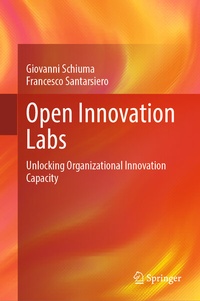
Open Innovation Labs
Description

This book allows readers to discover the great potential of Open Innovation Labs (OILs). The book offers a practical and in-depth exploration of OILs, guiding readers through their establishment and management. Uniting academic research and actionable insights, this book equips professionals and researchers with the tools to unlock their organization's innovation potential.
The book looks into the evolution of innovation spaces, from historic inventors' workshops to modern OILs, and uncovers their impact on organizational transformation. It explores the crucial role of OILs in fostering a culture of continuous innovation and driving collaboration with diverse stakeholders. Readers will benefit from a roadmap to help create, nurture, and optimize OILs to suit their unique organizational context.
With its focus on practicality and applicability, this book is a key resource for helping readers build, manage, and succeed with OILs. From business leaders to educators and policymakers, it empowers readers to shape a thriving ecosystem of innovation, leading organizations toward a future of sustainable growth and positive change.
More details
Other editions
Additional editions
Persons
As co-authors and experts in Innovation Management and Knowledge Management, our collaborative work and collective experience highlight the significance of the book "Open Innovation Labs: Unlocking Organizational Innovation Capacity" for readers.
Combining our expertise, we have conducted extensive research and action-oriented studies, including interviews, on-site visits, and case analyses of numerous international innovation labs. Our joint efforts have allowed us to gain comprehensive insights into the transformative power of OILs and their impact on organizational innovation capacity.
Throughout our careers, we have developed and refined management models, frameworks, and practical toolboxes to implement and manage OILs effectively. These models have been tested in real-world settings, resulting in improved collaboration, accelerated innovation, and enhanced organizational value creation.
By co-authoring this book, we aim to present a cohesive and holistic perspective on the subject matter. Our collaborative work reinforces the book's practical relevance and applicability, synthesizing multiple perspectives, experiences, and case studies from various innovation labs worldwide.
The book addresses the needs of a diverse audience, including scholars, researchers, educators, policymakers, and professionals in different industries. Our multidimensional approach allows us to connect theoretical insights with real-world practices, making the content accessible and beneficial to readers from various backgrounds and fields.
The book offers the reader a unique opportunity to leverage the knowledge of OILs. It equips the readers with the knowledge and tools they need to harness the full potential of OILs to enhance their organization's innovation capacity and stay ahead in the dynamic world of innovation. It provides actionable strategies, evidence-based insights, and practical guidance to empower organizations to enhance their innovation capacity and foster a culture of collaboration and co-creation.
Content
Introduction.- The Evolution of Innovation Spaces From Inventors Workshops to Open Innovation Labs.- Why You Need an Open Innovation Lab.- What Is an Open Innovation Lab.- The Mindset of an Open Innovation Lab Innovation Paradigms and Inspiring Principles.- Key Resources Time Space and Facilitation.- Tools and Technologies of an Open Innovation Lab.- Categories of Open Innovation Labs.- Open Innovation Labs Management Model.- Open Innovation Labs for Innovation Capacity Development.- Open Innovation Labs in Practice.- Mistakes to Avoid and Critical Dimensions of Success.- Roadmap for Creating and Developing Open Innovation Labs.- The Future: Challenges and Opportunities.- References.
