

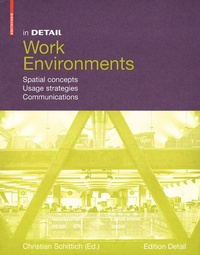
In Detail, Work Environments
Description

Die Anforderungen an unsere Arbeitsräume haben sich in jüngster Zeit grundlegend verändert: Wechselnde Belegungsdichte und Raumnutzung fordern in gleicher Weise Flexibilität der Raumstrukturen wie neue Berufe und innovative Arbeitsmethoden. Digitalisierung unserer Arbeitsmedien beeinflusst dabei ebenso die Planung der Arbeitsräume wie neue Materialien und Gebäudetechnologien. Bei aller Fexibilität und Technik steht der Mensch aber im Mittelpunkt - wie lassen sich also die vielschichtigen Konzepte hinsichtlich Raumklima, Licht, Akustik und auch Ergonomie mit unterschiedlich nutzbaren Raumstrukturen in Einklang bringen?
Entsprechend dem typologischen Ansatz der Reihe stellt dieser Im Detail-Titel die verschiedenen Arbeitswelten anhand deren Nutzung vor. Im Zentrum steht dabei immer das gelungene Zusammenspiel zwischen technischen Standards, organisatorischen Strukturen und den menschlichen Ansprüchen.
More details
Other editions
Additional editions
Person
Content
- Intro
- New work environments
- The world of office work in flux - usage strategies and freedom of choice
- Typology of research buildings
- Office design and knowledge economy
- "Success factor office" - myth or key to sustainable business success?
- Ergonomic workplace design
- Acoustic design in open-plan offices
- Planning of integrated daylight and artificial lighting for the work environment
- User satisfaction as a measure of workplace quality in the office
- Projects
- Office building of Claus en Kaan Architecten in Amsterdam
- Volksbank in Salzburg
- Aachen Münchener head office in Aachen kadawittfeldarchitektur
- Smart working concept for Credit Suisse in Zurich Camenzind Evolution
- Factory building in Rehau
- group8 architects' office in Geneva
- Unilever headquarters in Hamburg
- Office building on the Novartis campus in Basel
- Rambøll head office in Copenhagen
- The Yellow Building in London
- Rena Lange headquarters in Munich
- Nya Nordiska headquarters in Dannenberg
- voestalpine Steel Service Center in Linz
- Office and warehouse of the Sohm company in Alberschwende
- Depot of the Municipality Poing
- Handicraft estate in Valbonne
- Sedus Stoll research and development centre in Dogern
- Trumpf development centre in Ditzingen
- "Projekthaus" of the BMW Group in Munich
- Special laboratories at the University of Leipzig
- Fraunhofer Institute in Ilmenau
- Courtyard at the Czech Technical University of Prague
- Rolex Learning Center in Lausanne
- Project Data - Architects
- Authors
- Illustration Credits
