

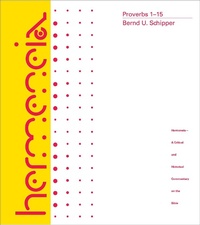
Proverbs 1-15
Published on 5. November 2019
624 pages
978-1-5064-6381-0 (ISBN)
Description

The book of Proverbs is more than the sum of its parts. Even if some individual proverbs and collections could be older, the overall composition stems from the late Persian or early Hellenistic period. In its present form, the book of Proverbs introduces the scribal student to the foundations of sapiential knowledge and its critical reflection. By discussing different worldviews and contrasting concepts on the relationship between God, the world, and humanity, the book of Proverbs paves the way to both the critical wisdom of Job and Ecclesiastes and the masterful combination of Wisdom and Torah in Sirach.
Scholarly research has long situated the book of Proverbs within ancient Near Eastern literature but declared it to be something "alien" within the Hebrew Bible. In contrast to such a position, the present commentary interprets the book of Proverbs against the background of both ancient Near Eastern literature and the literature of the Hebrew Bible. One aim of the commentary is to discuss new ancient Near Eastern parallels to the book of Proverbs, with a special focus on Egyptian wisdom literature, including Demotic texts from the sixth to fourth centuries BCE.
An equally important aim of this commentary is a detailed exegesis of Proverbs 1-15 as well as an analysis of the overarching strategy of the book of Proverbs as a whole. Taking the prologue of the book in Prov 1:1-7 as a hermeneutical key, the book of Proverbs turns out to be a masterful composition addressing both the beginner and the advanced sage. With its allusions to other biblical texts, including the book of Deuteronomy, the Psalms and the Prophets, the book of Proverbs can be connected to forms of scribal exegesis in Second Temple literature. By using the same scribal techniques as other literati of his time, the scribal sage responsible for some parts of the book as well as its final compilation seeks to provide deeper insight into the complex world of scribal knowledge and sapiential thought.
Scholarly research has long situated the book of Proverbs within ancient Near Eastern literature but declared it to be something "alien" within the Hebrew Bible. In contrast to such a position, the present commentary interprets the book of Proverbs against the background of both ancient Near Eastern literature and the literature of the Hebrew Bible. One aim of the commentary is to discuss new ancient Near Eastern parallels to the book of Proverbs, with a special focus on Egyptian wisdom literature, including Demotic texts from the sixth to fourth centuries BCE.
An equally important aim of this commentary is a detailed exegesis of Proverbs 1-15 as well as an analysis of the overarching strategy of the book of Proverbs as a whole. Taking the prologue of the book in Prov 1:1-7 as a hermeneutical key, the book of Proverbs turns out to be a masterful composition addressing both the beginner and the advanced sage. With its allusions to other biblical texts, including the book of Deuteronomy, the Psalms and the Prophets, the book of Proverbs can be connected to forms of scribal exegesis in Second Temple literature. By using the same scribal techniques as other literati of his time, the scribal sage responsible for some parts of the book as well as its final compilation seeks to provide deeper insight into the complex world of scribal knowledge and sapiential thought.
More details
Other editions
Additional editions
Schipper, Bernd U.
Proverbs 1-15
Book
11/2019
Fortress Press,U.S.
€59.50
Article not available at the moment
Person
By Bernd U. Schipper
Content
- Front Cover
- Title Page
- Copyright
- Contents
- The Author
- Foreword
- Preface
- Reference Codes
- General Introduction
- The Composition of Proverbs 1-9
- 1:1-7 The Gateway to the Book of Proverbs: Wisdom for Beginners and the Advanced
- 1:8-19 The False Path: Evildoers and Their Deceptive Speech
- 1:20-33 Personified Wisdom as the Only Valid Form of Instruction
- 2:1-22 The "Table of Contents" to the Instructions
- 3:1-12 Yhwh-Wisdom: A Theological Foundation
- 3:13-20 On Personified Wisdom and Yhwh, the Creator
- 3:21-35 Yhwh-Wisdom as Imperative Instruction
- 4:1-9 Wisdom as Educative Knowledge: An Instruction for Multiple Generations
- 4:10-19 The Two Ways: The Path of the Righteous and the Wicked
- 4:20-27 A Sapiential Teaching on the Body
- 5:1-23 The "Strange Woman" and the Wrong Way
- 6:1-19 A Sapiential Interlude on Different Types of People
- 6:20-35 The "Strange Woman" and Torah Wisdom
- 7:1-27 The "Strange Woman": A Case Study
- 8:1-36 Personified Wisdom between God and Humankind
- 9:1-18 Lady Wisdom or Dame Folly? A Decision between Life and Death
- Introduction to Proverbs 10-22
- 10:1-32 An Introduction to "Discursive Wisdom"
- 11:1-31 The Individual and the Social Dimensions of Sapiential Knowledge
- 12:1-28 The Sapiential Dichotomy: The Righteous and the Wicked
- 13:1-25 A Sapiential Instruction in the Garb of Proverbial Wisdom
- 14:1-35 The Limits of Human Understanding: A Critical Perspective
- 15:1-33 From Experiential Wisdom to Divine Wisdom
- Bibliography
- Indexes
- Designer's Notes
- Bibliography
- Indexes
- Back Cover
