

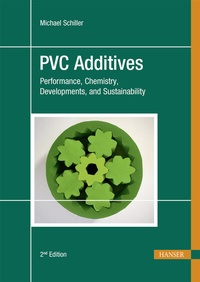
PVC Additives
Performance, Chemistry, Developments, and Sustainability
2nd Edition
Published on 11. April 2022
499 pages
978-1-56990-872-3 (ISBN)
Description

PVC differs in its stabilization compared to other commodity plastics. Various metal compounds are suitable for the stabilization of PVC: lead, tin, calcium, magnesium, zinc, rare earths, and also almost-metal-free systems. These differences are described in the introductory part of this book, with their advantages, possibilities, and problems, from the perspective of the chemist but made understandable for salespeople and technicians.
Numerous tables and figures are included, providing structures and physico-chemical data. A special section for beginners is dedicated to guiding formulations and test methods. A relatively short section deals with development trends in Europe. Sustainability is a major theme, and it is demonstrated that PVC has a strong potential to develop into a fully sustainable material.
Another section deals with the everyday problems in the processing of PVC, such as the formation of specks, photo-effects, and plate-out. Plate-out is a common problem in the processing of PVC but only relatively few publications cover it. The causes, influencing factors, and mechanisms are still poorly understood. This section, unique in the literature, provides assistance in the selection and dosage of raw materials to PVC processor, based on the influencing factors during processing.
Included in this 2nd edition is a significant new section on bio-based platicizers, as well as many other updates, additions, and improvements, such as new test methods and guide formulations, coverage of chemical blowing agents and antistatic agents, and much more.
Reviews / Votes
"The author, Michael Schiller, has advanced degrees in organic chemistry and photo chemistry, and more then 20 years leading R&D at pvc manufacturers. His passion for pvc, as well as his humor, shine through the text. [...] The second edition includes a new section on plasticizers based on renewable resources. [...] Although written from a chemist's perspective the text is accessible for anyone in the pvc industry who needs to be knowledgable about these subjects. The book is thus useful to read as a primer or to have a reference when formulating pvc compounds or troubleshooting problems in processing or applications." Jennifer Markarian, Plastics Engineering, January, 2023 "Dieses Buch bietet eine umfassende Darstellung der Stabilisatorsysteme und anderer Additive für PVC." Kunststoffe, Juni 2015 "Das Buch ist leicht verständlich geschrieben, mit der Absicht das Thema nicht nur fortgeschrittenen Chemikern und Kunststofftechnikern, sondern auch Einsteigern nahe zu bringen." GAK Gummi - Fasern - Kunststoffe, Juni 2015More details
Other editions
Additional editions
Book
04/2022
2nd Edition
Hanser Publications
€199.99
Available immediately
Person
Author
Dr. Michael Schiller is founder and owner of HMS Concept e.U., a consultancy company for chemical, environmental, and plastic technology in Arnoldstein/Austria. He was previously head of the Innovation and Sustainability Center at Akdeniz Kimya and Managing Director of Akdeniz Kimya, Austria. Before that, he was R&D Manager and Head of Group R&D at Chemson AG, and has worked in the PVC industry since 1992.
He is a well-known author, editor, and lecturer in the field of PVC and its additives, and is co-volume editor of the Plastics Additives Handbook, 6th edition.
ISNI:
ISNI:
Content
- Intro
- Preface
- About the Author
- Contents
- 1 PVC Stabilizers
- 1.1 The Production of Polyvinyl Chloride (PVC)
- 1.2 Thermal Degradation of PVC
- 1.3 One-Packs
- 1.4 Heat Stabilizers for PVC
- 1.4.1 Metal-Free Base Stabilizers
- 1.4.2 Metal Soaps as Base Stabilizers
- 1.4.3 Tin Stabilizers
- 1.4.4 Lead Stabilizers
- 1.4.5 Rare Earth Stabilizers
- 1.4.6 Antimony and Bismuth Stabilizers
- 1.5 Costabilizers for PVC
- 1.5.1 Inorganic Costabilizers
- 1.5.2 Antioxidants
- 1.5.3 ß-Diketones and Derivatives
- 1.5.4 Epoxy Compounds
- 1.5.5 Organic Phosphites
- 1.5.6 Polyols
- 1.5.7 Perchlorates
- 1.6 Guide Formulations
- 1.6.1 Additives for PVC Products in Contact with Drinking Water and Foodstuffs
- 1.6.2 Individual Guide Formulations
- 1.6.2.1 Guide Formulations for Pipes
- 1.6.2.2 Guide Formulations for Profiles
- 1.6.2.3 Guide Formulations for Sheets
- 1.6.2.4 Guide Formulations for Rigid Films
- 1.6.2.5 Guide Formulations for Cables
- 1.6.2.6 Guide Formulations for Flexible PVC Applications
- 1.6.2.7 Guide Formulations for Plastisol Applications
- 1.7 Test Methods
- 1.7.1 Mixing
- 1.7.2 Dispersibility
- 1.7.3 Production of Rolled Sheets
- 1.7.4 Rheology
- 1.7.5 Degree of Gelation
- 1.7.6 Softening Temperature
- 1.7.7 Thermostability
- 1.7.7.1 Static Thermostability
- 1.7.7.2 Dynamic Thermostability
- 1.7.8 Light Stability
- 1.7.9 Color
- 1.7.10 Gloss
- 1.7.11 Electrical Volume Resistance, Surface Resistance, and Capacitance
- 1.7.12 Fogging
- 1.7.13 Plate-Out
- 1.7.14 Shore Hardness
- 1.7.15 Impact Strength
- 1.7.16 Elongation at Break and Ultimate Tensile Strength
- 1.7.17 Pinking Test
- 1.7.18 Dry Blend Flow
- 1.7.19 LOI
- 1.8 Technical Problems with PVC Processing and Suggestions for Solutions
- 1.8.1 Plate-Out
- 1.8.2 Photo Effects
- 1.8.3 Extrusion Troubleshooting Guide
- 1.9 Stabilizer Producers
- 2 Additional PVC Additives
- 2.1 Lubricants
- 2.1.1 Introduction
- 2.1.2 Lubricants: Chemistry and Mechanisms of Action
- 2.1.3 Methods to Characterize and Test Lubricants
- 2.1.4 Lubricant Producers
- 2.2 Functional Fillers
- 2.2.1 Introduction
- 2.2.2 Fillers: Chemistry and Effects
- 2.2.3 Methods to Characterize and Test Functional Fillers
- 2.2.4 Filler Producers
- 2.3 Plasticizers
- 2.3.1 Introduction
- 2.3.2 Plasticizers: Chemistry and Mechanisms of Action
- 2.3.3 Bio-Based Plasticizers
- 2.3.3.1 Introduction
- 2.3.3.2 Drivers for the Development of Bio-Based Chemicals
- 2.3.3.3 Bio-Based Content and Labeling
- 2.3.3.4 Renewable Feedstocks for Bio-Based Plasticizers
- 2.3.3.5 Compositions of Bio-Based Plasticizers
- 2.3.4 Bio-Attributed Plasticizers
- 2.3.5 Methods to Characterize and Test Plasticizers
- 2.3.6 Plasticizer Producers
- 2.4 Titanium Dioxide
- 2.4.1 Introduction
- 2.4.2 Titanium Dioxide: Chemistry and Mechanisms of Action
- 2.4.3 Methods to Characterize and Test Titanium Dioxides
- 2.4.4 Titanium Dioxide Producers
- 2.5 Processing Aids and Impact Modifiers
- 2.5.1 Introduction
- 2.5.2 The Chemistry and Effects of Processing Aids and Impact Modifiers
- 2.5.2.1 Processing Aids or Flow Modifiers
- 2.5.2.2 Impact Modifiers
- 2.5.3 Methods to Characterize and Test Processing Aids and Impact Modifiers
- 2.5.3.1 Flow Modifiers and Processing Aids
- 2.5.3.2 Impact Modifiers
- 2.5.4 Producers of Processing Aids and Impact Modifiers
- 2.6 Chemical Blowing Agents
- 2.7 Antistatics
- 3 Uncharted Territory in PVC Processing: Plate-Out
- 3.1 Literature Review of Plate-Out
- 3.2 Plate-Out in the Venting Unit
- 3.3 Plate-Out in the Tooling and Adapter
- 3.3.1 Typical Compositions of Plate-Out from the Tooling
- 3.3.2 Laboratory Experiments
- 3.3.2.1 Introduction
- 3.3.2.2 The Influence of Moisture
- 3.3.2.3 The Influence of the Mixing Process
- 3.3.2.4 The Influence of Tooling Quality
- 3.3.2.5 The Influences of Mass Temperature, Mass Pressure and Extrusion Torque, Chalk, Titanium Dioxide, and Modifiers
- 3.3.2.6 The Influence of Lubricants and Metal Soaps
- 3.3.3 Summary for Plate-Out in Tooling and Adapter
- 3.4 Plate-Out in the Calibration
- 3.4.1 Typical Compositions of Calibration Plate-Out
- 3.4.2 Possible Mechanisms for the Formation of Plate-Out in the Calibration
- 3.4.3 Investigations of Plate-Out Formation in the Calibration
- 3.5 Troubleshooting Guide for the Prevention of Plate-Out
- 4 Uncharted Territory in the Use of PVC Products: Photo Effects
- 4.1 Literature Review of Photochemical Degradation of PVC Products
- 4.1.1 Photochemical Degradation of PVC
- 4.1.2 Degradation of PVC Phthalate Plasticizers during Weathering
- 4.2 Photobluing
- 4.2.1 Fundamental Experiments
- 4.2.2 Results and Discussion
- 4.2.2.1 Reproducibility and the Comparison of Xeno Test and Outdoor Weathering
- 4.2.2.2 Influence of the PVC Stabilizer
- 4.2.2.3 Influence of the Stabilizer Producer
- 4.2.2.4 Influence of PVC, Chalk, and the Processing Conditions
- 4.2.2.5 Influence of Modifiers and White Pigment
- 4.2.2.6 Influence of the Lattice Structure of Titanium Dioxide
- 4.2.2.7 Influence of the Titanium Dioxide Coating
- 4.2.2.8 Influence of Titanium Dioxide Levels
- 4.2.2.9 Influence of Oxygen
- 4.2.3 Conclusions and Summary for Photobluing
- 4.2.4 Outlook
- 4.3 Photopinking
- 4.4 Photograying
- 4.4.1 True Photograying
- 4.4.2 Apparent Photograying
- 4.5 Environmental Influences on the Weathering of Plastic Windows
- 4.5.1 Introduction
- 4.5.2 Rust Film
- 4.5.3 Soot
- 4.5.4 Pollen
- 4.5.5 Simulation of Environmental Effects
- 4.5.5.1 The Samples
- 4.5.5.2 A Simulation Method: The Bandol Wheel
- 4.5.5.3 Irradiation Trials without Contaminants
- 4.5.5.4 Irradiation Trials with Rust Film WJ 364 as Contaminant
- 4.5.5.5 Irradiation Trials with Soot WJ 365 as Contaminant
- 4.5.5.6 Irradiation Trials with Pollen as Contaminant
- 4.5.5.7 Summary of Bandol Wheel Experiments and Conclusions
- 4.5.6 Investigations by Xeno Test
- 4.5.7 Restoration
- 4.5.8 What Has Changed in Window Profiles Extrusion from 1985 to 2005: A Review
- 4.6 Chalk as Filler in u-PVC Products: New Insights into Influences on Weathering Behavior
- 4.6.1 Formation of Calcium Oxalate
- 4.6.1.1 Calcium Oxalate and Oxalic Acid: Influence on Artificial Weathering
- 4.6.1.2 Calcium Oxalate: A Product Resulting from Weathering of Plastic Window Frames?
- 4.6.1.3 Summary of Findings Regarding Oxalate Formation
- 4.6.2 Influence of Trace Elements in Chalk on Weathering
- 4.6.2.1 Directed Contamination by Trace Elements
- 4.6.2.2 Results of Artificial Weathering with Xeno Test
- 4.6.2.3 Summary of Investigations into the Influence of Trace Elements in Chalks on Weathering of PVC Profiles
- 4.6.3 Calcium Carbonate as Filler and the Chalking of PVC Pipes
- 4.6.3.1 Materials and Methods
- 4.6.3.2 Influence on Appearance
- 4.6.3.3 Results of Outdoor Weathering
- 4.6.3.4 Conclusion and Summary
- 5 PVC and Sustainability
- 5.1 A Changing World
- 5.2 From Business to Business
- 5.3 From Business to Society
- 5.4 Chemicals in a Changing World
- 5.5 The Relevance for PVC
- 5.6 PVC in the Scientific Assessment
- 5.7 The Engagement of the European PVC Industry for Sustainable Development
- 5.8 The Sustainability Challenges Resulting from the TNS Framework
- 5.9 Biodiversity?The Sixth Challenge?
- 5.10 Schedule for a Sustainable Future
- 5.11 Do We Accept the Challenges?
- 5.12 Synergistic Progress with Vinyl 2010 and VinylPlus
- 5.13 Innovation by Progress
- 5.14 Further Advantages of Proactivity for a Sustainable Development
- 5.15 The Pedigree for PVC
- 5.16 Sustainability without Myths
- 5.17 PVC and the Future
- 5.18 Associations, Platforms, Conferences, and Publications in the PVC Industry Worldwide
- Index
- Leere Seite
