

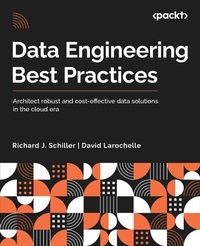
Data Engineering Best Practices
Architect robust and cost-effective data solutions in the cloud era
1st Edition
Published on 18. March 2025
550 pages
978-1-80324-736-6 (ISBN)
Description

No detailed description available for "Data Engineering Best Practices".
All prices
More details
Other editions
Additional editions
Richard J. Schiller | David LaRochelle
Data Engineering Best Practices
Architect robust and cost-effective data solutions in the cloud era
Book
10/2024
Packt Publishing
€56.90
Shipment within 3-4 weeks
Persons
Schiller Richard J. :
Richard J. Schiller is a chief architect, distinguished engineer, and startup entrepreneur with 40 years of experience delivering real-time large-scale data processing systems. He holds an MS in computer engineering from Columbia University's School of Engineering and Applied Science and a BA in computer science and applied mathematics. He has been involved with two prior successful startups and has co authored three patents. He is a hands-on systems developer and innovator.Larochelle David :
David Larochelle has been involved in data engineering for startups, Fortune 500 companies, and research institutes. He holds a BS in computer science from the College of William & Mary, a Masters in computer science from the University of Virginia, and a Master's in communication from the University of Pennsylvania. David's career spans over 20 years, and his strong background has enabled him to work in a wide range of organizations, including startups, established companies, and research labs.
Richard J. Schiller is a chief architect, distinguished engineer, and startup entrepreneur with 40 years of experience delivering real-time large-scale data processing systems. He holds an MS in computer engineering from Columbia University's School of Engineering and Applied Science and a BA in computer science and applied mathematics. He has been involved with two prior successful startups and has co authored three patents. He is a hands-on systems developer and innovator.Larochelle David :
David Larochelle has been involved in data engineering for startups, Fortune 500 companies, and research institutes. He holds a BS in computer science from the College of William & Mary, a Masters in computer science from the University of Virginia, and a Master's in communication from the University of Pennsylvania. David's career spans over 20 years, and his strong background has enabled him to work in a wide range of organizations, including startups, established companies, and research labs.
Content
- Cover
- Title Page
- Copyright and Credits
- Contributors
- Table of Contents
- Preface
- Chapter 1: Overview of the Business Problem Statement
- What is the business problem statement?
- Anti-patterns to avoid
- Patterns in the future-proof architecture
- Future-proofing is .
- Organization into zone considerations
- Cloud limitations
- The Intelligence Age
- Use case definitions
- The mission, the vision, and the strategy
- Principles and the development life cycle
- The architecture definition, best practices, and key considerations
- The DataOps convergence
- Summary
- Chapter 2: A Data Engineer's Journey - Background Challenges
- Challenge #1 - platform architectures change rapidly
- Platform architectures in the 21st century
- Impacts on business strategy
- A flexible software development life cycle to manage platform risk
- Challenge #2 - Total cost of ownership (TCO) is high
- ETL architecture costs are high!
- Buy versus build choices impact a solution's longevity
- Challenge #3 - Evolving data repository patterns - identifying big rocks for data engineers
- Intake, integration, and storage challenges in data engineering
- Identifying the big rocks to be placed first into your design
- Being able to handle technology hype
- Summary
- Chapter 3: A Data Engineer's Journey - IT's Vision and Mission
- The vision
- Develop the IT engineering vision
- Vision summary
- The mission and the IT strategy
- IT's vision
- IT's mission
- IT mission summary
- Principles, frameworks, and best practices
- The architecture reflects the vision
- Principles summary
- Data engineering patterns for IT operability
- What patterns are required and how are they specified?
- Pattern summary
- Summary
- Chapter 4: Architecture Principles
- Architecture principles overview
- Architecture foundation
- Data lake, mesh, and fabric
- Data immutability
- Third party tool, cloud platform-as-a-service (PaaS), and framework integrations
- Data mesh principles
- Data mesh metadata
- Data semantics in the data mesh
- Data mesh, security, and tech stack considerations
- What are the key foundational takeaways?
- Architecture principles in depth
- Principle #1 - Data lake as a centerpiece? No, implement the data journey!
- Principle #2 - A data lake's immutable data is to remain explorable
- Principle #3 - A data lake's immutable data remains available for analytics
- Principle #4 - A data lake's sources are discoverable
- Principle #5 - A data lake's tooling should be consistent with the architecture
- Principle #6 - A data mesh defines data to be governed by domain-driven ownership
- Principle #7 - A data mesh defines the data and derives insights as a product
- Principle #8 - A data mesh defines data, information, and insights to be self-service
- Principle #9 - A data mesh implements a federated governance processing system
- Principle #10 - Metadata is associated with datasets and is relevant to the business
- Principle #11 - Dataset lineage and at-rest metadata is subject to life cycle governance
- Principle #12 - Datasets and metadata require cataloging and discovery services
- Principle #13 - Semantic metadata guarantees correct business understanding at all stages in the data journey
- Principle #14 - Data big rock architecture choices (time series, correction processing, security, privacy, and so on) are to be handled in the design early
- Principle #15 - Implement foundational capabilities in the architecture framework first
- Summary
- Chapter 5: Architecture Framework - Conceptual Architecture Best Practices
- Conceptual architecture overview
- Best practice organization
- How does the conceptual architecture align with the logical architecture and physical architecture?
- Conceptual architecture best practices
- Conceptual architecture description
- Conceptual architecture glossary
- What are the data architecture's key issues identified in the conceptual architecture?
- Best practice composition of the conceptual architecture
- Conceptual to logical architecture mapping
- Summary
- Chapter 6: Architecture Framework - Logical Architecture Best Practices
- Logical architecture overview
- Organizing best practices
- How does the logical architecture align with the conceptual and physical architecture?
- Detailed capabilities of the ingestion zones
- ETL data pipelines
- Bronze standard datasets
- Detailed capabilities of the transformation zones
- Data quality features
- Data lake house and warehouse
- Gold and silver standard datasets
- Detailed capabilities of the consumption zones
- Data analytics
- Accessing silver standard datasets from the consumption zone
- Trade-offs between public cloud, on-premises, and multi-cloud
- Cost of ingest or egress for cloud data
- Cost of a dedicated network line to the point of service
- Cost of provisioning
- Cost of monitoring and observability
- Hybrid or multi-cloud choices!
- The benefits of a multi-cloud strategy
- Summary
- Chapter 7: Architecture Framework - Physical Architecture Best Practices
- Physical architecture overview
- Best practice organization
- How does the physical architecture align with the logical and conceptual architecture?
- How should the physical architecture align with the operational processes/capabilities of the solution?
- Examples of physical reference architectures
- Summary
- Chapter 8: Software Engineering Best Practice Considerations
- SBP 1 - follow the architecture!
- The core value of architectural integrity
- The downstream impact of deviating
- Ensuring adherence in your data engineering team
- Continuous evolution and architecture
- Conclusion
- SBP 2 - implement Agile methodology for your organization!
- Introduction to Agile methodology
- Agile principles and their significance in data engineering
- Benefits of implementing Agile in data engineering
- Challenges and considerations in Agile data engineering
- Steps to implement Agile in data engineering
- Tools and Agile practices tailored for data engineering
- Conclusion
- SBP 3 - generate objectives and key results (OKRs)!
- Introduction and deep dive into OKRs
- Crafting data-centric OKRs
- Potential challenges with OKRs in data engineering
- Reviewing and iterating on OKRs in a data context
- SBP 4 - implement data as a product!
- SBP 5 - implement shift left testing (SLT) processes!
- Understanding SLT
- Benefits of SLT in data engineering
- Implementing shift left testing
- Specific shift left testing strategies for data engineering
- Challenges in shift left testing for data engineering
- Tools and technologies to facilitate shift left in data engineering
- Synergy with other data best practices
- SBP 6 - implement the difficult first!
- The philosophy of tackling the hard tasks first
- How data engineers can prioritize difficult tasks
- Implementing difficult data tasks
- Synergy with other data best practices
- Conclusion
- SBP 7 - avoid premature optimization
- The true cost of premature optimization
- Recognizing and avoiding the trap in data engineering
- Balancing performance needs and over-optimization in data engineering
- Synergy with other data best practices
- SBP 8 - automate cloud code snippet deployments with standard deployment scripted wrappers
- The importance of deployment automation
- The deployment model choices
- Benefits of using scripted deployment wrappers
- Version control - ensuring consistency and traceability
- Relevance to data engineering in cloud environments
- Practical implementation steps
- Challenges and precautions
- Synergy with other software and data best practices
- SBP 9 - define and implement NFRs first
- Distinguishing functional (FRs) from non-functional requirements (NFRs)
- Relevance to data engineering
- Key NFRs in cloud data engineering
- Defining and implementing NFRs
- Risks of neglecting early implementation of NFRs
- SBP 10 - implement data journey journaling to facilitate future problem resolution
- Relevance to data engineering
- Challenges and considerations
- SBP 11 - implement data journey pipelines that are experimental first!
- Enabling data pipeline experimentation as datasets are readied
- Releasing data like code
- Challenges and considerations
- SBP 12 - choose languages with solid reasoning
- Key languages in data engineering and their roles
- The pressures and limitations imposed by PaaS offerings
- Pitfalls to avoid
- SBP 13 - drive scripting and PaaS code with parameterization using a secure configuration management repository tool
- The power of parameterization and configuration management
- The growth of configuration complexity
- Why parameterize?
- Configuration management repositories and configuration management databases (CMDBs)
- Best practices for secure configuration management
- SBP 14 - be prepared to prune dead code over time
- The accumulation of dead code in software and PaaS systems
- The unique challenge of PaaS service configurations
- Pruning dead code
- SBP 15 - if it doesn't fit, don't force it
- use a microservice
- PaaS and its boundaries
- Microservices as a contingency strategy
- Challenges and considerations of this dual approach
- Pitfalls to avoid
- Summary
- Chapter 9: Key Considerations for Agile SDLC Best Practices
- Prevent Agile from being fragile
- Agile methodology
- Core principles of Agile from the Agile Manifesto
- Agile and data engineering
- Why Agile?
- The impact of a unified Agile approach on team performance and system quality
- Software Development Lifecycle (SDLC) processes
- Objectives and Key Results (OKRs)
- Agile methodology (tuned to the organization)
- Business development strategy
- Test/quality strategy
- Operational strategy
- Data security strategy
- Summary
- Chapter 10: Key Considerations for Quality Testing Best Practices
- Quality testing overview
- How not to test!
- Evolving the test discipline
- Test terminology
- Key test definitions
- Test driven development (TDD)
- Acceptance test driven development (ATDD) versus developer test driven development (DTDD)
- Behavioral driven development (BDD)
- Shift left testing
- Test framework example
- Data wrangling and profiling
- Deterministic data profiling
- Machine learning driven data QA
- Summary
- Chapter 11: Key Considerations for IT Operational Service Best Practices
- IT operational best practices overview
- IT operational best practices - introduction
- Service Level Agreements (SLAs)
- Data contract service level agreements/data contract management
- Continuous integration/continuous deployment (CI/CD)
- Observability with proactive alerting
- Automated data and system anomaly detection and remediation
- Data system anomaly detection
- Application Performance Monitoring
- Blue/green versus continuous deployment trade-offs
- Key takeaways
- Summary
- Chapter 12: Key Considerations for Data Service Best Practices
- Data service best practices overview
- Software and data engineering drivers for best practices
- Zero trust versus defense in depth
- National data localization
- Privacy protection
- Personally Identifiable Information (PII)
- Data service engineering best practices
- Data engineering best practice 1 - implement a data mesh, not just a data fabric
- Data engineering best practice 2 - implement data pipelines (for analytics)
- Data engineering best practice 3 - implement data pipelines (for machine learning)
- Data engineering best practice 4 - use equivalent production and staging environments
- Data engineering best practice 5 - a pipeline's concurrent threads should run and scale in a distributed manner
- Data engineering best practice 6 - data pipelines should run as streams making use of PaaS services where possible
- Data engineering best practice 7 - create DataOps standards for data pipeline development
- Data engineering best practice 8 - implement tool selection criteria with weighted selection toward built-in integration with core components of the architecture
- Data engineering best practice 9 - implement Pub/Sub models for economy of scale when supporting customers with the same dataset subscription
- Data engineering best practice 10 - data wrangling tool selection to create a clean gold zone copy of datasets
- Data engineering best practice 11 - a data catalog is part of an essential metadata implementation
- Data engineering best practice 12 - define data owners, security, rights, and access for consumers upfront
- Data engineering best practice 13 - train your experts and let them train and retrain others
- Data engineering best practice 14 - handle errors gracefully
- Data engineering best practice 15 - run multiple data pipeline tasks as a directed acyclic graph (DAG)
- Summary
- Chapter 13: Key Considerations for Management Best Practices
- Niche focus areas - best practices overview
- Data profiling
- Heuristic data analysis
- Gaps
- Calendar trend deviations
- Metadata strategy
- Azure cloud provider perspective on metadata
- A metadata tool provider's perspective on metadata
- A knowledge engineering provider's perspective on metadata
- Metadata perspectives summary
- Summary
- Chapter 14: Key Considerations for Data Delivery Best Practices
- Data delivery best practices overview
- Streaming data delivery
- Data delivery with publishing/subscribing (pub/sub) methods
- Data delivery streaming with examples
- Consumable data delivery as a repository
- Custom-built analytics sandbox with Confidential Compute
- Using a third-party aggregator for analytics
- Data delivery into cloud service provided areas
- Using cloud provider's offerings
- Bulk data delivery
- Using various cloud provider offerings
- Summary
- Chapter 15: Other Considerations - Measures, Calculations, Restatements, and Data Science Best Practices
- Overview of other data engineering problems for consideration
- Data engineer statement of value
- Modern data science/analysis workbench
- What are the capabilities of a modern data science/analyst's workbench?
- Using notebooks in production
- Calculations and measures
- Difficult analytics features
- Key capabilities in the analytics workbench
- Historical data correction processing
- Notebooks
- Notebook technologies
- Summary
- Chapter 16: Machine Learning Pipeline Best Practices and Processes
- Machine learning (ML)/artificial intelligence (AI) overview
- The current and future state of AI
- Machine learning pipeline
- Model governance and compliance
- Why are models rarely deployed?
- What is the MLOps model life cycle?
- Technology necessities
- Data annotation
- Sampling the data lake
- Managing data annotation
- Real data versus created (synthetic) data
- Model training
- Model testing and evaluation
- Smoke tests
- ML asset deployment
- A/B testing
- Handling regressions
- MLOps frameworks
- Summary
- Chapter 17: Takeaway Summary - Putting It All Together
- People, technology, and processes
- Working with other people
- Develop your solutions' technology with clear processes
- Focus on the process of information value creation
- Other important challenges
- Business realities
- Security and privacy
- Knowledge engineering
- Artificial intelligence
- Summary
- Chapter 18: Appendix and Use Cases
- Use cases overview
- Technology background deep-dive
- Prompt engineering frameworks with examples
- Learn about new knowledge base generation tools with examples
- High level use cases
- Health Sciences Knowledge Graph (KG)
- Life Sciences Semantic Information Engine (ELSSIE)
- Microblog message analysis (Dataminr)
- Summary
- Index
- About Packt
- Other Books You May Enjoy
