

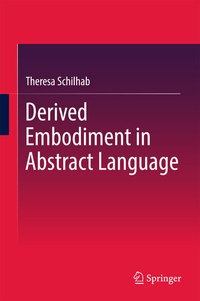
Derived Embodiment in Abstract Language
Description

How does knowledge of phenomena and events we have no direct experiences of emerge? Having a brain that learns from being in the world, how can we conceive of prehistoric dinosaurs, Atlantis, unicorns or even 'desire'? This book is about how abstract knowledge becomes anchored in direct experiences through well-formed conversations.
Within the framework of evolutionary biology and through the lens of contemporary studies in cognitive science, the neurosciences, sociology and anthropology, this book traces topics such as our inborn sensitivity to the environment, bottom-up and top-down processes in knowledge formation and the importance of language when we learn to categorise the world.
A major objective of this monograph is to identify the key determinants of the specific interactivity mechanisms that control the cognitive processes while we are linguistically immersed. The emphasis is on real-life interactions in conversations. While the concrete word-object paradigm depends relatively more on direct experiences, the successful acquisition of abstract knowledge depends on the emphatic skills of the interlocutor. He or she must remain sensitive to the level and quality of the imagination of the child while making mental tableaus that are believed to elicit images to which the child associates the concept.
Derived embodiment in abstract thought is a landmark synthesis that operationalizes contemporary neuroscience studies of acquisition of knowledge in the real life conversational context. The result is an exciting biology-based contribution to theories of knowledge acquisition and thinking in sociology, cognitive robotics, anthropology and not at least, pedagogy.
More details
Other editions
Additional editions
Content
Preface.- 1. Introduction to the book.- 2. Interactional expertise.- 3. Grounded cognition.- 4. Concrete and 'abstract' knowledge.- 5. Derived embodiment and interactional expertise.- 6. Mental applications.- 7. Educational implications.- 8. Issues to consider.- References.
