

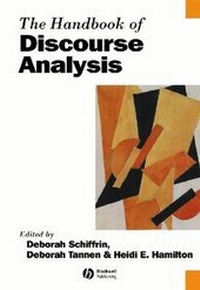
The Handbook of Discourse Analysis
Description

Reviews / Votes
"This is an excellent handbook - well-conceived andcomprehensive. It will be a valuable resource for researchers andan absolute boon to teachers. The distinguished group of authorsand the range of approaches represented makes it a fitting partnerto Schiffrin's Approaches to Discourse Analysis, surely thebest text around for a graduate introduction to discourse analysis.Together, the two constitute a formidable library of informationfor students and teachers alike." Helen Aristar-Dry, EasternMichigan University "Not only fascinating to read, but also a valuable referenceresource for anyone working in, or with an interest in, discourseanalysis." Discourse and Society"The volume is intended as, and succeeds in being, both anauthoritative guide to the field and a contribution to currentresearch" Forum for Modern Language Studies, Vol 39,2003 "(T)he handbook with be a valuable source of information andinspiration for further research in discourse analysis in thecontext of modern language studies and in linguistics in general."The Modern Language Journal "These are success stories that are bound to encourageresearchers from various disciplinary backgrounds and nationaltraditions to turn to discourse analysis as a viable methodologicaland theoretical framework." Social AnthropologyMore details
Other editions
Additional editions
Persons
Content
Part I: Discourse Analysis and Linguistics:.
1. Intonation And Discourse: Current Views From Within: Elizabeth Couper-Kuhlen (University Of Konstanz).
2. Cohesion And Texture: Jim Martin (University Of Sydney).
3. Discourse Markers: Language, Meaning And Context: Deborah Schiffrin (Georgetown University).
4. Discourse And Semantics: Neal Norrick (Saarland University).
5. Discourse And Relevance Theory: Diane Blakemore (Southampton University).
6. Discourse And Information Structure: Gregory Ward And Betty Birner (Northwestern University).
7. Historical Discourse Analysis: Laurel Brinton (University Of British Columbia).
8. Typology And Discourse: John Myhill (University Of Haifa).
9. Register Variation: A Corpus Approach: Douglas Biber (Northern Arizona University) And Susan Conrad.
Part II: The Linking Of Theory and Practice In Discourse Analysis:.
10. Nine Ways Of Looking At Apologies: The Necessity Of Interdisciplinary Theory And Method In Discourse Analysis: Robin Lakoff (University Of California, Berkeley).
11. Interactional Sociolinguistics: A Personal Perspective: John Gumperz (University Of California, Berkeley).
12. Discourse As An Interactional Achievement III: The Omnirelevance Of Action: Emanuel Schegloff (University Of California, Los Angeles).
13. Discourse And Interaction: Monica Heller (University Of Toronto).
14. The Linguistic Structure Of Discourse: Livia Polanyi (FX Palo Alto Lab).
15. The Variationist Approach Towards Discours Structural Effects And Socio-Interactional Dynamics: Sylvie Dubois (Louisiana State University) And David Sankoff (Université De Montréal).
16. Computer-Assisted Text And Corpus Analysis: Lexical Cohesion And Communicative Competence: Michael Stubbs (University Of Trier).
17. The Transcription Of Discourse: Jane Edwards (University Of California, Berkeley).
Part III: Discourse: Language, Context, and Interaction:.
Political, Social, And Institutional Domains.
18. Critical Discourse Analysis: Teun Van Dijk (University Of Amsterdam).
19. Discourse And Racism: Ruth Wodak (Universität Wein) And Martin Reisigl.
20. Political Discourse: John Wilson (University Of Ulster).
21. Discourse And The Media: Colleen Cotter (Georgetown University).
22. Discourse Analysis In The Legal Context: Roger Shuy (Georgetown University).
23. The Discourse Of Medical Encounters: Nancy Ainsworth-Vaughn (Michigan State University).
24. Language And Medicine: Suzanne Fleischman (University Of California, Berkeley).
25. Discourse In Educational Settings: Carolyn Adger (Temple University).
26. Institutional Narratives: Charlotte Linde (Institute For Research On Learning).
Culture, Community, And Genre.
27. Discourse And Intercultural Communication: Ronald And Suzanne Scollon (Georgetown University).
28. Discourse And Gender: Shari Kendall And Deborah Tannen (Georgetown University).
29. Discourse And Aging: Heidi Hamilton (Georgetown University).
30. Child Discourse: Jenny Cook-Gumperz And Amy Kryatzis (Both University Of California, Santa Barbara).
31. Computer-Mediated Discourse: Susan Herring (University Of Texas).
32. Discourse And Narrative: Barbara Johnstone (Carnegie Mellon University).
33. Discourse And Conflict: Christina Kakavá (Mary Washington College).
Part IV: Discourse Across Disciplines:.
34. The Analysis Of Discourse Flow: Wallace Chafe (University Of California, Santa Barbara).
35. The Discursive Turn In Social Psychology: Rom Harré (Linacre College, Oxford And Georgetown University).
36. Discourse And Language Teaching: Elite Olshtain (Hebrew University) And Marianne Celce-Murcia (University Of California, Los Angeles).
37. Discourse Analysis In Communication: Karen Tracy (University Of Colorado).
38. Discourse And Sociology: Sociology And Discourse: Allen Grimshaw (Indiana University).
39. Imagination In Discourse: Herb Clark And Mija Vanderwege (Both Stanford University).
40. Literary Pragmatics: Jacob Mey (Odense University).
41. Computational Perspectives On Discourse And Dialogue: Bonnie Webber (University Of Pennsylvania).
Index.
