

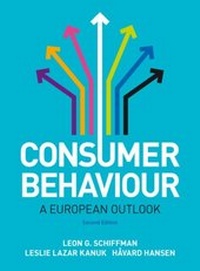
Consumer Behaviour E Book
Description

Consumer Behaviour focuses not only on what consumers buy, but also why they buy, when they buy, where they buy and how they evaluate their purchase, and how they ultimately dispose of it.
The second edition has been thoroughly adapted and revised to reflect European conditions, and to focus attention on critical concepts in consumer behaviour. In doing so the authors illuminate the ways in which marketers apply the principles of consumer behaviour to the development and implementation of marketing strategies. The new 'Innovation In Action feature' will give practical examples to help you student link Consumer Behaviour with how it is practised in the workplace.
All prices
More details
Other editions
Additional editions
Persons
Leon G. Schiffman is J. Donald Kennedy Chair in E-Commerce at the Peter J. Tobin College of Business at St. John's University, New York City, USA.
Leslie Lazar Kanuk is Emeritus Professor of Marketing at the City University of New York Graduate School, USA.
H©vard Hansen is Professor of Marketing at the UiS Business School, University of Stavanger, Norway.
Content
- Front Cover
- Consumer behaviour
- Brief contents
- Contents
- Part 1 introduction
- An introduction to the study of consumer behaviour
- Development of the marketing concept and the discipline of consumer behaviour
- Customer value, satisfaction and retention
- The impact of digital technologies on marketing strategies
- Marketing ethics and social responsibility
- Consumer behaviour and decision-making are interdisciplinary
- The plan of this book
- Summary
- Consumer research
- Consumer research paradigms
- The consumer research process
- Summary
- Market segmentation
- What is market segmentation?
- Criteria for effective targeting of segments
- Bases for segmentation
- Implementing segmentation strategies
- Summary
- Part 2 the consumer as an individual
- Consumer decision-making
- What is a decision?
- Levels of consumer decision-making
- Models of consumers: four views of consumer decision-making
- A model of consumer decision-making
- Consumer gifting behaviour
- Beyond the decision: consuming and possessing
- Summary
- Consumer motivation
- Motivation as a psychological force
- The dynamics of motivation
- Types and systems of needs
- Motivational research
- Summary
- Personality and consumer behaviour
- What is personality?
- Theories of personality
- Personality and understanding consumer diversity
- Brand personality
- Self and self-image
- Virtual personality or self
- Summary
- Consumer perception
- Elements of perception
- Dynamics of perception
- Consumer imagery
- Perceived risk
- Ethics and consumer perception
- Summary
- Consumer learning
- The elements of consumer learning
- Behavioural learning theories
- Cognitive learning theory
- Measures of consumer learning
- Ethics and consumer learning
- Summary
- Consumer attitude formation and change
- What are attitudes?
- Structural models of attitudes
- Attitude formation
- Strategies of attitude change
- Behaviour can precede or follow attitude formation
- Summary
- Communication and consumer behaviour
- Components of communication
- The communications process
- Designing persuasive communications
- Marketing communication and ethics
- Summary
- Part 3 consumers in their social and cultural settings
- Reference groups and family influences
- What is a group?
- Understanding the power of reference groups
- Selected consumer-related reference groups
- Celebrity and other reference group appeals
- The family is a concept in flux
- Socialisation of family members
- Other functions of the family
- Family decision-making and consumption-related roles
- The family life cycle
- Summary
- Social class and consumer behaviour
- What is social class?
- The measurement of social class
- Lifestyle profiles of the social classes
- Social-class mobility
- The affluent consumer
- Middle-class consumers
- The working class and other non-affluent consumers
- Recognising the 'techno-class'
- Summary
- The influence of culture and subculture on consumer behaviour
- What is culture?
- The invisible hand of culture
- Culture satisfies needs
- Culture is learned
- Culture is shared
- Culture is dynamic
- The measurement of culture
- What is subculture?
- Nationality subcultures
- Religious subcultures
- Geographic and regional subcultures
- Age subcultures
- Sex as a subculture
- Subcultural interaction
- Summary
- Cross-cultural consumer behaviour: an international perspective
- The imperative to be multinational
- Cross-cultural consumer analysis
- Alternative multinational strategies: global versus local
- Cross-cultural psychographic segmentation
- Summary
- Part 4 more on the consumer's decision-making process
- Consumer influence and the diffusion of innovations
- What is opinion leadership?
- Dynamics of the opinion leadership process
- The motivation behind opinion leadership
- Measurement of opinion leadership
- A profile of the opinion leader
- Frequency and overlap of opinion leadership
- The situational environment of opinion leadership
- The interpersonal flow of communication
- Marketers seek to take control of the opinion leadership process
- Diffusion of innovations
- The diffusion process
- The adoption process
- A profile of the consumer innovator
- Summary
- Consumer decision-making - again
- Glossary
- Index
- Back Cover
