

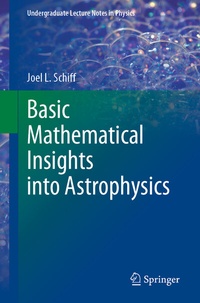
Basic Mathematical Insights into Astrophysics
Description

This book will show how it is possible to explore the Universe not only with telescopes but also with Mathematics. Moreover, this book aims at explaining the equations governing the behavior of the stars, planets, and galaxies, which are very accessible to the average undergraduate who has studied some Mathematics in school. We will also probe into unseen black holes to determine their mass as well as investigate other intriguing celestial phenomena such as dark matter and dark energy, the expansion of the Universe, and explore via Einstein's Theory of Relativity, the very foundations of space and time itself. You will discover that both Special and General Relativity are absolutely essential for the functioning of the Global Positioning System (GPS), which illustrates how astrophysical ideas can impact everyday lives.
Lastly, this book provides insight into how Mathematics allows us to see and hear how the Universe ticks. Each chapter is a front row seat for those who wish to listen to some of the most beautiful music expressed by the Universe, Mathematics.
More details
Other editions
Additional editions
Person
Joel L. Schiff has a PhD in Mathematics from the University of California Los Angeles (UCLA). He has spent his career at the University of Auckland, Auckland, New Zealand and written eight books on mathematical and scientific subjects including astronomy. With colleague Wayne Walker, he helped developed the Arithmetic Fourier Transform used in signal processing. The author was also the founder publisher of the international journal Meteorite , and in 1999, he and his wife discovered a new asteroid from their backyard observatory. They named it after notable New Zealand meteorite scientist, Brian Mason. As well, the author has for years done astrometrical observations of Near-Earth Asteroids that are sent to the database maintained by the Center for Astrophysics/Harvard & Smithsonian.
Content
Chapter 1. Measurement.- Chapter 2. Down to Earth.- Chapter 3. Let There Be Light.- Chapter 4. Newton's Laws.- Chapter 5. Kepler's Laws.- Chapter 6. Climbing the Distance Ladder.- Chapter 7. Hubble's Law of the Universe.- Chapter 8. Relativity.- Chapter 9. Black Holes.- Chapter 10. The Universe.
