

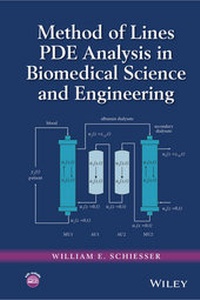
Method of Lines PDE Analysis in Biomedical Science and Engineering
Description

Reviews / Votes
"This book demonstrates the use of numerical methods for the computer solution of partial differential equations (PDEs) as applied to biomedical science and engineering...The book is worth reading not only for mathematicians but also for, e.g., chemical engineers, medical researchers, clinicians, epidemiologists and statisticians." (Mathematical Reviews/MathSciNet June 2017)More details
Other editions
Additional editions
Person
Content
- Intro
- Title Page
- Copyright
- Dedication
- Table of Contents
- Preface
- About the Companion Website
- Chapter 1: An Introduction to MOL Analysis of PDEs: Wave Front Resolution in Chromatography
- 1.1 1D 2-PDE model
- 1.2 MOL routines
- 1.3 Model output, single component chromatography
- 1.4 Multi component model
- 1.5 MOL routines
- 1.6 Model output, multi component chromatography
- References
- Chapter 2: Wave Front Resolution in Vegf Angiogenesis
- 2.1 1D 2-PDE model
- 2.2 MOL routines
- 2.3 Model output
- 2.4 Conclusions
- References
- Chapter 3: Thermographic Tumor Location
- 3.1 2D, 1-PDE model
- 3.2 MOL analysis
- 3.3 Model output
- 3.4 Summary and conclusions
- References
- Chapter 4: Blood-Tissue Transport
- 4.1 1D 2-PDE model
- 4.2 MOL routines
- 4.3 Model output
- 4.4 Model extensions
- 4.5 Conclusions and summary
- References
- Chapter 5: Two-Fluid/Membrane Model
- 5.1 2D, 3-PDE model
- 5.2 MOL analysis
- 5.3 Model output
- 5.4 Summary and conclusions
- Chapter 6: Liver Support Systems
- 6.1 2-ODE patient model
- 6.2 Patient ODE model routines
- 6.3 Model output
- 6.4 8-PDE ALSS model
- 6.5 Patient-ALSS ODE/PDE model routines
- 6.6 Model output
- 6.7 Summary and conclusions
- Appendix - Derivation of PDES for Membrane and Adsorption Units
- A.6.1 PDEs FOR MEMBRANE UNITS
- A.6.2 PDEs FOR ADSORPTION UNITS
- References
- Chapter 7: Cross Diffusion Epidemiology Model
- 7.1 2-PDE model
- 7.2 Model routines
- 7.3 Model output
- 7.4 Summary and conclusions
- Reference
- Chapter 8: Oncolytic Virotherapy
- 8.1 1D 4-PDE model
- 8.2 MOL routines
- 8.3 Model output
- 8.4 Summary and conclusions
- Reference
- Chapter 9: Tumor Cell Density in Glioblastomas
- 9.1 1D PDE model
- 9.2 MOL routines
- 9.3 Model output
- 9.4 -Refinement error analysis
- 9.5 Summary and conclusions
- References
- Chapter 10: Mol Analysis with a Variable Grid: Antigen-Antibody Binding Kinetics
- 10.1 ODE/PDE model
- 10.2 MOL routines
- 10.3 Model output
- 10.4 Summary and conclusions
- Appendix: Variable Grid Analysis
- References
- Appendix A: Derivation of Convection-Diffusion-Reaction Partial Differential Equations
- Reference
- Appendix B: Functions dss012, dss004, dss020, vanl
- Reference
- Index
- End User License Agreement
Chapter 1
An Introduction to MOL Analysis of PDEs: Wave Front Resolution in Chromatography
This first chapter introduces a partial differential equation (PDE) model for chromatography which is a basic analytical method in biomedical science and engineering (BSME). For example, chromatography can be used to analyze a stream of various proteins through selective adsorption. Thus, the model can also be applied to adsorption as a basic procedure for separating biochemical species such as proteins. The computer implementation (programming, coding) of the model is in R1.
The intent of this chapter is to
- Derive a basic chromatography PDE model, including the required initial conditions (ICs) and boundary conditions (BCs).
- Illustrate the coding of the model within the method of lines (MOL) through a series of R routines, including the use of library routines for integration of the PDE derivatives in time and space.
- Present the computed model solution in numerical and graphical (plotted) format.
- Discuss the features of the numerical solution and the performance of the algorithms used to compute the solution.
- Consider extensions of the model and the numerical algorithms.
1.1 1D 2-PDE model
The configuration of a chromatography column is illustrated in Fig. 1.1.
Figure 1.1 Diagram of a chromatographic column
We can note the following details about the column represented in Fig. 1.1:
- The column is one dimensional (1D) with distance along the column, , as the spatial (boundary value) independent variable. Time is an initial value independent variable. A solid adsorbent is represented as spherical particles that fill the column. A fluid stream flows through the column in the interstices (voids) between the adsorbent particles. The flowing stream enters the base of the column at , and exits the top at .
- The two PDE dependent variables are:
- -: concentration of the adsorbate (the chemical component to be processed) in the fluid stream.
- -: adsorbate concentration on the adsorbent.
- The adsorbate enters the column at with a prescribed (entering) concentration that serves as a boundary condition (BC) for the PDE3. Note that the boundary value can be a function of .
- The exiting stream at has the concentration which is a function of . The variation of this exiting stream is of primary interest when using the model. A plot of against is termed a breakthrough curve.
- An overall objective in formulating the model and computing numerical solutions is to determine , and in particular, how effective the chromatographic column is in altering the entering stream with concentration .
In summary, the numerical solution of the PDE model will give the dependent variables and as a function of . is a primary output from the model, that is, the outflow adsorbate concentration as a function of time.
A mass balance on the adsorbate stream4 gives
1.1awhere
Eq. (1.1a) is a mass conservation balance for the flowing adsorbate with the terms explained further in the following comments.
- LHS-1: - accumulation of adsorbate in the incremental volume . The CGS units of this term are , that is, the accumulation of adsorbate per second within the incremental volume . If the derivative is negative, the adsorbate is depleted (reduced). Also, some elaboration of the units of length is possible.
- : (so that the void fraction is not dimensionless)
- :
- :
- :
Thus, more detailed units of the LHS derivative of eq. (1.1a) are:
The distinction between and (and later, ) will not generally be retained in the subsequent discussion (only cm will be used), but this distinction should be kept in mind when analyzing units in the model.
- RHS-1: - flow (by convection) of absorbate into the incremental volume at . The units of this term are , that is, the flow of adsorbate per second into the incremental volume. Note that has the units This is generally termed a superficial or linear velocity and is assumed constant across the chromatographic column (any wall effects are neglected).
- RHS-2: - flow (by convection) of absorbate out of the incremental volume at . Again, the units of this term are , that is, the flow of adsorbate per second out of the incremental volume.
- RHS-3: - volumetric rate of adsorption (when this term is negative, adsorbate moves from the fluid to the adsorbent) or desorption (when this term is positive). The units of this term are , that is, the transfer of adsorbate per second within the incremental volume.
Three additional points about this term can be observed.
- and are volumetric (not surface) adsorbent concentrations with the units . has the units and has the units 1/s (explained next). By definition,
and
Then the units of the term are:
- The forward rate of adsorption, , is usually termed a logistic rate. Note that it is nonlinear from the product of the two dependent variables, , which means that an analytical solution to the PDE model is probably precluded, but a numerical solution can be easily programmed and calculated. Also, for this forward rate is positive giving adsorption from this term in eq. (1.1a) , and for this term reflects desorption (when the adsorbate concentration exceeds the equilibrium adsorbent concentration, ).
- When , adsorption takes place (with a reduction in from eq. (1.1a) since this term is multiplied by a minus). Conversely, when , this term reflects desorption (and an increase in from eq. (1.1a)).
If eq. (1.1a) is divided by ,
or for ,
1.1bEq. (1.1b) is the PDE for the calculation of . For the subsequent analysis and programming, we will take as independent of so it can be taken outside the derivative in (even though the transfer of adsorbate could affect , but this will not be considered). as a function of is an interesting case that could be investigated through the use of eq. (1.1b). Note also that the column cross sectional area, , canceled in going from eq. (1.1a) to eq. (1.1b) , that is, we come to the somewhat unexpected conclusion that does not appear in eq. (1.1b).
Also, in eq. (1.1b),
as expected for consistent units in eq. (1.1b) , that is, the units in the various terms in eq. (1.1b) are since eq. (1.1b) is a mass balance on the fluid.
A PDE for follows from an analogous mass balance for the adsorbent. The starting point is
1.2aDivision by gives
1.2bNote that the adsorption terms in eqs. (1.1b) and (1.2b) are opposite in sign which indicates that the rate absorbate leaves (or enters) the fluid stream equals the rate adsorbate is transferred to (or leaves) the adsorbent. Also, the LHS and RHS terms in eq. (1.2b) have the units , since eq. (1.2b) is a mass balance on the adsorbent in an incremental volume . Again, cancels in going from eq. (1.2a) to eq. (1.2b).
Eqs. (1.1b) and (1.2b) are a (two equations in two unknowns) for the concentrations . One other variable, , appears in the adsorption rate in these two PDEs. This adsorbent equilibrium concentration might be assumed to be a constant, for example, corresponding to a monolayer of the adsorbate on the adsorbent. Or can be considered a variable from an equilibrium relation such as, for example, a Langmuir isotherm of the form
1.3where are constants typically measured experimentally.
Eq. (1.1b) is first order in and (and is termed a first-order, hyperbolic PDE). Therefore, it requires one initial condition (IC)5 and one boundary condition (BC).6,7
The IC is taken as
1.4aThe BC is taken as
1.4bwhere and are prescibed functions of and , respectively.
Eq. (1.2b) is first order in so it requires one IC
1.4cEq. (1.4b) is a Dirichlet BC since the dependent variable is specified at the boundary . Other types of BCs are discussed in subsequent chapters.
Eqs. (1.1) to (1.4) constitute the PDE model for the chromatographic column. We next consider the programming of these equations within the MOL framework.
1.2 MOL routines
The discussion of the routines for eqs. (1.1) to (1.4) starts with the main program.
1.2.1 Main program
The listing of the main program follows.
Listing 1.1 Main program pde_1_main for eqs. (1.1) to (1.4)
# # Delete previous workspaces rm(list=ls(all=TRUE)) # # 1D, one component, chromatography model # # The ODE/PDE system is # # u1_t = -v*u1_z - (1 - eps)/eps*rate (1.1b) # # u2_t = rate (1.2b) # # rate = kf*u1*(u2eq - u2) - kr*u2 # # u2eq = c1*u1/(1 + c2*u1) (1.3) # # Boundary...
