

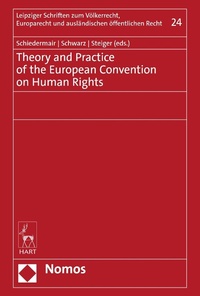
Theory and Practice of the European Convention on Human Rights
Description

Der Sammelband bietet einen Einblick in aktuelle Debatten zu Theorie und Praxis der Europäischen Menschenrechtskonvention. Das Buch gliedert sich in drei Teile: Verfahrensrechtliche Aspekte, Grundsätze Herausforderungen durch die aktuelle Rechtsprechung sowie Interaktion mit nationalen Rechtssystemen. Der Sammelband versammelt die Vorträge, die im Jahre 2019 im Rahmen der "1. International Summerschool" der Universitäten Leipzig und Dresden gehalten wurden. Ziel des Buches ist es, die weitere Forschung und den Diskurs über die Arbeitsweise des Europäischen Gerichtshofs für Menschenrechte zu fördern, ein Ziel, das in der zweiten Sommerschule im Jahr 2021 fortgesetzt wird.Mit Beiträgen vonVeronika Bilkova, Katharina Braun, Robert Frau, Hanaa Hakiki, Beti Hohler, Stefanie Lemke, Helga Molbaek-Steensig, Jacopo Roberti di Sarsina, Christiane Schmaltz, Barbara Sonczyk, Dominik Steiger, Edith Wagner und Alain Zysset.
More details
Other editions
Additional editions
Content
- Cover
- A. Human Rights and Procedural Law
- Protecting Human Rights Through Criminal Law: The Revival of the Procedural Obligations
- A. Introduction
- B. Protecting Human Rights through Criminal Law: The Jurisprudence of the ECtHR
- I. Positive Obligations and Criminal Law
- II. The Procedural Obligations to Investigate and Prosecute
- 1. The Standard for an Effective Investigation
- 2. Criticism of the Court's Approach to Criminal Law Measures
- 3. Unintentional Infliction of Death or Life-Threatening Injuries
- C. The Rationales behind the Obligations to Criminalise, Investigate, and Prosecute
- D. Conclusion
- Bibliography
- The European Court of Human Rights and Article 18 - An Indicator for the State of Democracy in Europe?
- A. Introduction - An Alarming Tendency
- B. Article 18 ECHR - Autonomous Application Linked with Substantive Convention Guarantees
- C. Development of the Case Law - From Uncertainty to Clarification
- D. Application of Article 18 in Conjunction with Article 6 - Inconsistency, but Positive Signals
- E. Burden and Standard of Proof
- I. Burden of Proof - Open Questions and Lack of Guidance for Applicants
- II. Standard of Proof - The Usual Approach
- III. Application of these Principles - A Safeguard against Undemocratic Tendencies
- F. Non-Examination of Article 18 - Missed Chances to 'Raise the Red Flag'
- G. Conclusion - A Developing Tool in Need of Sharpening
- Bibliography
- The Copenhagen Declaration: Wrapping up the Interlaken Reform?
- A. Introduction
- B. The Interlaken Reform: The Latest Chapter in a History of Reforms
- C. Progress in the Interlaken Process up until Copenhagen
- D. The Copenhagen Declaration
- E. Conclusion
- Bibliography
- B. Fundamental Human Rights Principles Facing New Challenges
- How many Strikeouts are too many? The ECtHR's Evolving Approach to Repetitive Cases and the Limits of Efficiency
- A. The Increase in Strikeouts
- B. Strikeouts and Repetitive Cases
- I. The Widespread Disregard for the Obligations under the Convention
- II. Ukraine and the Chernobyl Victims
- C. The Court's Evolving Procedural Approach
- I. 2001 to 2009: The First Friendly Settlement and Case-by-Case Adjudication
- II. 2009: The Pilot Judgment Procedure
- III. From 2012 to 2015: The Fast-Track Procedure
- 1. The Procedure for Well-Established Case Law
- 2. Unilateral Declarations
- IV. 2017: The Mass Strikeout in Burmych
- D. Appraising the Judgment in Burmych
- I. The Flawed Prioritisation of Non-repetitive over Repetitive Cases
- II. The Lack of Weighing and Balancing
- III. The Substantive Evolution of the Convention
- IV. The Lack of a Public Hearing: Perceived Procedural Fairness and Legitimacy
- E. Conclusion
- I. A Call for more Realism
- II. The further Development of the Convention and Compliance with Existing Obligations
- III. Efficiency at the Expense of the Court's Legitimacy?
- ANNEX
- Bibliography
- Protection of Human Rights Defenders and Whistleblowers under Human Rights Law
- A. Who are Human Rights Defenders and Whistleblowers?
- I. Who are Human Rights Defenders?
- II. Who are Whistleblowers?
- III. What are the Shared Features and the Differences between the two Groups?
- B. How does the Increased Vulnerability of Human Rights Defenders and Whistleblowers Manifest Itself?
- I. Private Life and Safety
- II. Activities in the Public Space
- III. Economic and Social Status
- IV. Increased Vulnerability of Human Rights Defenders and Whistleblowers
- C. Legal Regulations Applicable to Human Rights Defenders and Whistleblowers
- I. Legal Standards Applicable to Human Rights Defenders
- II. Legal Standards Applicable to Whistleblowers
- D. Conclusions
- Bibliography
- The ECtHR's Jurisprudence on the Prohibition of Collective Expulsions in Cases of Pushbacks at European Borders: A Critical Perspective
- A. Introduction
- B. The Prohibition of Collective Expulsion and Strasbourg: A Basic Definition
- I. Expulsion
- II. Collective
- III. Alien
- C. The 'Own Culpable Conduct' Exception
- I. Conditions of Applicability
- II. Genuine and Effective Access to Means of Legal Entry and Cogent Reasons
- 1.'Genuine and Effective' in the Court's Jurisprudence on Access to Rights
- 2. 'Effective' in the Court's Jurisprudence on Access to Rights before Domestic Courts
- III. Impact of the 'Own Culpable Conduct' Exception on the Applicability of Article 4 Protocol 4 ECHR at Borders
- D. The Prohibition of Collective Expulsions: A Comparative Conclusion
- I. The Prohibition of Collective Expulsions within the ECHR Framework
- 1. Article 3 ECHR and the Prohibition of Torture and Inhuman or Degrading Treatment
- 2. Article 13 ECHR and the Right to an Effective Remedy
- II. The Prohibition of Collective Expulsions in Other Regional Human Rights Instruments
- 1. The American Convention on Human Rights
- 2. The African Charter on Human and Peoples' Rights
- E. Conclusion
- Bibliography
- Protecting Democratic Elections Against Online Influence via "Fake News" and Hate Speech - The French Loi Avia and Loi No. 2018-1202, the German Network Enforcement Act and the EU's Digital Services Act in Light of the Right to Freedom of Expression
- A. The Facts: Old Habits of Influencing Elections Die Hard - And How Legislatures Deal With It
- I. A Very Short History of Influencing Elections
- II. Today's Story of Influencing Elections - Manipulating the Democratic Process via "Fake News" and Hate Speech
- 1. "Fake News" and the Difference between Mis-, Dis- and Mal-Information
- 2. Hate Speech: Spreading Hatred based on Intolerance
- 3. The Recent Rise of "Fake News" and Hate Speech in the Context of Elections
- III. Fighting Back - European States' and the EU's Response to Counter Election Influence
- 1. The French Approach: Generally Combatting Hate Speech
- "Fake News" only in Election Times
- a) Loi Avia Against Hate Speech: Not Enough Time and Too Much Discretion
- b) Loi No. 2018-1202 Against the Manipulation of Information: A much more Differentiated and Precise Approach
- 2. The German Approach: Generally Combatting Hate Speech and - less so - "Fake News"
- 3. The EU Approach: Adding an Additional Layer to the Protection of Elections
- a) Personal and Material Scope of Application
- b) (Excluding) Liability of Online Platforms
- c) Notice and Takedown Procedure and Legal Remedies
- d) "Fake News" and Advertisement Regulation
- e) Further Duties of Very Large Online Platforms
- f) Fines and Penalties
- g) Summary - Regulating "Fake News" and Hate Speech, Not Only in Election Times
- 4. Conclusion: Regulating Online Intermediaries in Different Ways
- B. The Law: Applying the ECHR to Laws Regulating "Fake News" and Hate Speech
- I. Who is Protected and Who is Bound by the ECHR? Of Individuals and States, the EU, Companies, and Bots
- 1. Individuals - Protected by the ECHR
- 2. Companies and Bots - Protected and Indirectly Bound by the ECHR
- 3. States and the EU - Bound but not Protected by the ECHR
- 4. Summary - Personal Application as a Mainly Procedural Question, not a Material Question
- II. The Scope of the ECHR's Substantive Protection in Light of the French, German and EU Legislation Regulating Online Speech
- 1. Freedom of Expression on the Internet - Offline Rules also Apply Online
- 2. The Material Scope of Freedom of Expression
- 3. Right to Receive Information
- III. Freedom of Expression v. Protection of Elections - Justifying the French, German, and EU Legislation Regulating Online Speech
- 1. Protection of Elections as a Legitimate Aim Prescribed by Law
- a) Protection of Elections as a Legitimate Aim
- b) Prescribed by Law, especially Foreseeability and Effective Judicial Review
- aa) Foreseeability: What is Manifestly Illegal Content?
- bb) Effective Judicial Review: Some Work to be Done
- cc) Summary: DSA-Draft as a Model for National Legislation
- 2. The Right Balance between Protecting Elections and Ensuring Freedom of Expression
- a) Different Rights and Interests to be taken into Account
- b) Dis- and Mal-Information and Hate Speech
- c) The Online Speech Case Law of the ECtHR
- aa) Delfi v. Estonia (2015) - Demanding a Notice and Takedown Procedure ..
- bb) MTE and Index.hu ZRT v. Hungary (2016) - .. But not in all Cases
- cc) Pihl v. Sweden (2017) - Limited Liability for Small Blogs
- dd) Høiness v. Norway (2019) - Reiteration of the Court's Cautious Approach
- d) Application of the Court's Case Law: Has the Right Balance Been Found?
- IV. Conclusion: Regulating Online Intermediaries while Ensuring Freedom of Expression
- Bibliography
- A Culture of Justification or a Culture of Presumption? The Turn to Procedural Review and the Normative Function of Proportionality at the European Court of Human Rights
- A. Introduction
- B. The turn to procedural review ('TPR')
- C. The TPR, Proportionality and Justification
- I. Authority and Justification
- II. From proportionality to justification.
- III. And back...
- D. Conclusion
- Bibliography
- C. Human Rights and National Legal Orders
- Judicial and Prosecutorial Independence in Europe: How Politicized Judges and Prosecutors Undermine the Right to a Fair Trial in Eastern Europe and Central Asia
- A. Introduction
- B. The Role and Responsibilities of Judges and Prosecutors
- C. Country Studies
- I. Azerbaijan
- II. Russia
- III. Ukraine
- D. Outlook
- Bibliography
- The Role and Impact of the European Convention on Human Rights Beyond States Parties: The curious case of the ECHR in Kosovo
- A. Introduction
- B. Setting the Scene
- I. Short Political History of Kosovo: from an Autonomous Province to Declaration of Independence
- C. International Presence in Kosovo and the ECHR
- I. Kosovo's Relationship with the ECHR: How it all Began
- II. UNMIK and EULEX Human Rights Review Mechanisms and Their Reliance on the ECHR
- D. Current status of the ECHR in Kosovo: The Constitution and Beyond
- I. Incorporation of the ECHR in the Constitution of the Republic of Kosovo
- II. The Status of ECtHR's Jurisprudence within Kosovo's Constitutional Framework
- III. Judicial Protection of Human Rights and Fundamental Freedoms within the Kosovo Legal System
- 1. The Constitutional Court
- 2. Individual Referrals
- 3. Strengthening the Domestic Capacity to Implement Human Rights and Fundamental Freedoms in accordance with the Principle of Subsidiarity
- E. Beyond the Constitution - the ECHR as a Directly Applicable Source of Law for the Kosovo Specialist Chambers
- I. Legal Framework of the KSC
- II. Implications of the Legal Framework of the KSC
- III. The ECHR and War Crimes Cases in Former Yugoslavia: A Valuable Source?
- F. Conclusion
- Bibliography
- Extraterritorial Application of Human Rights Law - New Developments with regard to Germany
- A. Introduction: The ECHR's Position in Germany
- I. Constitutional Framework
- II. The ECHR's position in the German Legal Order
- B. Human Rights Law in Times of Armed Conflict
- I. General Relationship between the two Regimes
- II. Derogations from Human Rights Law in Armed Conflict and other Public Emergencies
- C. Extraterritorial Applicability of Human Rights Law
- D. New Developments in Jurisprudence
- I. European Court of Human Rights: Al-Skeini
- II. European Court of Human Rights: Hanan
- III. The new German Approach
- IV. The Federal Constitutional Court's Approach and the Hanan-Case
- E. Summary
- Bibliography
- List of Authors
