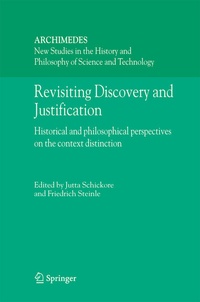
Revisiting Discovery and Justification
Description

The distinction between the contexts of discovery and justification has had a turbulent career in philosophy of science. At times celebrated as the hallmark of philosophical approaches to science, at times condemned as ambiguous, distorting, and misleading, the distinction dominated philosophical debates from the early decades of the twentieth century to the 1980s. Until today, it informs our conception of the content, domain, and goals of philosophy of science. It is due to this fact that new trends in philosophy of experimentation and history and sociology of science have been marginalized by traditional scholarship in philosophy. To acknowledge properly this important recent work we need to re-open the debate about the nature, development, and significance of the context distinction, about its merits and flaws. The contributions to this volume provide close readings and detailed analyses of the original textual sources for the context distinction. They revise those accounts of 'forerunners' of the distinction that have been written through the lens of Logical Empiricism. They map, clarify, and analyse the derivations and mutations of the context distinctions as we encounter them in current history and philosophy of science. The re-evaluation of the distinction helps us deal with the philosophical challenges that the New Experimentalism and historically, socio-politically and economically oriented science studies have placed before us. This volume thus clears the ground for the productive and fruitful integration of these new developments into philosophy of science.
More details
Other editions
Additional editions