

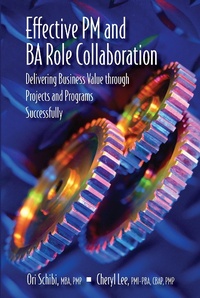
Effective PM and BA Role Collaboration
Delivering Business Value Through Projects and Programs Successfully
Published on 1. September 2015
366 pages
978-1-60427-765-4 (ISBN)
Description

Designated by PMI as Recommended Reading for Business Analysts!This innovative guide shows how the business analyst (BA) role can be executed in collaboration with the project or program manager (PM) role to produce higher quality products, requirements, and success rates, with solutions that deliver business value and products and services that better satisfy stakeholder needs. It evaluates the PM and BA roles current contrasting perceptions and defines the roles they should fulfill.
More details
Other editions
Additional editions
Ori Schibi | Cheryl Lee
Effective PM and BA Role Collaboration
Delivering Business Value Through Projects and Programs Successfully
Book
09/2015
J Ross Publishing
€71.50
Article not available at the moment
Person
Ori Schibi is President of PM Konnectors, a Toronto-based privately held corporation. This author and speaker is an instructor and part-time professor, Project Management Professional (PMP), and certified PRINCE2 (Practitioner), with an MBA from York University. He co-founded the PMI Southern Ontario Chapter¿Business Analysis Community. Ori is a thought-leader and subject matter expert with over 25 years of experience in driving operational and process improvements, software implementations, and complex programs to stabilize business, create growth and value, and lead sustainable change. An underlying theme in Ori's work is value creation through establishing collaborative relations between business and IT and with customers, bridging gaps and building partnerships, and getting teams to focus on the main goals of creating value and customer satisfaction.In addition to the success of his consulting and training work, Mr. Schibi's book, Managing Stakeholder Expectations for Project Success (2013) was recognized as apublication that "significantly advances project management knowledge, concepts, and practice" and was nominated for PMI's coveted 2013 David I. Cleland Project Management Literature Award.Cheryl Lee is a Certified Business Analysis Professional (CBAP), Professional in Business Analysis (PMI-PBASM) and Project Management Professional (PMP), with an Honours Bachelor of Science Degree from the University of Toronto.As a highly experienced business analysis and project management practitioner and trainer, Cheryl has mastered the ability to harmonize the PM and BA roles in order to deliver seamless and successful implementations. This author, speaker, and passionate business analysis nerd never misses an opportunity to help mentor and inspire other PMs and BAs. She has conducted multiple public webinars and presentations at conferences, chapter meetings, and local colleges and universities.Cheryl's devotion to the profession of business analysis is further demonstrated by her non-profit contributions. She served as a Director with the IIBA Toronto Chapter where she initiated and facilitated the CBAP study group and co-founded the PMI Southern Ontario Chapter - Business Analysis Community, the first Business Analysis Community within a PMI chapter, with her co-author Ori Schibi.
Content
- Front Cover
- Title Page
- Copyright
- Contents
- Preface
- About the Authors
- Dedication
- WAV
- Chapter 1: Challenges Related to Project Management and Business Analysis
- Define Effective
- One Entity?
- Challenges
- Splitting the Work
- Understanding Each Other's Capacity
- Aligning Areas of Focus
- Integrating the Requirements
- Estimating Techniques
- Reporting
- Divide Areas of Responsibility
- Terminology
- Common Conflict Areas
- Scope Management
- Attitude
- Understanding
- The BA Welcome Package and Early Project Deliverables
- More Challenges
- Strategy and the Organization
- Trust Building
- Time Management and Prioritization
- Engaging Others, Elicitation, and Communication
- Quality and Cost of Quality: The Value Perceptions
- Project Needs, Business Needs, and Product and Technical Needs
- Testing and Other Constraints
- Attention to Detail
- Cross-Functional Conflicts
- Estimates
- Turning a Group of People into a Team
- Final Thoughts on Challenges Related to Project Management and Business Analysis
- References
- Chapter 2: Misconceptions of the Roles of the PM and the BA
- Misconceptions of the Role of the Project Manager
- Misconceptions of the Role of the Business Analyst
- Misconceptions of the Professions of Project Management and Business Analysis
- Final Thoughts on the Misconceptions about the Roles of the PM and the BA
- References
- Chapter 3: Growing and Integrating the Professions
- Project Management Institute and International Institute of Business Analysis
- PBA vs. CBAP® Certification
- IIBA's BABOK® and PMI's Business Analysis for Practitioners
- Measuring and Growing the PM and BA Skill Sets
- The Evaluations Process
- Right Brain and Left Brain
- Why Projects Fail
- Project Management Skills Assessment
- Right Brain Soft Project Management Skills
- Left Brain Hard Project Management Skills
- Business Analysis Skills Assessment
- Right Brain Soft Business Analysis Skills
- Left Brain Hard Business Analysis Skills
- Findings
- Final Thoughts on Growing and Integrating the Professions
- References
- Chapter 4: Enterprise Analysis, Portfolio Management, and the PMO
- Enterprise Analysis
- Defining Business Needs
- The Problem Statement
- Conduct Root Cause Analysis
- Other Techniques to Define Business Needs
- Defining Business Requirements
- Assessing Capability Gaps
- Brainstorming Potential Projects
- Feasibility Studies
- Defining Scope
- Preparing the Business Case
- Business Case Decision
- Managing Projects for Value
- Tracking Project Benefits
- Recap: Enterprise Analysis
- Portfolio and the PMO
- From EA to Portfolio Management
- Better Business Alignment with Strategic Goals
- What's in a Name
- Roles Involved
- Hands-on Portfolio Management Utilizing the PMO
- Challenges with PMOs
- Doing More with Less
- Lack of Communication, People Skills, Leadership, and Interpersonal Skills Management
- What to Do so That PMOs Do Not Fail
- How to Establish a Successful PMO
- Follow Logical Steps
- Recap: Portfolio Management and the PMO
- BAs to the Rescue
- Final Thoughts on Enterprise Analysis, Portfolio Management, and the PMO
- References
- Chapter 5: Communication and Stakeholder Expectations Management
- The Source of Most Problems on Projects Is People
- Mini PM-BA Analysis
- The PM-BA Contract
- The BA Package
- The Real Deal-Understanding Stakeholders
- The BA's Ability to Contribute to the Stakeholder Analysis
- Sources of Uncertainty
- Stakeholder Analysis
- Make Assumptions When You Have to
- Stakeholders and the Requirements
- Manage the Stakeholders
- Being Proactive
- Stakeholder Engagement and Expectations Management
- How to Engage
- Defining Success
- The PM, the BA, and the Definition of Success
- The Balloon Theory
- The Communication Gap
- Communication Planning and Related Contracts
- The Communication Plan
- Team Contract and Ground Rules
- General Communication
- E-mails
- Meetings
- Conflict Management
- Constructive Conflict
- Unconstructive Conflict
- Leadership for Effective Conflict Management
- Conflict-What's in a Word?
- Conflict Management and Difficult Conversations
- The Dialogue
- Win-Win
- Communication Is Not a 50/50 Effort
- Emotional Resilience
- Virtual Teams
- Ground Rules for Virtual Meetings
- Mitigated Speech
- Changing Projects through Effective Communication
- Final Thoughts on Communication and Stakeholder Expectations Management-Aut Non Tentaris, Aut Perfice
- References
- Chapter 6: Requirements Definition
- Planning for Requirements Definition and Management
- The Business Analysis Plan
- The Requirements Management Plan
- The Project Management Plan
- Product vs. Project Requirements
- Product Requirements Elicitation
- The Many Layers of Product Requirements
- Use Cases
- Requirements Documents
- Product Requirements Sign-off
- Product Requirements in Agile Environments
- User Stories
- Defining Project Requirements
- Release Planning
- Final Thoughts on Requirements Definition
- References
- Chapter 7: Assumptions, Constraints, Dependencies, and Risks
- Assumptions
- Project Assumptions
- We Managed the Assumptions: Now What?
- Assumption Categories
- Requirement Assumptions
- Assumption Pitfalls
- Constraints
- Project Constraints
- Requirement Constraints
- Constraint Pitfalls
- Dependencies
- Project Dependencies
- Dependencies-Timing and Types
- Generic Categories
- The List of Dependencies
- Requirement Dependencies
- Dependency Pitfalls
- Risks
- Project Risks
- Project Risk Pitfalls
- Requirement Risks
- Requirement Risk Pitfalls
- Final Thoughts on Assumptions, Constraints, Dependencies, and Risks
- References
- Chapter 8: Resource Management
- Resource Management Integration Areas and the PM-BA Collaboration Required
- Scope
- Time and Cost
- Resource Allocation
- Quality
- Risk
- Communication, Stakeholder Management, and Cross-functional Relations
- Influencing and Motivating
- Conflict Management
- Procurement
- Change Control
- Other Resource Integration Areas
- RAM-The Responsibility Assignment Matrix
- RACI Chart
- Four Steps
- Who Puts the RAM Together?
- Cross-project Dependencies
- A Mini RAM?
- Estimating and Scheduling
- Procrastination
- Language
- Delays
- Prioritization
- Contingency
- No Backward Estimates
- Estimates for Unknown Conditions
- Non-critical Path Delays
- Productivity, Utilization, and Efficiency
- Application of Concepts Inspired by Critical Chain
- Collaboration and Early Detection
- Resource Management and Organizational Considerations
- Cross-Project Urgency
- Priority and Urgency Considerations
- Time Management: Manage Your Day
- 1. Create a Daily Plan
- 2. Utilize Your Productive Times
- 3. Track Surprises and Emergencies
- Time Wasted
- In a Matrix Organization
- Final Thoughts on Resource Management
- Reference
- Chapter 9: Two Types of Change: Project and Organizational Change Management
- Project Change Management
- Agile Considerations for Project Changes
- Final Thoughts on Project Change Management
- Organizational and Strategic Change
- Change Initiatives
- Failures of Change Initiatives
- Why Change Initiatives Fail
- Driving Force(s) Behind Success
- Change and Project Management
- Ownership and Resistance
- The Need for Integration
- Types of Change
- The Change Stakeholders
- Attitudes Toward the Change
- Team Building
- Organizational Readiness for the Change
- Readiness Assessment-Making It Less Informal
- Why Readiness Assessment?
- What the Readiness Assessment Is About
- Know If You Are Ready
- Assessment Considerations
- The Assessment Questions
- Assessment Results: How Do You Know When You Are Ready?
- Final Thoughts on Organizational Change Management
- References
- Chapter 10: Project Quality, Recovery, and Lessons Learned
- What Is Quality?
- Cost of Quality
- How to Measure Cost of Quality
- Poka-yoke
- Project Performance Indicators
- Benefits of Reviewing Project Performance Indicators
- Project Indicator Measurements
- Project Rescue and Recovery
- What Recovery Is Not About
- What Is Recovery About?
- The Recovery Team
- Thoughts on PMs and BAs Throughout the Project Recovery
- PM-BA Collaboration
- Prevention Measures
- The Recovery Process
- Lessons Learned-One of the Most Cost-effective Ways to Improve
- What to Ask
- Post-implementation Review
- Final Thoughts on Project Quality, Recovery, and Lessons Learned
- References
- Chapter 11: Building a Partnership: Shared Responsibility Throughout-Putting It All Together
- The PM and the BA-Intertwined
- The PM/BA? Can One Person Perform Both Roles?
- Project and Requirements Differences
- Project Management 8.4 (It Looks Similar to Project Management BA)
- Timing and Context
- Enterprise Analysis-Before the Project
- Project Initiation (Initiation Process Group)
- Project Planning (Planning Process Group)
- Analysis (Planning Process Group)
- Design, Development, Testing, and Implementation Phases of the Project (Execution Process Group)
- Tasks to be Performed Throughout the Project (Monitoring and Controlling Process Group)
- Closing the Project (Closing Process Group)
- Benefits Realization/Product Evaluation
- Skills Comparison-The PM and the BA
- Different Types of Skills, Areas of Responsibility, and Role Characteristics
- How to Collaborate
- Final Thoughts on Building a Partnership: Two Roles One Entity = Value and Success
- More Success and Less Failure
- Wrap-up
- References
- Index
