

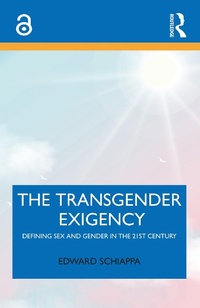
The Transgender Exigency
Defining Sex and Gender in the 21st Century
1st Edition
Published on 24. December 2021
252 pages
978-1-000-53866-3 (ISBN)
Description

At no other point in human history have the definitions of "woman" and "man," "male" and "female," "masculine" and "feminine," been more contentious than now. This book advances a pragmatic approach to the act of defining that acknowledges the important ethical dimensions of our definitional practices.
Increased transgender rights and visibility has been met with increased opposition, controversy, and even violence. Who should have the power to define the meanings of sex and gender? What values and interests are advanced by competing definitions? Should an all-boys' college or high school allow transgender boys to apply? Should transgender women be allowed to use the women's bathroom? How has growing recognition of intersex conditions challenged our definitions of sex/gender? In this timely intervention, Edward Schiappa examines the key sites of debate including schools, bathrooms, the military, sports, prisons, and feminism, drawing attention to the political, practical, and ethical dimensions of the act of defining itself.
This is an important text for students and scholars in gender studies, philosophy, communication, and sociology.
The Open Access version of this book, available at www.taylorfrancis.com, has been made available under a Creative Commons Attribution-Non Commercial-No Derivatives 4.0 license.
Increased transgender rights and visibility has been met with increased opposition, controversy, and even violence. Who should have the power to define the meanings of sex and gender? What values and interests are advanced by competing definitions? Should an all-boys' college or high school allow transgender boys to apply? Should transgender women be allowed to use the women's bathroom? How has growing recognition of intersex conditions challenged our definitions of sex/gender? In this timely intervention, Edward Schiappa examines the key sites of debate including schools, bathrooms, the military, sports, prisons, and feminism, drawing attention to the political, practical, and ethical dimensions of the act of defining itself.
This is an important text for students and scholars in gender studies, philosophy, communication, and sociology.
The Open Access version of this book, available at www.taylorfrancis.com, has been made available under a Creative Commons Attribution-Non Commercial-No Derivatives 4.0 license.
Reviews / Votes
"Above all, this book provides a very basic service to our society's vexed debates about transgender: it gives the empiricals. I have not come across a book that lays out the relevant factual background better than this one does. Through careful and detailed discussion of the particularities involved, Schiappa develops a pragmatic, moderate, and sensible approach to the main issues, culminating in his very helpful proposal to apply four different levels of gatekeeping to transgender people in different kinds of context. This moderate and context-nuanced approach is a sensible corrective to the ideological extremism that all too often comes from both sides."- Sophie Grace Chappell, Professor of Philosophy, Open University
"Definitions matter: American, socialist, patriot, Trumpian. . . and woman. Schiappa does not think it is obvious that the state should be involved in all defining, though clearly it should in some. His warm, scholarly, humane, and readable book brings the discussion of trans rights and responsibilities to a higher level. But perhaps more significantly, it raises, too, the level of the discussion about definition itself. The next time you reach for a definition to make an argument, think Schiappa, and pause. A long time. So you don't start throwing rocks."
- Deirdre N. McCloskey, Distinguished Professor of Economics, History, English, and Communication, University of Illinois at Chicago
More details
Edition
1. Auflage
Language
English
Place of publication
London
United Kingdom
Publishing group
Taylor & Francis Ltd
Target group
College/higher education
Illustrations
3 Halftones, black and white; 3 Illustrations, black and white
File size
3,16 MB
ISBN-13
978-1-000-53866-3 (9781000538663)
Copyright in bibliographic data and cover images is held by Nielsen Book Services Limited or by the publishers or by their respective licensors: all rights reserved.
Schweitzer Classification
Other editions
Additional editions

Book
12/2021
1st Edition
Routledge
€207.70
Shipment within 10-20 days
Book
12/2021
1st Edition
Routledge
€61.30
Shipment within 10-20 days
Person
Edward Schiappa is the John E. Burchard Professor of Humanities at the Massachusetts Institute of Technology. His work in rhetorical theory and media studies has been published in journals in Classics, Psychology, Philosophy, English, Law, and Communication Studies. He is the author of a number of books, including Defining Reality: Definitions and the Politics of Meaning and Beyond Representational Correctness: Rethinking Criticism of Popular Media.
Content
Introduction, Part 1: Definitions and the Transgender Exigency, 1 The Role of Regulatory Definitions, 2 A Brief History of Defining Sex and Gender, 3 The Transgender Exigency, Part 2: Definitional Contexts, 4 Schools, 5 Bathrooms, 6 Military, 7 Sports, 8 Prisons, 9 Feminism, Part 3: What Now?, 10 A Pragmatic Approach to Defining Sex and Gender
