

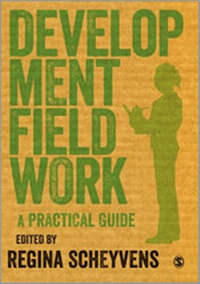
Development Fieldwork
A Practical Guide
2nd Edition
Published on 17. February 2014
312 pages
978-1-4462-9745-2 (ISBN)
Description

This book provides an invaluable guide to undertaking development fieldwork in both the developing world and in western contexts. It takes you through all the key stages in development research and covers:
Research design and the roles of quantitative and qualitative methods.
Research using archival, textual and virtual data, along with using the internet ethically.
Practical as well as personal issues, including funding, permissions, motivation and attitude.
Culture shock, ethical considerations and working with marginalized, vulnerable or privileged groups, from indigenous peoples through to elites and corporations.
How to write up your findings.
Sensitive, engaging and accessible in tone, the text is rich in learning features; from boxed examples to bullet-pointed summaries and questions for reflection. Development Fieldwork is the perfect companion for students engaged in research across development studies, geography, social anthropology or public policy.
Research design and the roles of quantitative and qualitative methods.
Research using archival, textual and virtual data, along with using the internet ethically.
Practical as well as personal issues, including funding, permissions, motivation and attitude.
Culture shock, ethical considerations and working with marginalized, vulnerable or privileged groups, from indigenous peoples through to elites and corporations.
How to write up your findings.
Sensitive, engaging and accessible in tone, the text is rich in learning features; from boxed examples to bullet-pointed summaries and questions for reflection. Development Fieldwork is the perfect companion for students engaged in research across development studies, geography, social anthropology or public policy.
Reviews / Votes
This is a fantastic collection of the 'ins' and 'outs' of development-related fieldwork. From ethical concerns to practical encounters, the volume offers clear and useful advice for both first time researchers and seasoned academics on negotiating 'the field'. Already one of the most dog-eared books on my shelf! -- Dr. Simon Springer Development Fieldwork is without doubt the best available guide to dealing with practical, methodological and ethical issues in 'development' research, within and across 'North' and 'South'. It addresses both long-standing and more recently emerging research issues with sensitivity, insight, good sense and a clear commitment to engaged, responsible research practices and relationships. It is a vital resource for undergraduate dissertation students and postgraduates, but has much to offer even experienced researchers. Development Fieldwork is an essential resource. -- Dr. Emma Mawdsley An excellent overview of the pitfalls and problems of fieldwork in remote places... elegant, incisive and enjoyable... good humoured and eminently practical - the "Lonely Planet" guide to the field. -- Professor John Connell The writers through the 'gift of the gab' and brilliant advocacy in the temple of development have forged useful approaches in the furnace of practical experiences for the benefit of new, upcoming, emerging and established development researchers. -- Prof. Oladele O. IdowuAll prices
More details
Edition
Second Edition
Language
English
Place of publication
London
United Kingdom
Target group
College/higher education
ISBN-13
978-1-4462-9745-2 (9781446297452)
Copyright in bibliographic data and cover images is held by Nielsen Book Services Limited or by the publishers or by their respective licensors: all rights reserved.
Schweitzer Classification
Other editions
Additional editions
Book
02/2014
2nd Edition
SAGE Publications Ltd
€96.30
Shipment within 15-20 days

Book
02/2014
2nd Edition
SAGE Publications Ltd
€217.26
Shipment within 15-20 days
Book
08/2003
1st Edition
SAGE Publications Inc
€127.97
Article exhausted; check for reprint
Book
08/2003
1st Edition
SAGE Publications Inc
€55.95
Article exhausted; check for reprint
Person
Regina Scheyvens heads the Institute of Development Studies at Massey University, New Zealand. She combines a passion for teaching about international development with research on tourism and development. She has a particular interest in sustainable development options for people living in small island states. In addition to Development Fieldwork, Regina has published books on Tourism and Poverty (2010) and Tourism for Development: Empowering Communities (2002), along with articles on topics such as backpacker tourism, ecotourism, sustainable tourism and empowerment.
Content
Introduction - Regina Scheyvens and Sharon McLennan
PART ONE: METHODOLOGY
Designing Development Research - Warwick E. Murray and John Overton
Quantitative Research - John Overton and Peter van Diermen
Qualitative Research - Rochelle Stewart-Withers, Glenn Banks, Andrew McGregor and Litea Meo-Sewabu
Something Old, Something New: Research Using Archives, Texts and Virtual Data - Sharon McLennan and Gerard Prinsen
PART TWO: PREPARATION FOR THE FIELD
Practical Issues - Maria Borovnik, Helen Leslie and Donovan Storey
Personal Issues - Henry Scheyvens, Regina Scheyvens and Barbara Nowak
PART THREE: IN THE FIELD
Entering the Field - Sharon McLennan, Donovan Storey and Helen Leslie
Ethical Issues - Glenn Banks and Regina Scheyvens
Working with Marginalised, Vulnerable or Privileged Groups - Regina Scheyvens, Henry Scheyvens and Warwick E. Murray
PART FOUR: LEAVING THE FIELD
Anything to Declare? The Politics and Practicalities of Leaving the Field - Sara Kindon and Julie Cupples
Returning to University and Writing the Field - Julie Cupples and Sara Kindon
Ways Forward - Regina Scheyvens
PART ONE: METHODOLOGY
Designing Development Research - Warwick E. Murray and John Overton
Quantitative Research - John Overton and Peter van Diermen
Qualitative Research - Rochelle Stewart-Withers, Glenn Banks, Andrew McGregor and Litea Meo-Sewabu
Something Old, Something New: Research Using Archives, Texts and Virtual Data - Sharon McLennan and Gerard Prinsen
PART TWO: PREPARATION FOR THE FIELD
Practical Issues - Maria Borovnik, Helen Leslie and Donovan Storey
Personal Issues - Henry Scheyvens, Regina Scheyvens and Barbara Nowak
PART THREE: IN THE FIELD
Entering the Field - Sharon McLennan, Donovan Storey and Helen Leslie
Ethical Issues - Glenn Banks and Regina Scheyvens
Working with Marginalised, Vulnerable or Privileged Groups - Regina Scheyvens, Henry Scheyvens and Warwick E. Murray
PART FOUR: LEAVING THE FIELD
Anything to Declare? The Politics and Practicalities of Leaving the Field - Sara Kindon and Julie Cupples
Returning to University and Writing the Field - Julie Cupples and Sara Kindon
Ways Forward - Regina Scheyvens
